The book as revolution, as vision, as artifact.
Scroll Down
Reading a Colophon in 7 Steps Without Getting Lost
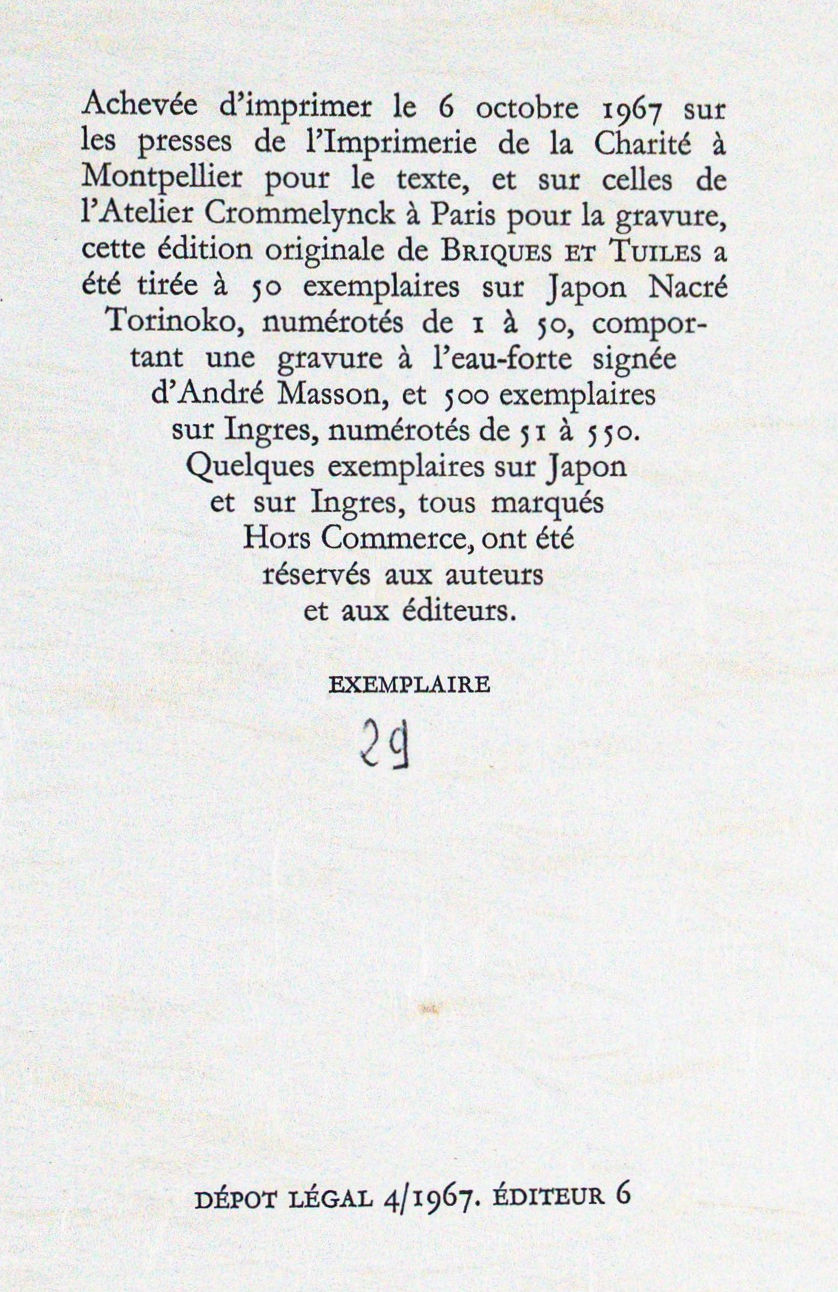
A colophon is never a decorative afterthought. It is the edition’s point of truth: the place where the publisher states, often with deceptive brevity, how the work was made, how it was distributed, and what distinguishes one copy from another. Read it well, and it becomes one of the most reliable tools in bibliographic judgment.
1. Start with the total print runBegin by identifying the full limitation. How many copies were issued in total? A colophon often establishes the entire architecture of an edition in a few lines, setting out the complete tirage before breaking it into categories. Without that overall structure, the rest cannot be read properly.
2. Observe how the edition is dividedMost sophisticated editions are tiered. A small group of copies may appear on luxury paper, followed by a larger run on a more standard but still fine support. This hierarchy is not incidental. It tells you which copies occupy the privileged position within the edition and what enhancements may legitimately belong to them.
3. Match the copy number to the paperA number alone proves very little. Copy 18, 46, or XII only becomes meaningful when tied to the paper named in the colophon. Japon, Chine, vélin d’Arches, Hollande, pur fil: these are not ornamental words. They define the state of the copy. If the numbering and the material do not correspond, caution is warranted.
4. Verify what the paper actually isThe colophon must be tested against the object itself. Paper can often be recognised by watermark, fibre, tone, surface, weight, or sheen. Under careful light, inconsistencies begin to appear. This is often where composite copies reveal themselves: the wording may sound correct, but the physical evidence does not fully align.
5. Read labels such as HC or EA with precisionTerms such as hors commerce or épreuve d’artiste should never be used loosely. Their meaning depends entirely on the colophon and on the internal logic of the edition. A copy is not HC merely because it seems special, nor is EA a generic synonym for rarity. These labels only retain value when used with bibliographic discipline.
6. Test every claim of completeness“Complete” is one of the most overused words in the trade. A copy is complete only in relation to what the colophon promises: a suite, an extra state, a signed justification, an additional plate, a prospectus, or another specific accompaniment. Precision matters. A vague assertion of completeness is not verification; it is only rhetoric.
7. Watch for copies that promise too muchOne of the clearest warning signs is a copy whose features exceed what its place in the tirage should allow. If a mid-run number is described as having a suite that the colophon reserves exclusively for the first copies on luxury paper, the copy may well be composite. That does not automatically disqualify it—but it must be described, valued, and understood accordingly.
To read a colophon well is to move from language to structure, from structure to material, and from material to proof. That habit of close reading does more than prevent errors: it sharpens cataloguing, clarifies value, and restores the edition to what it truly is—not merely a text reproduced, but a work issued under exact conditions, and preserved in states that still matter.
De la collection

AUTHORS · AUTHORS
Rare Books, Living Legacies Rare Books, Living Legacies
We specialize in rare, illustrated editions from the avant-garde movements. Every book is accompanied by high-quality visuals, detailed reports, and scholarly context.
Paris | 1931 | Japon nacré
€360
AUTHORS · AUTHORS
Rare Books, Living Legacies Rare Books, Living Legacies
We specialize in rare, illustrated editions from the avant-garde movements. Every book is accompanied by high-quality visuals, detailed reports, and scholarly context.
Paris | 1931 | Japon nacré
€360
AUTHORS · AUTHORS
Rare Books, Living Legacies Rare Books, Living Legacies
We specialize in rare, illustrated editions from the avant-garde movements. Every book is accompanied by high-quality visuals, detailed reports, and scholarly context.
Paris | 1931 | Japon nacré
€360
AUTHORS · AUTHORS
Rare Books, Living Legacies Rare Books, Living Legacies
We specialize in rare, illustrated editions from the avant-garde movements. Every book is accompanied by high-quality visuals, detailed reports, and scholarly context.
Paris | 1931 | Japon nacré
€360
The End!@
Bibliography
Carter, John. ABC for Book Collectors. London: Rupert Hart-Davis, 1952.
Glaister, Geoffrey Ashall. Encyclopedia of the Book. 2nd ed. New Castle, DE: Oak Knoll Press, 1996.
McKerrow, R. B. An Introduction to Bibliography for Literary Students. Oxford: Clarendon Press, 1927.
L'AVIS DU CONSERVATEUR
Ce dossier examine la frontière ténue entre légende et réalité dans l’édition d’avant-garde. Il met en lumière l’imbrication de la rareté et du récit, transformant l’absence bibliographique en présence mythique.


Related Reading
Rare Books, Living Legacies Rare Books, Living Legacies
We specialize in rare, illustrated editions from the avant-garde movements. Every book is accompanied by high-quality visuals, detailed reports, and scholarly context.
Paris | 1931 | Japon nacré
€360
Rare Books, Living Legacies Rare Books, Living Legacies
We specialize in rare, illustrated editions from the avant-garde movements. Every book is accompanied by high-quality visuals, detailed reports, and scholarly context.
Paris | 1931 | Japon nacré
€360
Rare Books, Living Legacies Rare Books, Living Legacies
We specialize in rare, illustrated editions from the avant-garde movements. Every book is accompanied by high-quality visuals, detailed reports, and scholarly context.
Paris | 1931 | Japon nacré
€360
Rare Books, Living Legacies Rare Books, Living Legacies
We specialize in rare, illustrated editions from the avant-garde movements. Every book is accompanied by high-quality visuals, detailed reports, and scholarly context.