


Aux poubelles de la gloire. N°
1-13
*Aux poubelles de la gloire* is a striking French journal published between 1977 and 1979, exploring the boundaries between art, literature, and social criticism. Edited by Guy Bodson and Laurent Gervereau, this publication serves as an intellectual crossroads where 'Pataphysics and Situationism meet. Its design, strongly reminiscent of the *Cahiers du Collège de ’Pataphysique*, reveals a deep affinity with the absurd science of imaginary solutions. Simultaneously, its visual language echoes the radical aesthetics of the Situationist International. For the bibliophile, it represents a rare document of a fleeting yet influential artistic dialogue.
Quantity


Bodson, Guy
Gervereau, Laurent
ILLUSTRATORS
ILLUSTRATORS
ILLUSTRATORS
Aux poubelles de la gloire. N°
1-13
1977 | Paris
An exceptionally lively and complete review set, in which late avant-garde irony and editorial inventiveness form a remarkably coherent whole.
*Aux poubelles de la gloire* is a striking French journal published between 1977 and 1979, exploring the boundaries between art, literature, and social criticism. Edited by Guy Bodson and Laurent Gervereau, this publication serves as an intellectual crossroads where 'Pataphysics and Situationism meet. Its design, strongly reminiscent of the *Cahiers du Collège de ’Pataphysique*, reveals a deep affinity with the absurd science of imaginary solutions. Simultaneously, its visual language echoes the radical aesthetics of the Situationist International. For the bibliophile, it represents a rare document of a fleeting yet influential artistic dialogue.
€620
Condition Report:
In-Depth Study
References & Bibliography
Edition Particulars
One of the rare complete sets with all original belly-bands.
1
Edition Particulars:
We welcome private inquiries, collaborations with institutions, and acquisition requests. Each message is treated with discretion and respect. We welcome private inquiries, collaborations with institutions, and acquisition requests.
1
Print Run:
Condition Report:
1
Copy Number:
Condition Report:
1
Paper:
Condition Report:
1
Signed:
Condition Report:
Product DETAIL
The journal presents a collection of short texts, reproductions of advertisements, typographical compositions, and mounted illustrations. At its core lies a critical reflection on the concept of 'glory', analyzed by the editors as a mechanism of psychological and social projection. The publication functions as a collage of ideas highlighting the absurdity of public recognition. Across the thirteen issues, an intellectual journey is charted, challenging the reader to look into the 'dustbins' of fame. The content is eclectic, combining reprints with original contributions. The whole work exudes an atmosphere of subversive humor and intellectual deconstruction.
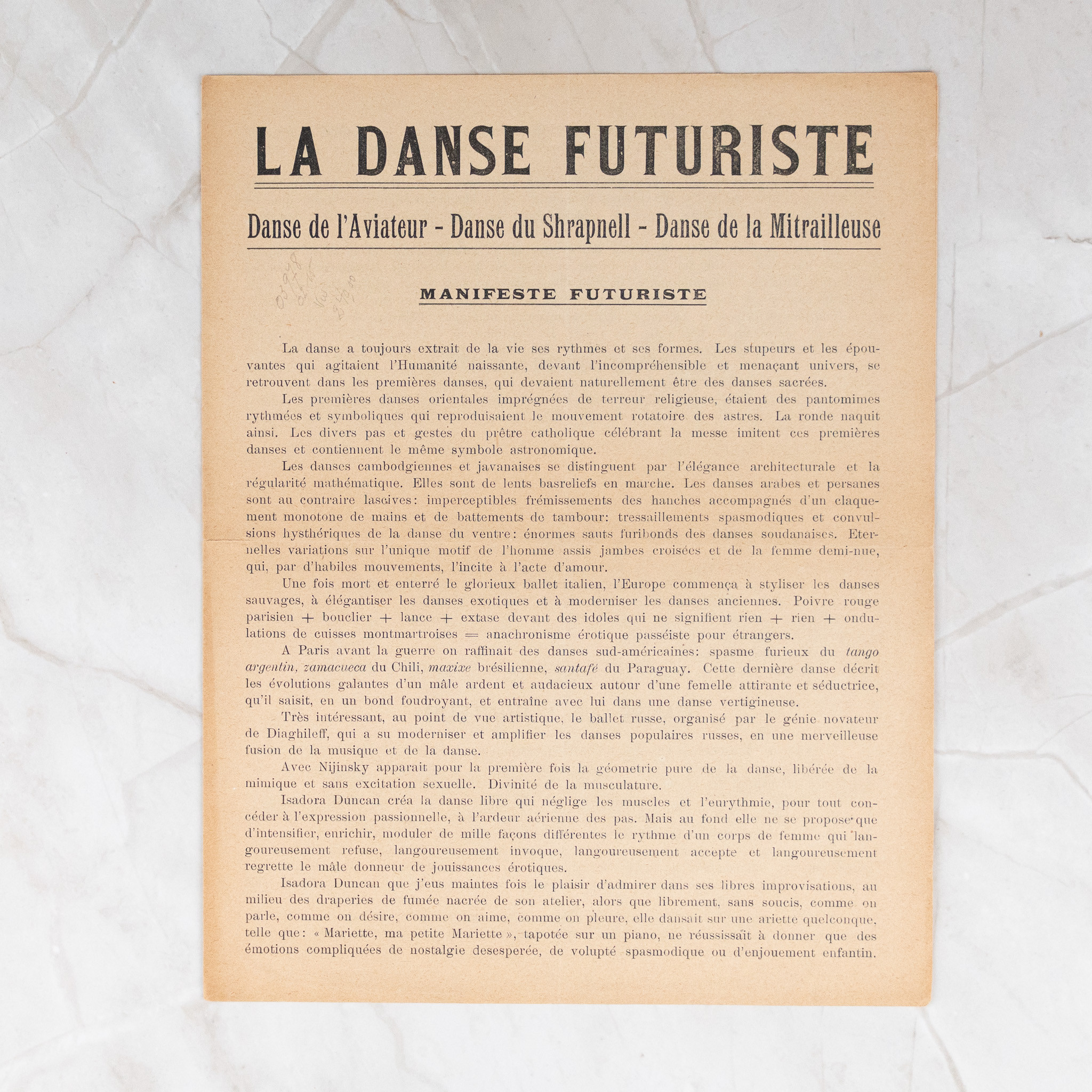
Marinetti, Filippo Tommaso
La Danse Futuriste. Danse de l’aviateur – Danse du shrapnell – Danse de la mitrailleuse. Manifeste futuriste
La Danse Futuriste is one of the key texts of Italian Futurism in its most direct, militant, and performative form. It is a separately issued French manifesto by Filippo Tommaso Marinetti, founder and tireless propagandist of the movement. Rather than a deluxe book, it is a tract, designed for the rapid circulation of ideas and for immediate impact. That modest physical form is precisely what makes it so faithful to Futurist practice, in which print was used as an instrument of artistic intervention. The text transfers the Futurist glorification of speed, violence, and mechanism into the realm of dance, doing so with the aggressive clarity that is so characteristic of Marinetti. As a separate French issue, the pamphlet is bibliographically intriguing, since specialists have catalogued it both as 1917 and as circa 1920. That uncertainty only adds to its interest rather than diminishing its importance. For collectors, this is above all a primary avant-garde document: scarce, fragile, and historically charged.
Revue
€700

Deineka, A. · Moor, D. · Perelman, V. · Sokolov-Skalya, P.
Russian avant-garde. Бригада художников (Brigada Khudozhnikov). № 2.
This single issue of *Бригада художников* (*Brigada Khudozhnikov*, “Artists’ Brigade”) captures a turning point in Soviet visual culture: one of the last pulses of Constructivist-periodical energy before doctrine tightened. Published in Moscow by OGIZ-IZOGIZ, the journal was short-lived (1931–1932) and survives as a small, finite run of issues. No. 2 (1932) shows artists and designers still deploying the grammar of modernity—hard-edged typography, rhythmic layout, collective voice—under rapidly shifting cultural policy. The involvement of figures such as Aleksandr Deineka and Dmitry Moor gives the issue real documentary weight for the history of graphic art and propaganda imagery. At 63 pages in the original Russian, it reads as both a periodical and a compact artist’s dossier. A scarce, tactile survivor of an ephemeral platform, poised on the threshold between experimental avant-garde practice and the consolidation of Socialist Realism. Condition: good.
Revue
€500

Paris, Union des Artistes Russes à · Picasso, Pablo
Bal olympique. Vrai bal sportif costumé
Programme for the costumed sports ball of the Union des Artistes Russes à Paris at the Taverne de l’Olympia, Friday 11 July 1924, staged alongside the Paris Games. The richly illustrated booklet comprises [12] pages with a cover by Victor Barthe; inside are contributions by Picasso, Marie Vassilieff, S. Fotinsky, N. Granovsky and Chatzman, with a nod to Manet’s *Olympia*. It distills the émigré energy of Montparnasse, fusing festivity with avant-garde graphics. Large oblong format; typographic work by François Bernouard on vélin Normandy. A finely preserved piece of ephemera uniting sport, art and spectacle. For bibliophiles, a rare hinge between dance programme, artist’s print culture, and Olympic memorabilia.
Revue
€850
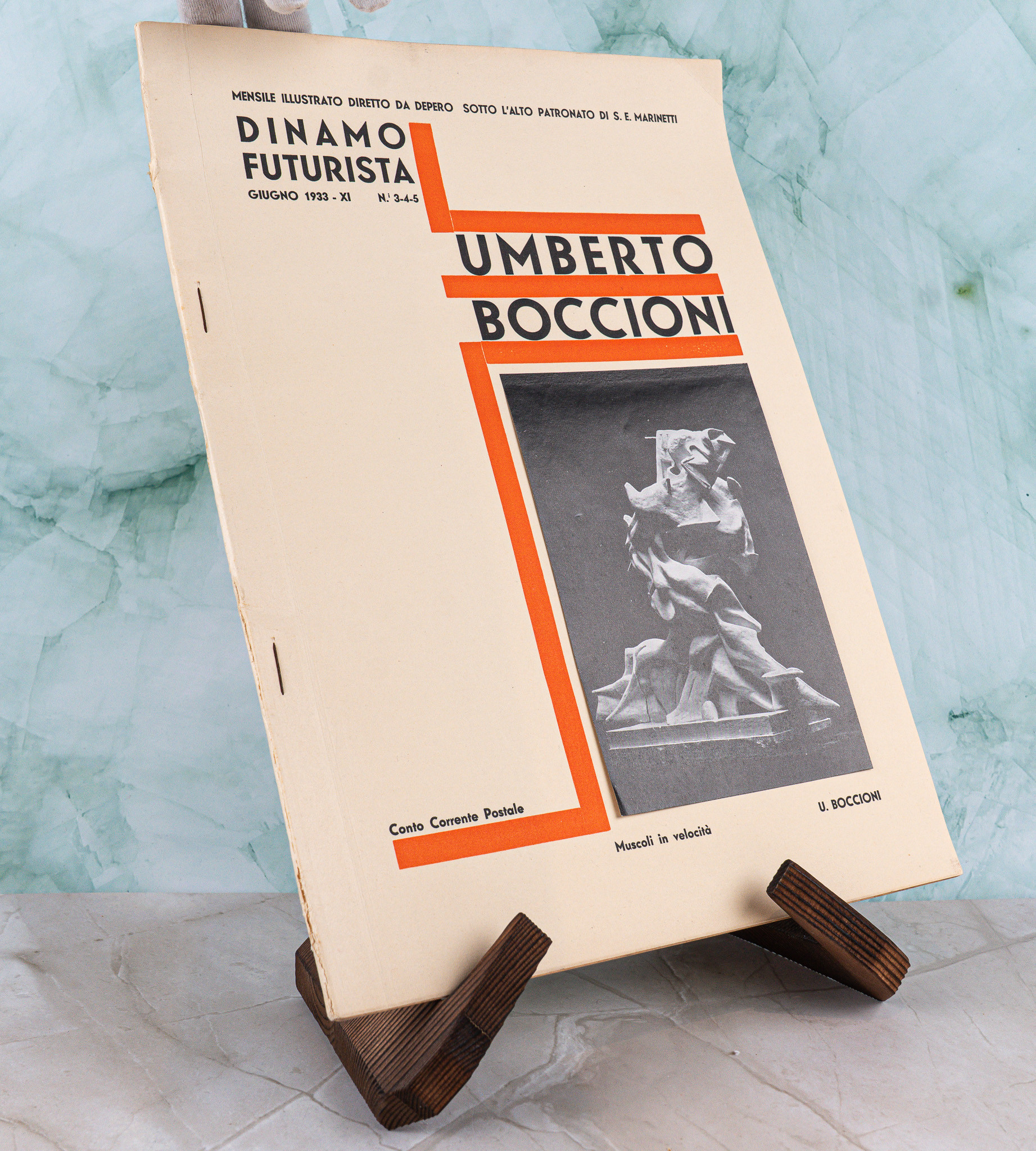
Depero, Fortunato · Boccioni, Umberto
Dinamo futurista, Anno I, nn. 3–4–5
The final, scarce issue of the futurist magazine steered and designed by Fortunato Depero. Issued for the National Tributes to Umberto Boccioni held by the City of Milan, 14–16 June 1933, it differs in format and graphic architecture from earlier numbers and was printed in an enlarged run. The production attains exceptional typographic and visual quality, with crisp Depero layout and photographic plates printed outside the text. Newly assembled, impassioned contributions by Marinetti, Buzzi, Russolo and Notari are interleaved with memorable quotations from Boccioni’s own writings. Two diagrams drawn by Depero articulate a vision of speed, energy and “dinamo” as the motor of modern art. Together with a rich iconographic selection, the issue stands as a simultaneously theoretical and visual homage to the pioneer of Italian Futurism.

