


Ben Vautier — Participations au Festival non art, anti art, la vérité est art...
This rare Fluxus portfolio, designed by Ben Vautier, embodies late-1960s dematerialised art: the work *is* a bundle of ideas, instructions, and attitudes. *Participations…* operates as a catalogue for a “non-material” exhibition and, at the same time, as a logistical trace of a festival announced as worldwide, from 1 to 15 June 1969. Instead of objects, the folder offers contributions reproduced through plain printing, stencil, or photocopy—an aesthetic of speed, circulation, and intention. It gathers voices that redrew the boundaries of art: from George Maciunas and Robert Filliou to Daniel Buren, Dieter Roth, Wolf Vostell, Joseph Beuys, with Marcel Duchamp as a conceptual horizon. The deliberately ironic tables of contents and playful notes on the submissions affirm a Fluxus principle: seriousness needs play. As a numbered first edition limited to 502 copies, it stands as an emblematic document of the moment when art became protocol, performance, and network.
Quantity


Vautier, Ben
ILLUSTRATORS
ILLUSTRATORS
ILLUSTRATORS
Ben Vautier — Participations au Festival non art, anti art, la vérité est art,
comment changer l’art et l’homme… (1–15 juin 1969)
1969 | Monaco | Mérino, Francis
A numbered Fluxus node: 76 leaves of ideas and actions, issued as a “worldwide festival” on paper.
This rare Fluxus portfolio, designed by Ben Vautier, embodies late-1960s dematerialised art: the work *is* a bundle of ideas, instructions, and attitudes. *Participations…* operates as a catalogue for a “non-material” exhibition and, at the same time, as a logistical trace of a festival announced as worldwide, from 1 to 15 June 1969. Instead of objects, the folder offers contributions reproduced through plain printing, stencil, or photocopy—an aesthetic of speed, circulation, and intention. It gathers voices that redrew the boundaries of art: from George Maciunas and Robert Filliou to Daniel Buren, Dieter Roth, Wolf Vostell, Joseph Beuys, with Marcel Duchamp as a conceptual horizon. The deliberately ironic tables of contents and playful notes on the submissions affirm a Fluxus principle: seriousness needs play. As a numbered first edition limited to 502 copies, it stands as an emblematic document of the moment when art became protocol, performance, and network.
€1,000
Condition Report:
In-Depth Study
References & Bibliography
Format
In-4 (Quarto) approx. 25 × 32 cm
Edition Particulars
One of 500 issued as loose sheets (21 × 27 cm) in a white folder; total limitation 502 numbered copies.
Print Run
502
Copy Number
No. 83
Inscription
No inscription
1
Edition Particulars:
We welcome private inquiries, collaborations with institutions, and acquisition requests. Each message is treated with discretion and respect. We welcome private inquiries, collaborations with institutions, and acquisition requests.
1
Print Run:
Condition Report:
1
Copy Number:
Condition Report:
1
Paper:
Condition Report:
1
Signed:
Condition Report:
Product DETAIL
The portfolio comprises [76] loose leaves (some printed recto-verso), assembled as a “catalogue” of proposals: happenings, actions, instructions, statements, and conceptual interventions. The contributions are not staged as objects to own, but as triggers for behaviour, attention, and participation. The plain mode of reproduction (print/photocopy) turns each sheet into a transmission device—an idea that can be repeated without losing its charge. Several leaves form a deliberately ironic table of contents, with whimsical remarks that undermine the seriousness of classification. The frame of a worldwide festival (1–15 June 1969) casts the set as temporary, everywhere-activatable, and anti-institutional. Reading becomes performative: the catalogue *does* what it describes.

Georges Mathieu, Henri Van Lier · Frasnay, Daniel
Mathieu : Galerie Veranneman,
14.1.71 - 6.2.71
This Brussels exhibition catalogue records a Georges Mathieu show at Galerie Veranneman in the winter of 1971. It is a concise yet highly distinctive publication in which the force of Mathieu’s calligraphic abstraction remains immediately present. Henri Van Lier’s preface provides a critical frame that does more than describe the work, placing it intellectually within post-war painting. Daniel Frasnay’s photographic contribution gives the booklet a taut visual rhythm and makes it more than a routine gallery handout. That combination of gallery publication, critical text, and images explains much of its appeal to collectors. The present copy is elevated further by an original drawing and a personal inscription from Mathieu to Madame Goldstein. It stands at once as exhibition document, artist-related imprint, and intimate relic.
Catalogue
€450
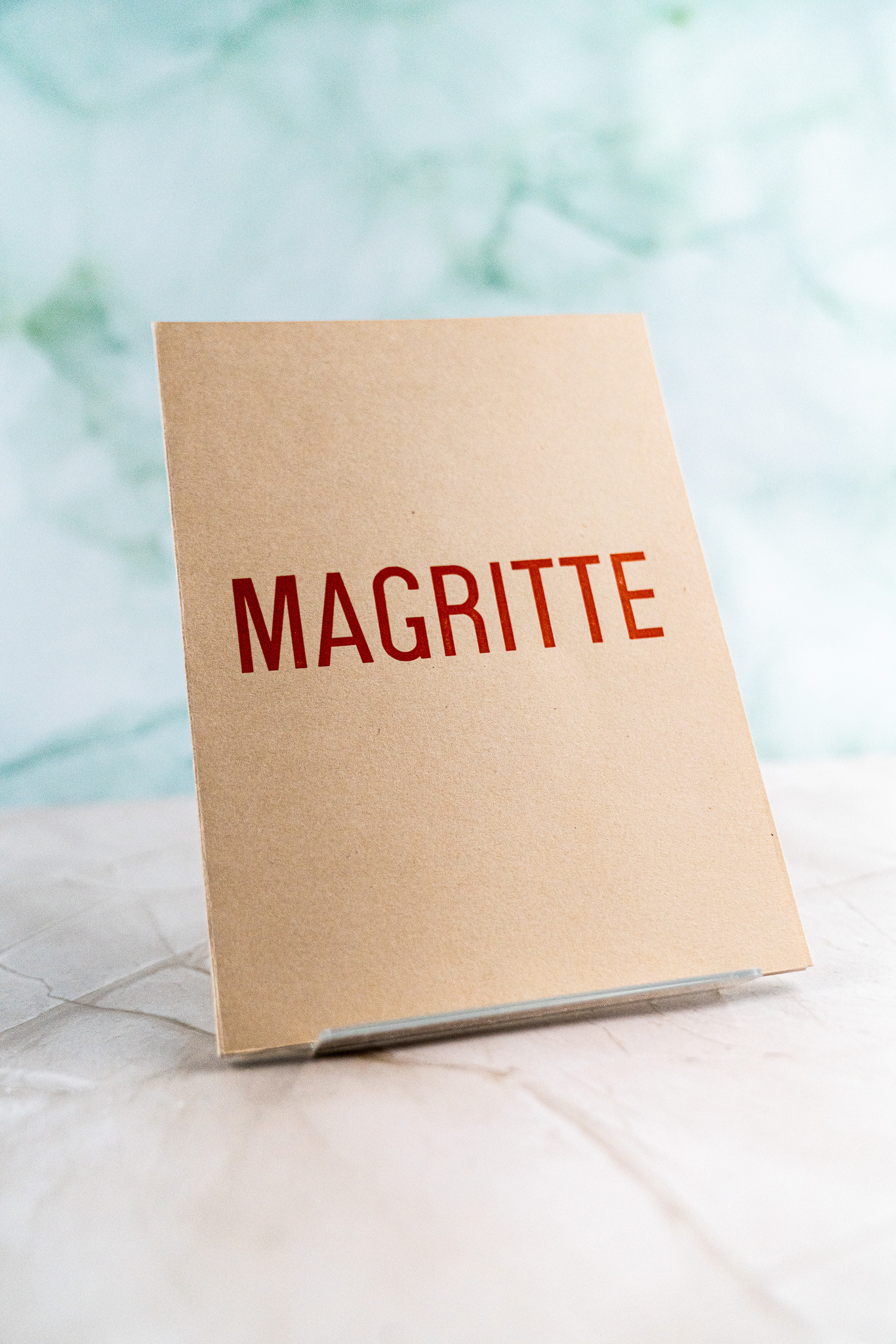
Mariën, Marcel · Magritte, René
Magritte
A rare Brussels wartime edition (1943). This monograph on Magritte is not an “ordinary” monograph or catalogue.
There are several reasons for this.
1) First recognized monograph
This is the first widely recognized monograph devoted to René Magritte. By 1943 Magritte was established in Belgium and had some international visibility through exhibitions, but this is the first fully illustrated publication devoted exclusively to him, with particular attention to works from the early 1940s.
2) War years and occupation
Published in 1943, in the midst of the war and under German occupation. For (Belgian) Surrealists this meant censorship, surveillance, and very limited public visibility; Surrealism was classified by the Nazis as “degenerate art.” As a result, exhibitions and publications were few, often semi-clandestine, sometimes under pseudonyms and with cautious, coded language. There were even instances of direct interference (for example, the premature closure of Raoul Ubac’s photographic exhibition in Brussels in 1941). That Marcel Mariën and Magritte brought this book out during the occupation shows both courage and an intellectual act of resistance. It is plausible that the edition of 1,025 copies reached readers in stages, slowly and mainly locally.
3) Association copy: Henri Parisot
This copy bears an extensive inscribed presentation by Magritte to Henri Parisot, a key figure on the French Surrealist scene—poet, translator, and publisher of Antonin Artaud, Paul Éluard, Benjamin Péret, and André Breton. Parisot served as an essential cultural mediator, introducing visionary precursors such as Novalis and William Blake to a French readership. Through his bibliophile editions and journals he provided an independent space outside Breton’s strict authority and helped preserve Surrealism’s legacy while linking it to broader traditions of mysticism and poetic experiment.
4) The date “72-X-79231”
The presentation is cryptically dated: “72-X-79231.” This is not a slip, but a deliberate Surrealist play with time and sequence—fully consistent with Magritte’s concerns (think of La durée poignardée / Time Transfixed and his word/image inversions). Such a poetic, non-linear date makes the inscription itself conceptual: the envoi enacts what the work proclaims—unhinging time. The “X” acts as a hinge within the number string; the formula mirrors Magritte’s method of estranging the everyday through a subtle shift in conventions. As paratext, the date turns the inscription into a performative gesture: it does Surrealism rather than merely naming it.
Catalogue
€3,200
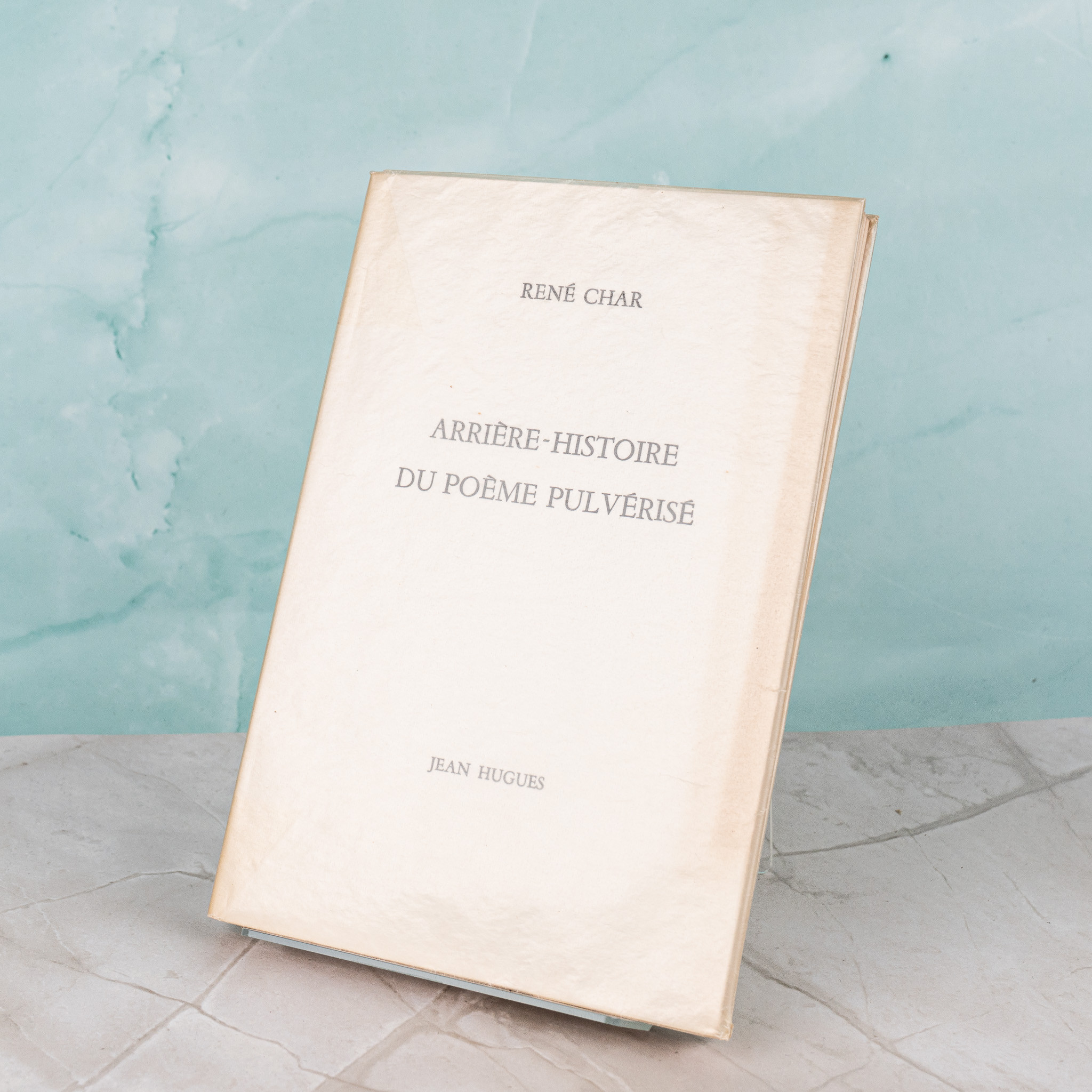
Char, Rene · Stael, Nicolas de
Arrière-histoire du poème pulvérisé
*Arrière-histoire du poème pulvérisé* is a later illustrated edition of a key text in which René Char looks back on the genesis and inner background of *Le Poème pulvérisé*. Published in 1972 by Imprimerie Union, it opens with a colour frontispiece by Nicolas de Staël. The pairing of Char and de Staël is especially charged: two post-war voices, each seeking concentration, clarity, and rupture in his own medium. This copy is one of only six hors commerce copies on Arches and is signed. The autograph presentation inscription to Doctor Marcel Zara, with poetic quotation and October 1972 dating, makes it a deeply personal copy.
Ill Book
€920
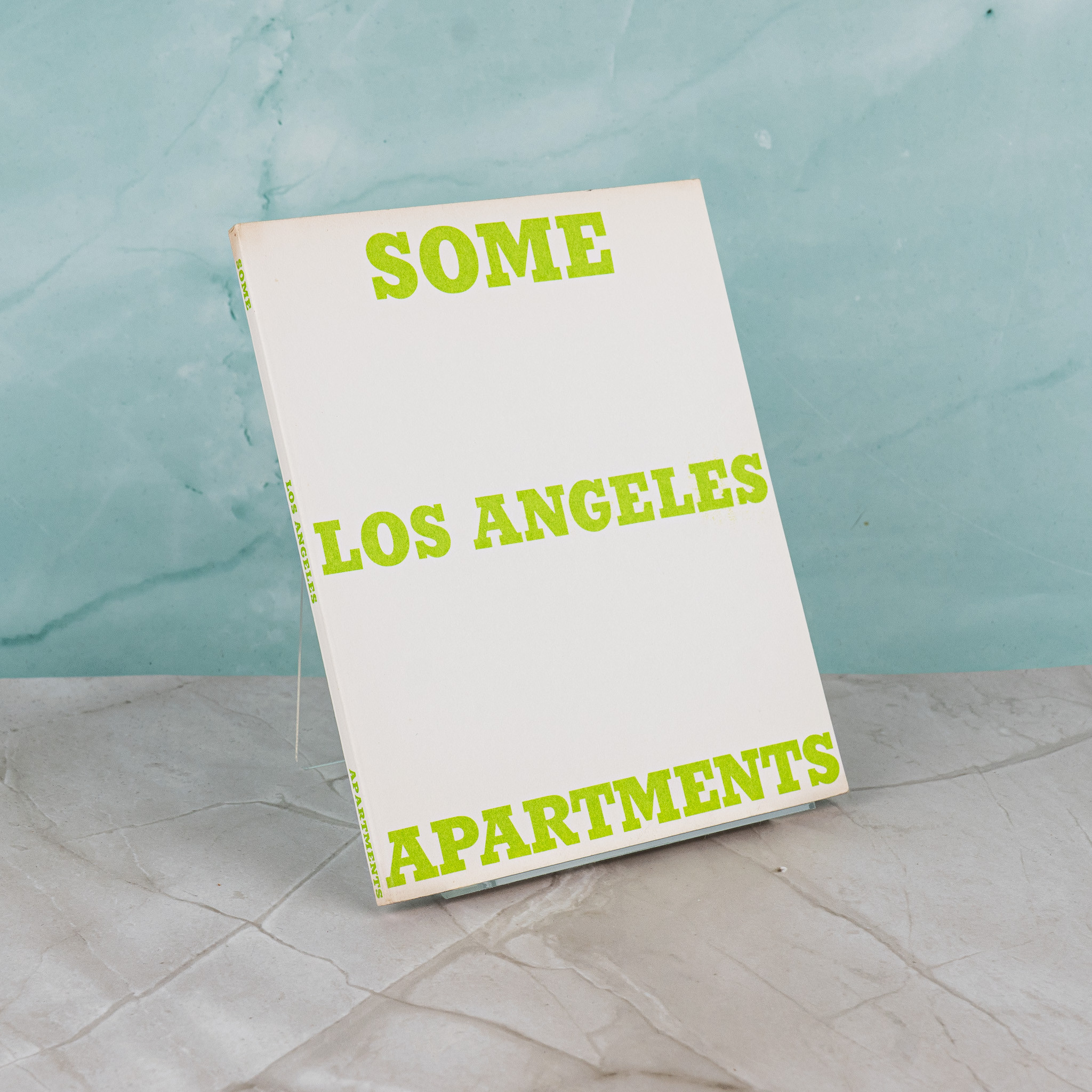
Ruscha, Edward · Ruscha, Ed
Some Los Angeles Apartments
Some Los Angeles Apartments is one of Ed Ruscha’s iconic early artist’s books, devoted to the banal architecture of Los Angeles. Instead of monuments, drama or urban glamour, Ruscha shows ordinary apartment buildings, coolly photographed and without visible sentimentality. This second edition of 1970, printed in 3,000 unnumbered copies, confirms the wider circulation of his conceptual book form. The small format, sober wrappers and original glassine wrapper make it an essential Ruscha object.

