


Bonpiet beau neuille
With *Bonpiet beau neuille*, Jean Dubuffet created in 1983 one of his last and most radical artist’s books, in which writing, drawing and speech almost merge. The text is composed in his idiosyncratic jargon, a phonetic and deliberately destabilized form of French that disrupts conventional spelling, syntax and literary decorum. Dubuffet himself calligraphed the text and combined it with 27 drawings, allowing words and images to operate as a single graphic structure. The book was issued by Jeanne Bucher in an extremely limited first edition reproduced in collotype by Atelier Arte. This copy, number 37, belongs to the 70 signed copies numbered 11 to 80 and consequently contains no unique original drawing. Only the first ten copies were accompanied by an original drawing. This edition must be clearly distinguished from the trade edition published by Ryôan-ji in 1984. Its probable provenance from the library of bibliophile Jacques Dauchez adds further interest to this exceptionally well-preserved copy.
Quantity


Dubuffet, Jean
Bonpiet beau neuille
1983 | Paris | Jeanne Bucher
An exceptionally limited first edition in which Dubuffet fuses language, handwriting and drawing into an indivisible artist’s book. Number 37 represents the signed 11–80 series in particularly fine condition, with the added interest of probable Jacques Dauchez provenance.
With *Bonpiet beau neuille*, Jean Dubuffet created in 1983 one of his last and most radical artist’s books, in which writing, drawing and speech almost merge. The text is composed in his idiosyncratic jargon, a phonetic and deliberately destabilized form of French that disrupts conventional spelling, syntax and literary decorum. Dubuffet himself calligraphed the text and combined it with 27 drawings, allowing words and images to operate as a single graphic structure. The book was issued by Jeanne Bucher in an extremely limited first edition reproduced in collotype by Atelier Arte. This copy, number 37, belongs to the 70 signed copies numbered 11 to 80 and consequently contains no unique original drawing. Only the first ten copies were accompanied by an original drawing. This edition must be clearly distinguished from the trade edition published by Ryôan-ji in 1984. Its probable provenance from the library of bibliophile Jacques Dauchez adds further interest to this exceptionally well-preserved copy.
€1,100
Condition Report:
In-Depth Study
References & Bibliography
Format
In-8 (Octavo) approx. 20 × 26 cm
Edition Particulars
Copy no. 37, one of 70 signed copies numbered 11–80; without an original drawing, which was reserved for copies 1–10.
Print Run
89
Copy Number
No. 37
Paper
« papiet féha lamin pare le moullin de Puymoyen » (papier fait à la main par le moulin de Puymoyen)
Inscription
Signed by the Author
Product DETAIL
*Bonpiet beau neuille* is not a conventional narrative but an autonomous literary and visual composition written in Dubuffet’s self-devised phonetic jargon. The text deliberately distorts French by rendering sounds, words and sentence boundaries contrary to the rules of standard language. The reader must therefore not merely read it but almost reconstruct and decipher it aloud. Written passages alternate and interact with 27 drawings, so that language and image together determine the rhythm of the book. Its development is associative and poetic rather than governed by a conventional plot. Dubuffet’s interest in everyday speech, the body, spontaneous marks and the instability of meaning is central throughout. The book thereby continues his long-standing resistance to cultural norms defining what correct language, correct art or correct representation should be.
Waldberg, Patrick · Ernst, Max
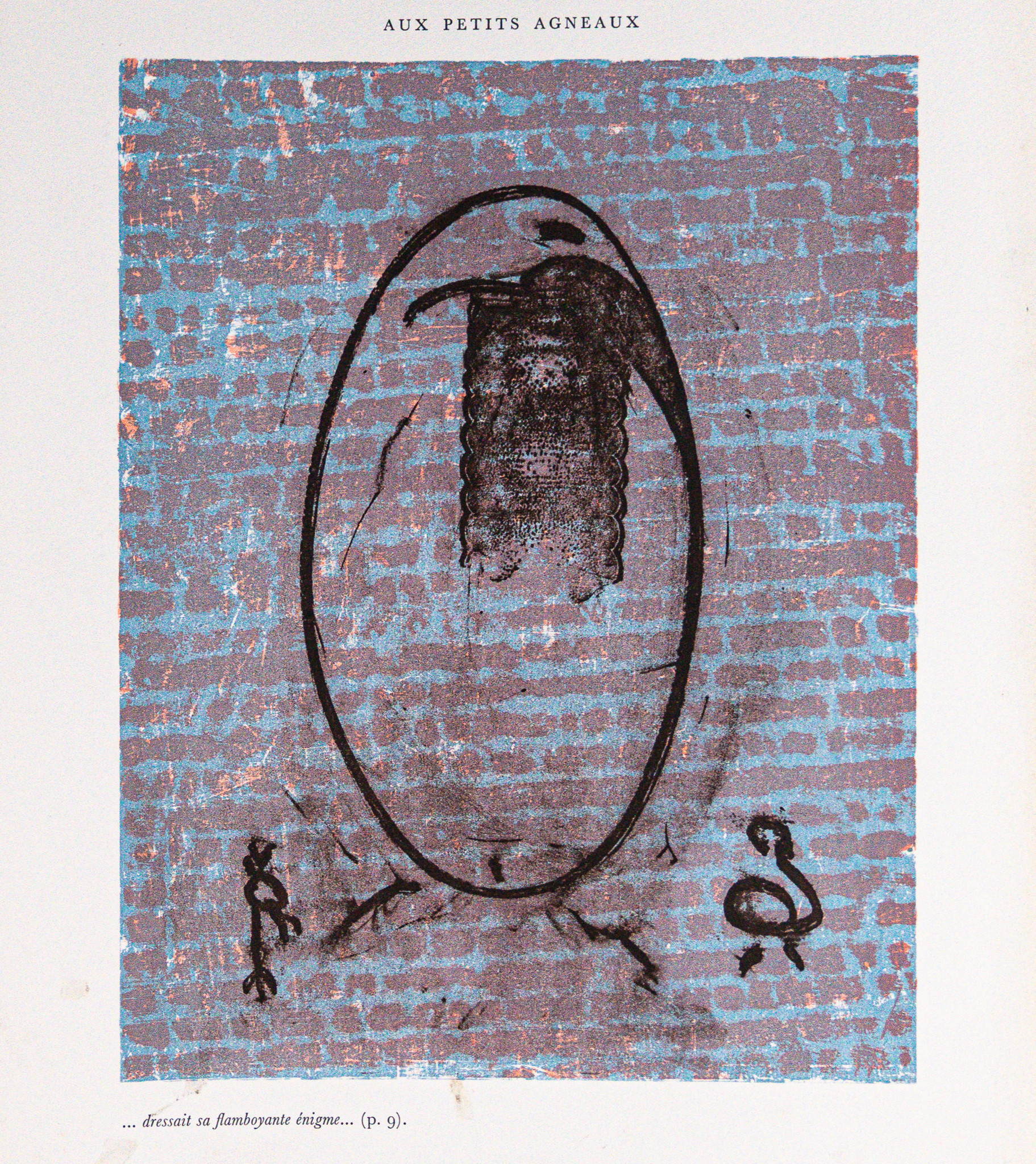
Aux Petits Agneaux
A artist’s book resulting from the collaboration between writer Patrick Waldberg and surrealist master Max Ernst. This first edition includes 19 original lithographs printed on luxurious vélin d'Arches. Published in Paris in 1971 in a limited edition of 174 copies signed by both author and artist, and presented in a custom publisher’s box.
Illustrated Book
€2,200

Bédouin, Jean-Louis · Hallart, Guy
L'arbre descend du singe
L'Arbre descend du singe is a beautifully illustrated edition that highlights the collaboration between the poet Jean-Louis Bedouin and the artist Guy Hallart. The work, published in a limited edition, is characterized by a rich dialogue between poetry and image, where the visual compositions reflect the dreamy and often cryptic nature of Bedouin's texts. The book is a tangible testament to the artistic symbiosis between the two creators and offers a unique insight into a creative dialogue from the mid-1970s.
Illustrated Book
€700

Michaux, Henri · Bettencourt, Pierre
Arriver à se réveiller
A rare first edition of Arriver à se réveiller, written by Henri Michaux in the tremulous post-war years. The text unfolds as an inward journey toward lucidity, where sleep and waking mirror each other. Printed and published by Pierre Bettencourt in his own workshop, the edition’s small run preserves the work’s intimacy. The title-page vignette, a linocut by Bettencourt, sets a spare, rhythmic visual key that amplifies Michaux’s vigilant, vulnerable tone. This copy is handsomely bound in brown morocco with balsa boards by Miguet, a tactile nod to lightness under tension. For bibliophiles, it is an exemplary union of poetry, craft, and experiment. The volume embodies the independence of the post-war small press and Michaux’s radical sensitivity.
Illustrated Book
€680
Char, Rene · Stael, Nicolas de
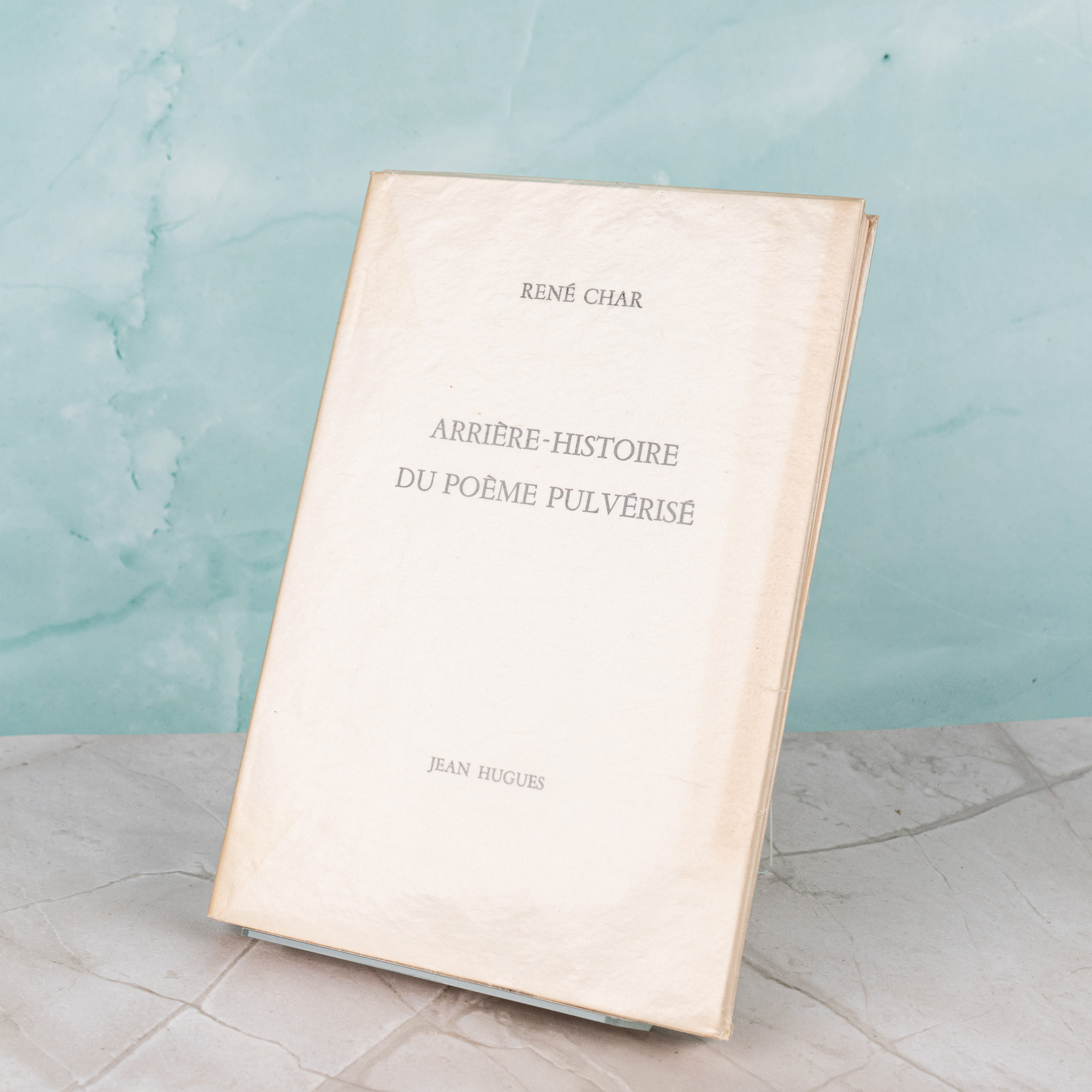
Arrière-histoire du poème pulvérisé
*Arrière-histoire du poème pulvérisé* is a later illustrated edition of a key text in which René Char looks back on the genesis and inner background of *Le Poème pulvérisé*. Published in 1972 by Imprimerie Union, it opens with a colour frontispiece by Nicolas de Staël. The pairing of Char and de Staël is especially charged: two post-war voices, each seeking concentration, clarity, and rupture in his own medium. This copy is one of only six hors commerce copies on Arches and is signed. The autograph presentation inscription to Doctor Marcel Zara, with poetic quotation and October 1972 dating, makes it a deeply personal copy.