


De l’humour noir
This sharp meditation by Breton on black humor appears here as a 1937 Paris pamphlet from GLM, in its first trade edition. Issued with a special wrapper and title page, the text was first printed in the catalogue of the Exposition Internationale de Paris 1937. The copy bears the royal-blue wrapper illustrated by Yves Tanguy. It also includes a reproduction of Breton’s collage assembling the chief «masters of black humor». The typography is remarkably crisp, characteristic of GLM’s workshops. Slim yet pointed, the booklet crystallises a decisive moment in Surrealist theory. A scarce piece with equal literary and bibliophilic appeal.
Quantity


Breton, André
Yves Tanguy
De l’humour noir
1937 | Paris | GLM (Guy Lévis-Mano)
A brief, incisive, and graphically elegant Surrealist manifesto. Copies in good condition are distinctly scarce. A choice item for GLM and Breton collections.
This sharp meditation by Breton on black humor appears here as a 1937 Paris pamphlet from GLM, in its first trade edition. Issued with a special wrapper and title page, the text was first printed in the catalogue of the Exposition Internationale de Paris 1937. The copy bears the royal-blue wrapper illustrated by Yves Tanguy. It also includes a reproduction of Breton’s collage assembling the chief «masters of black humor». The typography is remarkably crisp, characteristic of GLM’s workshops. Slim yet pointed, the booklet crystallises a decisive moment in Surrealist theory. A scarce piece with equal literary and bibliophilic appeal.
€500
Condition Report:
In-Depth Study
References & Bibliography
Format
In-12 (Duodecimo) approx. 17 × 22 cm
Edition Particulars
Copy from the ordinary issue; the numbered copies were limited to 30.
Paper
papier d’édition
Product DETAIL
Breton probes the paradoxical allure of humor that fuses cruelty, despair, and lucidity. He defines the «black» domain as a tool for subverting convention and releasing desire. The essay moves between polemic and poetics, adducing examples from literature and modern culture. Black humor is set against moralizing irony, urging a different ethics of reading. In condensed form, the piece serves as a theoretical prelude to Breton’s later work on the subject.

Michaux, Henri · Bettencourt, Pierre
Arriver à se réveiller
A rare first edition of Arriver à se réveiller, written by Henri Michaux in the tremulous post-war years. The text unfolds as an inward journey toward lucidity, where sleep and waking mirror each other. Printed and published by Pierre Bettencourt in his own workshop, the edition’s small run preserves the work’s intimacy. The title-page vignette, a linocut by Bettencourt, sets a spare, rhythmic visual key that amplifies Michaux’s vigilant, vulnerable tone. This copy is handsomely bound in brown morocco with balsa boards by Miguet, a tactile nod to lightness under tension. For bibliophiles, it is an exemplary union of poetry, craft, and experiment. The volume embodies the independence of the post-war small press and Michaux’s radical sensitivity.
Illustrated Book
€680

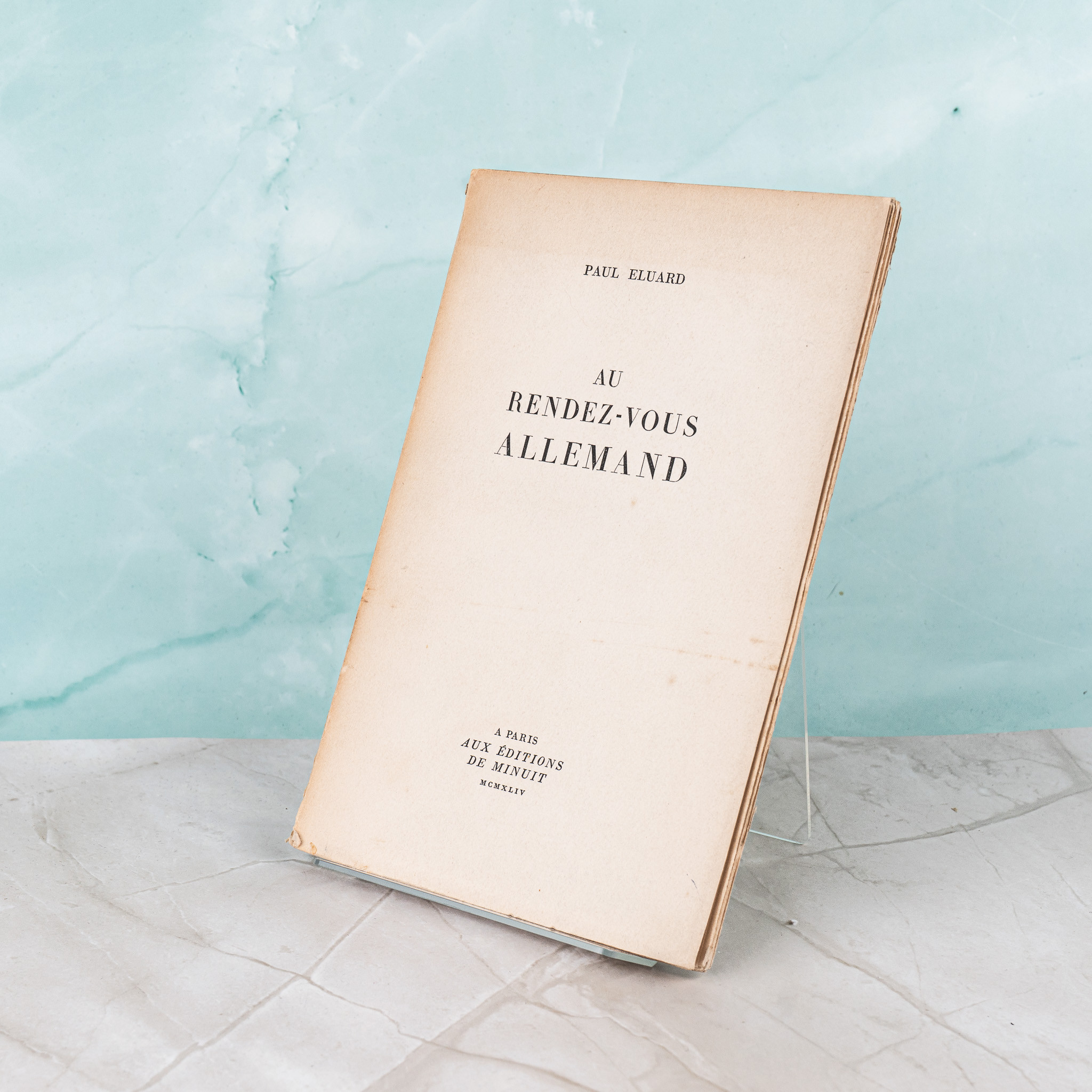
Éluard, Paul
Au rendez-vous allemand
Au rendez-vous allemand is one of the emblematic collections of Éluard’s wartime poetry. The book appeared in 1944 from Les Éditions de Minuit, the publishing house that, under the Occupation, became a moral landmark of the French literary Resistance. The volume gathers poems in which love, mourning, revolt and hope appear not as abstractions but as immediate necessities under German rule. The frontispiece, a portrait of the poet after Picasso, gives the book a powerful artistic signature: two voices of modern France, poet and artist, stand here in the same struggle. This is an ordinary, unnumbered copy, but signed by Éluard on the first page. That signature makes the book more than a Resistance document: it becomes a tangible witness to literary presence in a historically charged year. For the collector, it unites the clandestine aura of Minuit, Picasso’s name and Éluard’s own hand.
Illustrated Book
€350

Brillat-Savarin, Jean-Anthelme · Dufy, Raoul
Aphorismes et variétés.
An elegant *livre d’artiste* pairing Brillat-Savarin’s witty gastronomic aphorisms with twenty full-page original etchings by Raoul Dufy. Dufy’s airy, musical line lends the text a radiant cadence, turning the maxims into vignettes of conviviality and taste. Limited to 200 copies on Rives wove; this is no. 19, for the subscriber Mr Bernard-Beaumaine. Untrimmed copy with original covers and spine preserved, luxuriously rebound by F. Rousseau in 2001. Clear provenance enhances its appeal. Wrapper slightly toned; box with only the faintest rubbing. A refined encounter between culinary letters and modernist design.
Illustrated Book
€1,900

When a Signature Becomes Provenance
A signature confirms; a dedication connects; an association copy tells a story.

The Fragile Meaning of ‘Complet’
In auction descriptions, “complete” often sounds reassuring — but it is only meaningful when verified against the colophon, the justification, and the bibliography. For The Hidden Page, clarity begins where vague market language ends.

The Avant-Garde and the Illustrated Word
How the Twentieth Century Recast the Book as an Artistic and Ideological Medium