


De la méthode triolectique dans ses applications en situlogie générale
De la méthode triolectique dans ses applications en situlogie générale is a small but charged theoretical pamphlet by Asger Jorn. It presents the “triolectical” method as an alternative to dialectical thinking and links that speculation to the Situationist imagination of play, space and conflict. Its material form is modest — 11 pages, stapled white wrappers, diagrams — but its importance lies precisely in its autonomous publication. Jorn’s text emerged from the broader context of Sauvagerie, Barbarie, Civilisation and the study of signs engraved on churches in Eure and Calvados, but here it is detached as a separate theoretical object. The Scandinavian Institute of Comparative Vandalism in Aarhus functions as Jorn’s idiosyncratic laboratory for art-historical sabotage, comparative visual culture and anti-academic research. This copy is not a deluxe edition and bears no numbering, signature or original graphic work. Its value lies in its rarity, its early autonomous publication form and its close relation to Jorn’s Situationist thought.
Quantity


Asger Jorn
De la méthode triolectique dans ses applications en situlogie générale
1964 | Aarhus
This first separate edition of Jorn’s triolectical text is a rare small printed work of great theoretical density. It preserves the passage from Situationist vocabulary toward Jorn’s own ludic and anti-dialectical models. In its sobriety, it is a sharp document of avant-garde thought in working form.
De la méthode triolectique dans ses applications en situlogie générale is a small but charged theoretical pamphlet by Asger Jorn. It presents the “triolectical” method as an alternative to dialectical thinking and links that speculation to the Situationist imagination of play, space and conflict. Its material form is modest — 11 pages, stapled white wrappers, diagrams — but its importance lies precisely in its autonomous publication. Jorn’s text emerged from the broader context of Sauvagerie, Barbarie, Civilisation and the study of signs engraved on churches in Eure and Calvados, but here it is detached as a separate theoretical object. The Scandinavian Institute of Comparative Vandalism in Aarhus functions as Jorn’s idiosyncratic laboratory for art-historical sabotage, comparative visual culture and anti-academic research. This copy is not a deluxe edition and bears no numbering, signature or original graphic work. Its value lies in its rarity, its early autonomous publication form and its close relation to Jorn’s Situationist thought.
€250
Condition Report:
In-Depth Study
References & Bibliography
Edition Particulars
Unnumbered copy of the first separate edition; no deluxe issue, signature or original graphic work is recorded.
Inscription
No inscription
Product DETAIL
The text sets out Jorn’s idea of “triolectics”: a method based not on two opposing poles, but on three forces or positions that set one another in motion. Instead of classical dialectics, in which conflict tends toward synthesis, Jorn proposes a more dynamic model suited to play, strategy and social space. The diagrams visualize the relations between positions and make the theory both abstract and playful. The term “situlogy” points to a general study of situations, in which action, place, tension and change are thought together. The pamphlet is therefore not a narrative work, but a theoretical-poetic instrument. It shows how Jorn attempts to bring political, artistic and ludic concepts together in a compact method.

Ribemont-Dessaignes, Georges
Ariane
A remarkable copy of *Ariane*, published in the *Les Cahiers Nouveaux* series, inscribed with a poetic and enigmatic message by Ribemont-Dessaignes to Jacques Matarasso. This deluxe Japan paper edition was elegantly rebound in 1994 by Georges Leroux, in a restrained style that echoes the work’s Dadaist spirit.
Book
€1,100

Gracq, Julien
Au château d'Argol
Julien Gracq’s debut novel, issued by José Corti, sets a gothic castle on the Breton coast as the stage for a charged, almost dream-logic encounter between three figures. The prose is musical and image-rich, favouring symbolic landscapes and metaphysical weather. Born near Surrealism yet distinctly independent, the book establishes Gracq’s lucid enchantment from the start. For bibliophiles this is a key title: an early Corti publication, scarce in appealing condition, and the opening note of a major twentieth-century voice. Its limited print-run and initially slow reception add to the sense of discovery. This copy is on publisher’s stock.
Book
€610

Dominique Fourcade, Pierre Buraglio · Buraglio, Pierre
Au travail ma chérie
First volume in the Préférence series: a focused encounter between Dominique Fourcade and Pierre Buraglio. The Imprimerie nationale produced an exemplary typographic edition on Rives wove, limited to 100 copies signed by both. Buraglio “illuminates” the book with spare, hand-made interventions—strokes, contours, accents—that let the page breathe. The plain wrappers in a sturdy case stress the workshop feel. This copy bears a presentation to Jacques Dauchez, adding a vivid bibliophilic provenance. A scarce, exact book where typography, gesture, and poetry hold each other in balance.
Book
€725
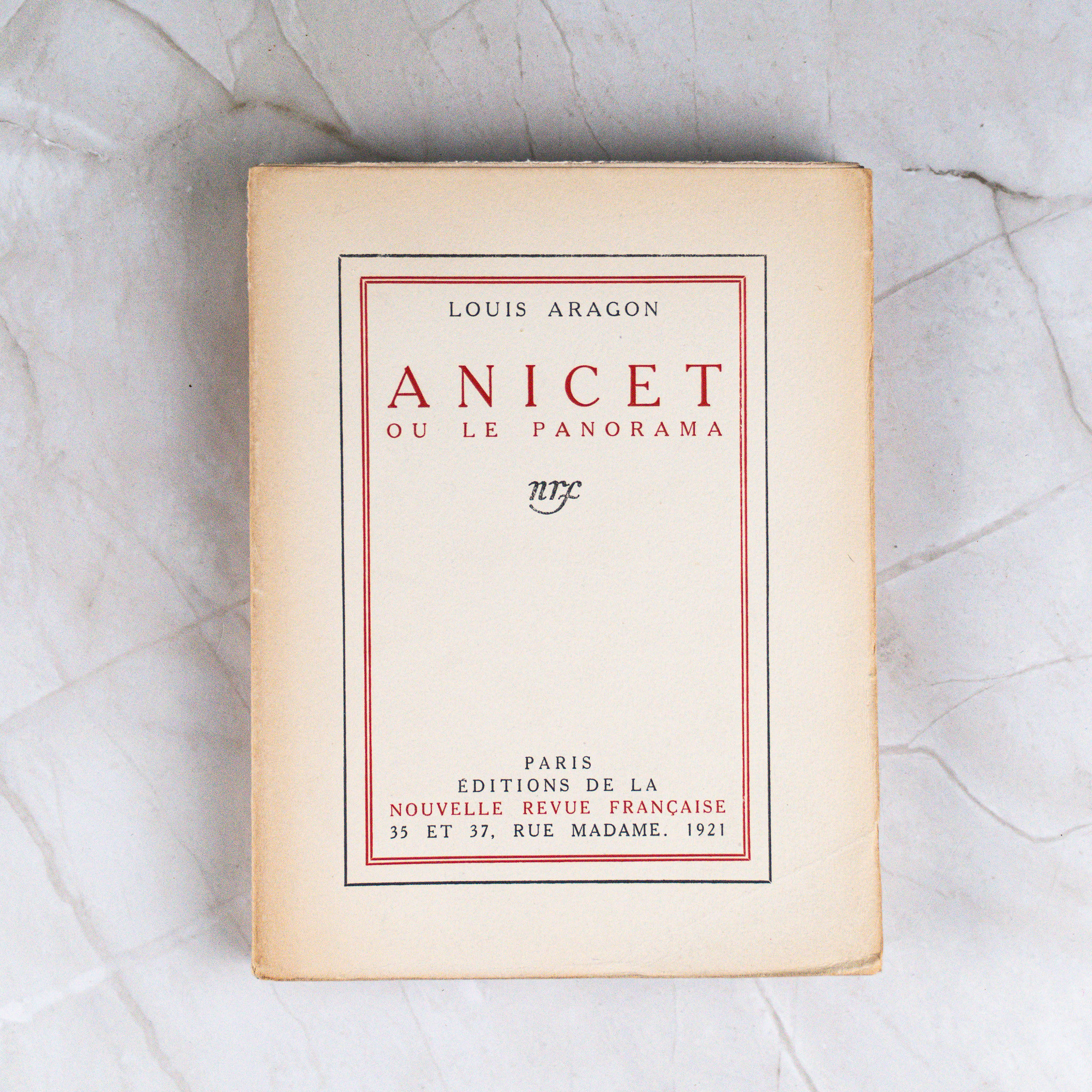
Aragon, Louis
Anicet ou le panorama
With *Anicet ou le panorama* (Paris, NRF, 1921), Louis Aragon delivers an early, deliberately hybrid novel written at the hinge between Dada disruption and the rise of Surrealism. The book proceeds by visions and sequences—a “panorama” in which identity, desire, and the act of looking continually shift. In this bibliophile form (“tirage de tête” reserved for NRF bibliophiles), the novel also becomes a collectible object intended for a small inner circle. This copy is specifically designated “pour le Dr. Sourdel” and numbered XLVIII, underscoring the selective, personalized nature of the issue. Published under the NRF imprint, Aragon is anchored in the literary center while keeping the book’s formal audacity intact. A key item for understanding the nervous modernity of the early 1920s.