


De la typographie et de l’harmonie de la page imprimée. William Morris et son...
De la typographie et de l’harmonie de la page imprimée is a refined fin-de-siècle publication devoted to the art of the printed page. Lucien Pissarro and Charles Ricketts place William Morris at the centre as a reformer of the book, printing and the applied arts. The work belongs to the circles in which the Arts and Crafts movement, private press ideals and the renewed valuation of typography meet. The title makes clear that typography is not treated as a technical accessory, but as an harmony of type, margin, paper and page design. The edition appeared in 1898, in London from Ricketts and in Paris from Floury, standing between English private press culture and French bibliophile reception. This copy belongs to the issue of 250 copies on Arnold handmade laid paper within a total edition of 256 copies. The present errata slip and only slight corner wear make it bibliographically attractive and complete.
Quantity


Pissarro, Lucien
Ricketts, Charles
ILLUSTRATORS
ILLUSTRATORS
ILLUSTRATORS
De la typographie et de l’harmonie de la page imprimée. William Morris et son influence sur les arts et métiers
1898 | Londres; Paris | Ricketts, Floury
A complete Arnold-paper copy in which Pissarro and Ricketts defend the harmony of the modern book page.
De la typographie et de l’harmonie de la page imprimée is a refined fin-de-siècle publication devoted to the art of the printed page. Lucien Pissarro and Charles Ricketts place William Morris at the centre as a reformer of the book, printing and the applied arts. The work belongs to the circles in which the Arts and Crafts movement, private press ideals and the renewed valuation of typography meet. The title makes clear that typography is not treated as a technical accessory, but as an harmony of type, margin, paper and page design. The edition appeared in 1898, in London from Ricketts and in Paris from Floury, standing between English private press culture and French bibliophile reception. This copy belongs to the issue of 250 copies on Arnold handmade laid paper within a total edition of 256 copies. The present errata slip and only slight corner wear make it bibliographically attractive and complete.
€750
Condition Report:
In-Depth Study
References & Bibliography
Format
In-8 (Octavo) approx. 20 × 26 cm
Edition Particulars
One of 250 copies on Arnold handmade laid paper within a total edition of 256; with errata slip and slight wear to corners.
Print Run
256
Paper
Arnold handmade laid paper
Inscription
No inscription
1
Edition Particulars:
We welcome private inquiries, collaborations with institutions, and acquisition requests. Each message is treated with discretion and respect. We welcome private inquiries, collaborations with institutions, and acquisition requests.
1
Print Run:
Condition Report:
1
Copy Number:
Condition Report:
1
Paper:
Condition Report:
1
Signed:
Condition Report:
Product DETAIL
The book discusses typography, page composition and the aesthetic coherence of the printed page. William Morris is the central example: his influence on book art, craft and design is described as a turning point in the modern revival of the well-made book. The text does not develop a narrative, but a series of principles concerning type choice, harmony, print quality and the moral value of craft. Pissarro and Ricketts situate printing within the broader Arts and Crafts context, where beauty and utility are not separated. The reader thus receives a compact theoretical and historical plea for the book as a total object. The presence of the errata slip underlines the concern for correction and precision that the text itself defends.
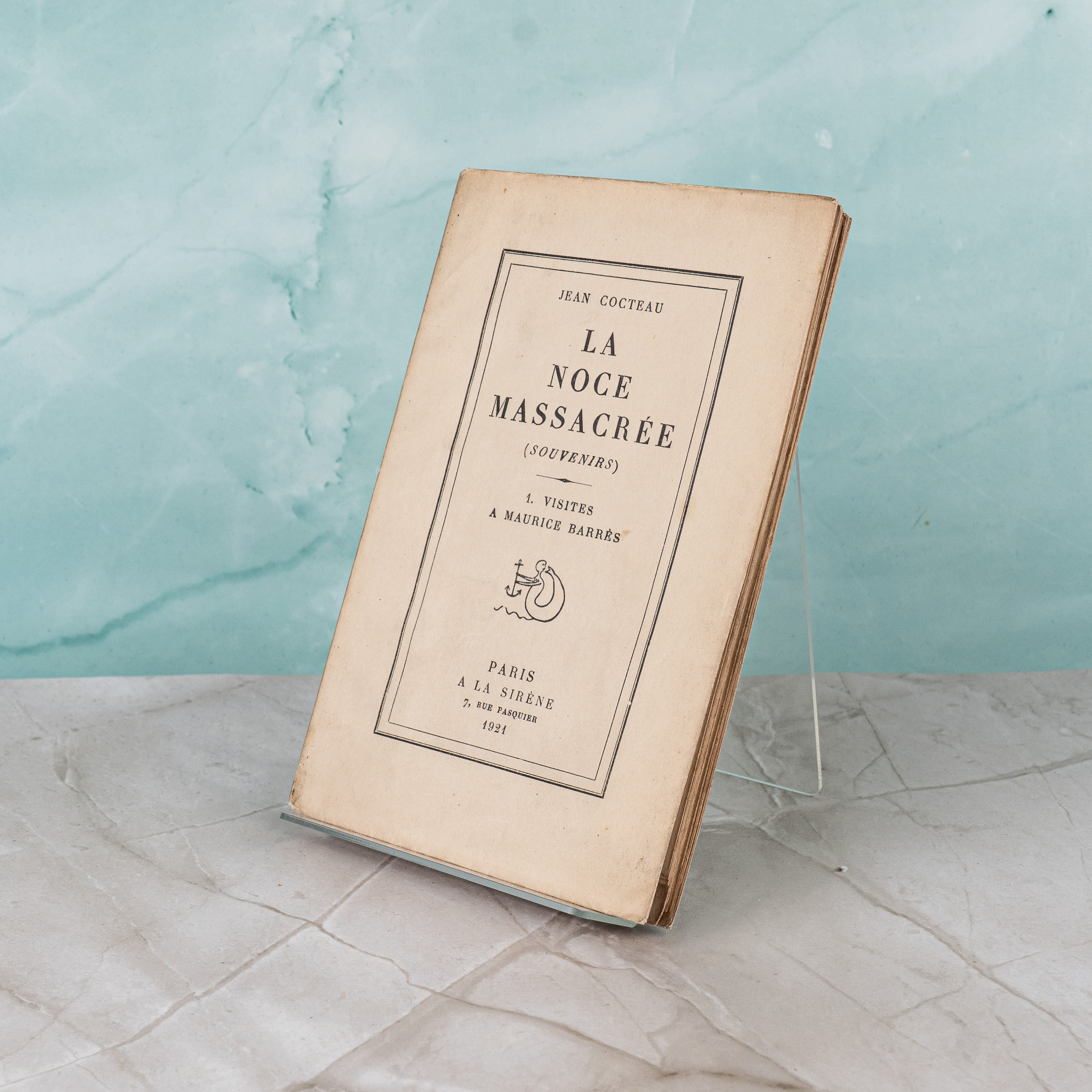
Cocteau, Jean
La Noce massacrée
La Noce massacrée belongs to Jean Cocteau’s early, sharply modernist phase, shortly after Parade and in close proximity to Raymond Radiguet. The book appeared in 1921 with À la Sirène, a publisher closely connected with the Parisian artistic avant-garde and literary modernism. The presence of a vignette after Picasso reinforces that context, although this is not an illustrated artist’s book in the strict sense. Cocteau writes from a milieu in which literature, theatre, ballet, visual art and social polemic constantly intersected. The printed dedication to Radiguet also makes the book a witness to a decisive friendship and intellectual alliance. This copy, n°XIX, belongs to the first 40 copies on vergé d’Arches, the most desirable form of the edition.
Book
€850
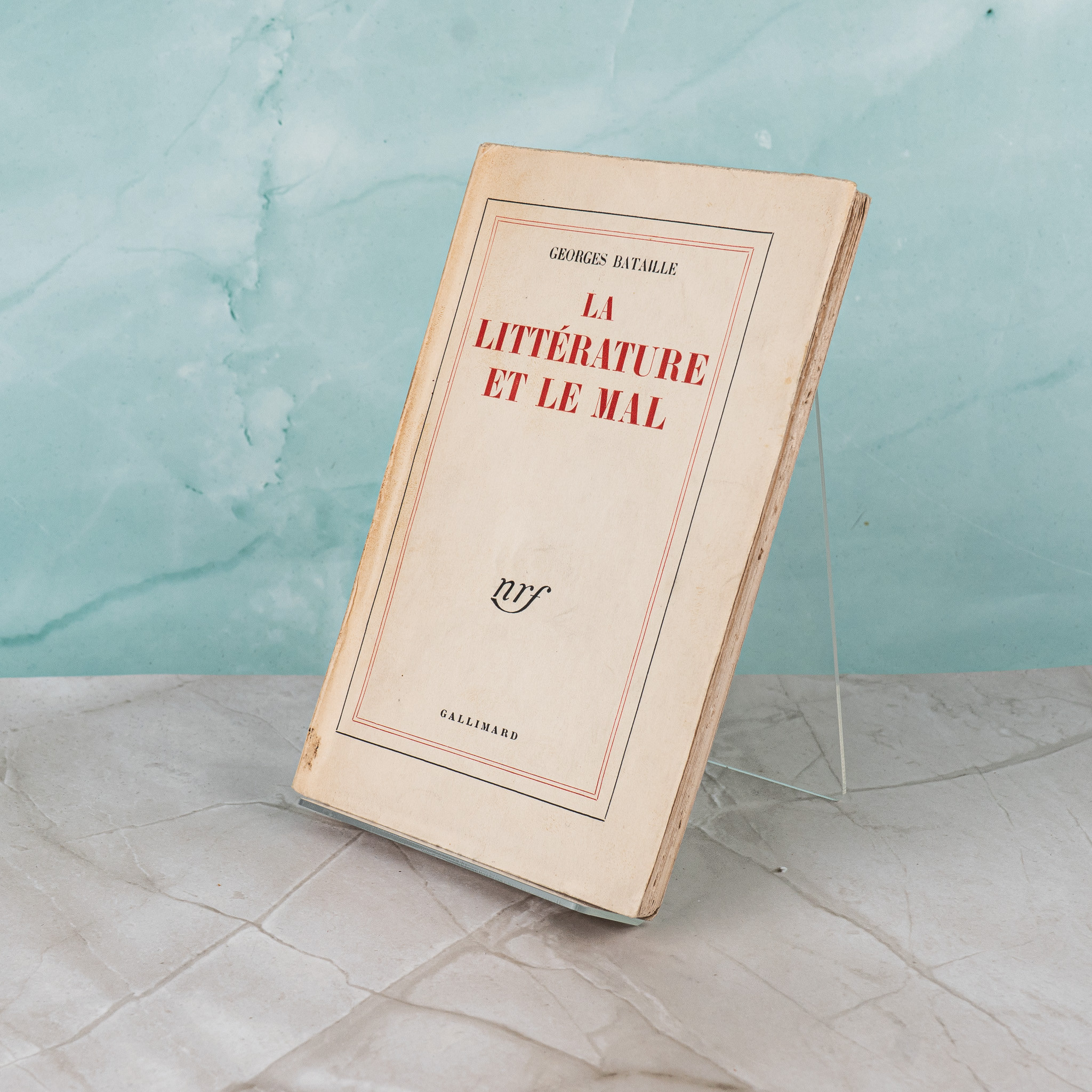
Bataille, Georges
La littérature et le mal
La littérature et le mal is one of Georges Bataille’s most penetrating books on the moral and metaphysical stakes of literature. In these essays he examines how major writers approach the boundary between law and transgression, guilt and sovereignty, eroticism and destruction. The volume brings together Emily Brontë, Baudelaire, Michelet, Blake, Sade, Proust, Kafka and Genet in a radical reading of literature as an experience of the forbidden. For Bataille, the literary work is not a polite mirror of morality, but a place where human beings encounter their most dangerous freedom. This copy is remarkable for its paper issue: one of only 25 on vélin pur fil Lafuma-Navarre, the sole large-paper issue.
Book
€1,600
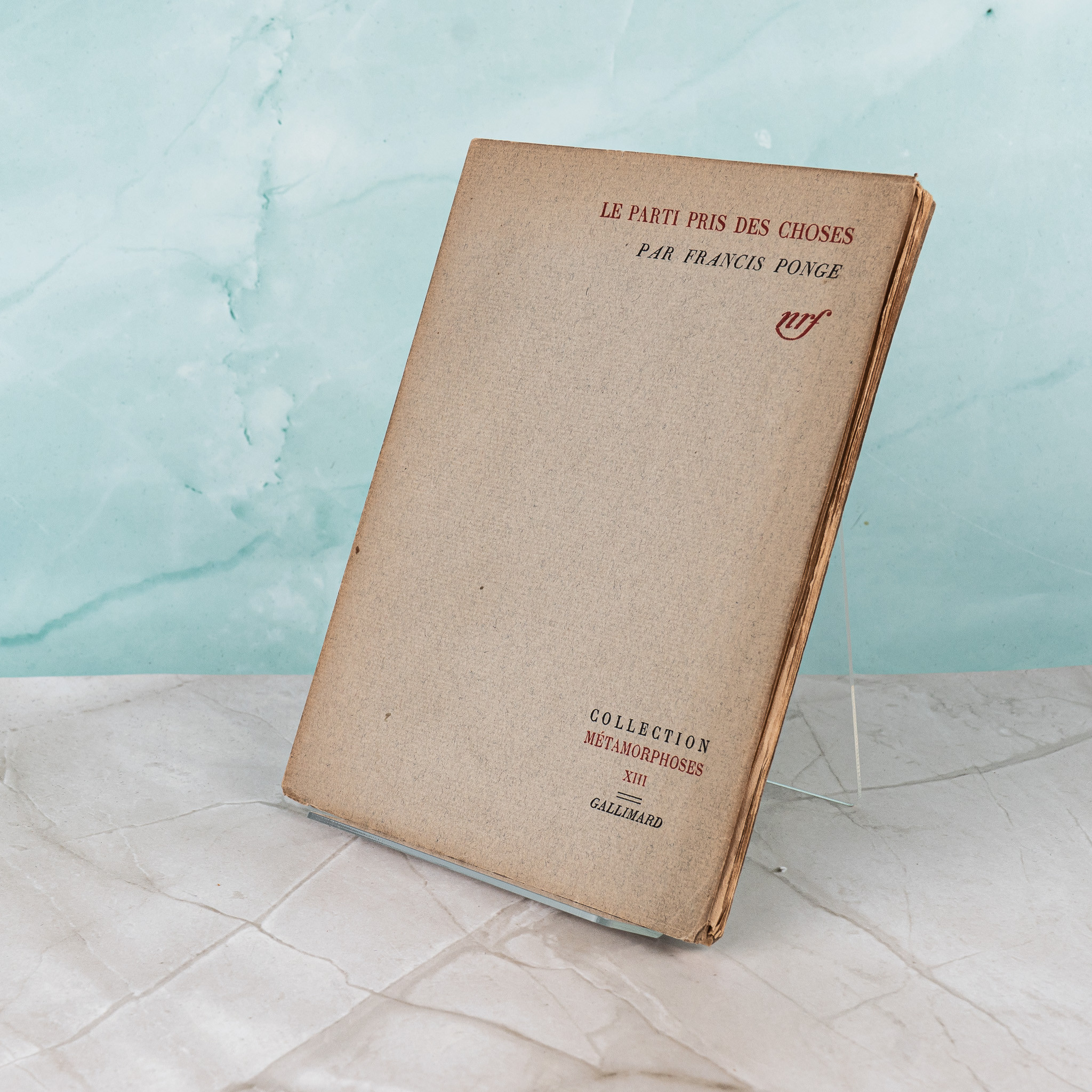
Ponge, Francis
Le Parti pris des choses
These two copies of Le Parti pris des choses form a remarkable paired witness to Francis Ponge’s visit to Zurich in March 1949. The book itself is one of the decisive prose works of French modernity: not lyrical confession, but a precise encounter with the mute dignity of things. Ponge gives ordinary objects — soap, bread, an oyster, a pebble, a cigarette — a language at once exact, ironic and sensuous. The double inscription to Frank Thiessing and to Madame Frank Thiessing gives the pair a strongly personal resonance. Frank C. Thiessing belonged to the Swiss world of graphic design, publishing and visual modernism, notably in relation to Hans Erni. These copies therefore connect Ponge’s literary materialism with the artistic and typographic networks of post-war Zurich.
Book
€1,300
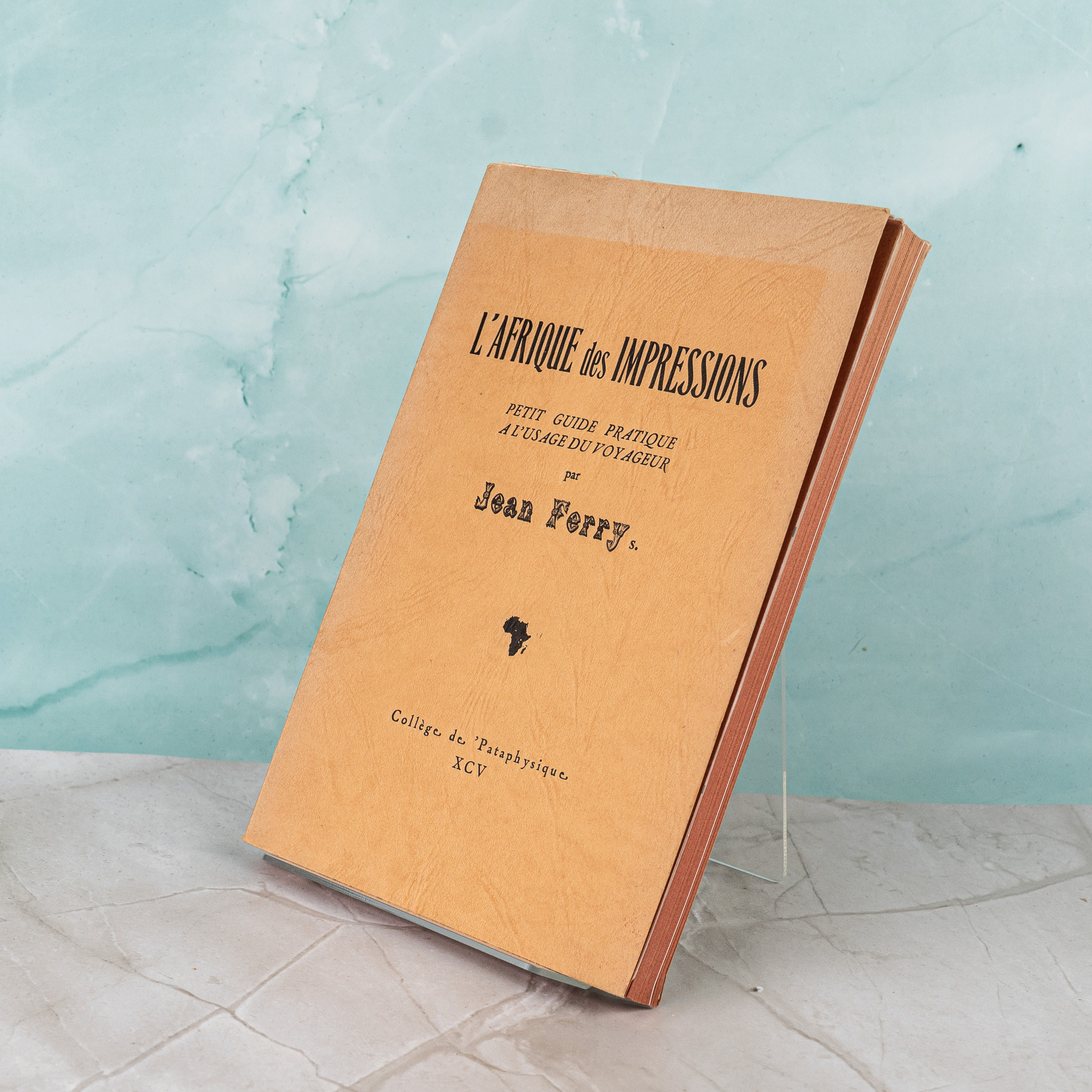
Ferry, Jean
L’Afrique des impressions. Petit guide pratique à l’usage du voyageur
L’Afrique des impressions is Jean Ferry’s pataphysical guide to Raymond Roussel’s imaginary Africa, published by the Collège de ’Pataphysique in 1967. Its title openly plays on Roussel’s Impressions d’Afrique, yet transforms exegesis into travel writing, scholarship into itinerary and reading into expedition. Ferry approaches Roussel not as an outside commentator, but as an initiate of verbal machinery, secret procedures and comic precision. This copy belongs to the rare group of 166 “exemplaires capitaux” on Authentique Papier Tropical du Ponukélé, and it duly contains the original drawing and autograph material required for that deluxe issue. Its dedication to Raphaël Ossona de Mendez places it within the living network of the Collège rather than in a merely external provenance. The accompanying manuscript note on codes, letters and the number 472 further heightens its Roussellian resonance. As a bibliophile object, it is at once guidebook, homage, private signal and pataphysical field instrument.

