


Delbrouck et M. Defize à la
Galerie Van Leer avril 1929
This rare exhibition catalogue accompanied the joint presentation of Émilie Delbrouck and Marcel Defize at Galerie Van Leer in Paris from 1 to 15 April 1929. The small publication comprises eight pages and reproduces two works. Its particular significance lies in André Breton’s preface, which places the exhibition directly within the Surrealist context of the period. The conjunction of two Belgian artists, a Parisian avant-garde gallery and Breton as advocate makes the pamphlet more than a passing exhibition document. Breton’s text later acquired a second life when it was reused under the title *Exposition X…, Y…*. The catalogue therefore preserves a tangible trace of the international exchanges surrounding Surrealism at the end of the 1920s. For the bibliophile, this meeting of art, programmatic writing and ephemeral print is especially compelling. The fragile condition of the present copy also emphasizes the inherently vulnerable nature of such exhibition catalogues.
Quantity


Breton, André
Delbrouck
Delize, M.
Émilie Delbrouck
Marcel Defize
Delbrouck et M. Defize à la
Galerie Van Leer avril 1929
1929 | Paris | Galerie Van Leer
A rare and ephemeral exhibition document bringing together two Belgian artists, a Parisian avant-garde gallery and André Breton at a decisive moment. Breton’s preface and its later reuse give this modest pamphlet an enduring place in the documentary history of Surrealism.
This rare exhibition catalogue accompanied the joint presentation of Émilie Delbrouck and Marcel Defize at Galerie Van Leer in Paris from 1 to 15 April 1929. The small publication comprises eight pages and reproduces two works. Its particular significance lies in André Breton’s preface, which places the exhibition directly within the Surrealist context of the period. The conjunction of two Belgian artists, a Parisian avant-garde gallery and Breton as advocate makes the pamphlet more than a passing exhibition document. Breton’s text later acquired a second life when it was reused under the title *Exposition X…, Y…*. The catalogue therefore preserves a tangible trace of the international exchanges surrounding Surrealism at the end of the 1920s. For the bibliophile, this meeting of art, programmatic writing and ephemeral print is especially compelling. The fragile condition of the present copy also emphasizes the inherently vulnerable nature of such exhibition catalogues.
€325
Condition Report:
In-Depth Study
References & Bibliography
Format
Divers
Edition Particulars
Copy disbound from its staples, with a small loss to the lower wrapper; presence of the loose erratum slip not confirmed.
Product DETAIL
The pamphlet documents the exhibition of Émilie Delbrouck and Marcel Defize held from 1 to 15 April 1929 at Galerie Van Leer, 41 rue de Seine in Paris. Across eight pages it presents the two artists and their work, including two reproduced plates. André Breton contributes the introductory preface, giving the exhibition an explicitly Surrealist frame. The booklet functions both as an exhibition catalogue and as the vehicle for Breton’s critical text. That text was later reused under the title *Exposition X…, Y…*, giving the occasional preface a broader afterlife within Breton’s writings. The publication also records contacts between Belgian artists and the Parisian avant-garde in 1929. Its chief interest lies in the conjunction of a short-lived exhibition with a text by one of Surrealism’s central figures.

Georges Mathieu, Henri Van Lier · Frasnay, Daniel
Mathieu : Galerie Veranneman,
14.1.71 - 6.2.71
This Brussels exhibition catalogue records a Georges Mathieu show at Galerie Veranneman in the winter of 1971. It is a concise yet highly distinctive publication in which the force of Mathieu’s calligraphic abstraction remains immediately present. Henri Van Lier’s preface provides a critical frame that does more than describe the work, placing it intellectually within post-war painting. Daniel Frasnay’s photographic contribution gives the booklet a taut visual rhythm and makes it more than a routine gallery handout. That combination of gallery publication, critical text, and images explains much of its appeal to collectors. The present copy is elevated further by an original drawing and a personal inscription from Mathieu to Madame Goldstein. It stands at once as exhibition document, artist-related imprint, and intimate relic.
Catalogue
€450

Vautier, Ben
Ben Vautier — Participations au Festival non art, anti art, la vérité est art,
comment changer l’art et l’homme… (1–15 juin 1969)
This rare Fluxus portfolio, designed by Ben Vautier, embodies late-1960s dematerialised art: the work *is* a bundle of ideas, instructions, and attitudes. *Participations…* operates as a catalogue for a “non-material” exhibition and, at the same time, as a logistical trace of a festival announced as worldwide, from 1 to 15 June 1969. Instead of objects, the folder offers contributions reproduced through plain printing, stencil, or photocopy—an aesthetic of speed, circulation, and intention. It gathers voices that redrew the boundaries of art: from George Maciunas and Robert Filliou to Daniel Buren, Dieter Roth, Wolf Vostell, Joseph Beuys, with Marcel Duchamp as a conceptual horizon. The deliberately ironic tables of contents and playful notes on the submissions affirm a Fluxus principle: seriousness needs play. As a numbered first edition limited to 502 copies, it stands as an emblematic document of the moment when art became protocol, performance, and network.
Catalogue
€1,000
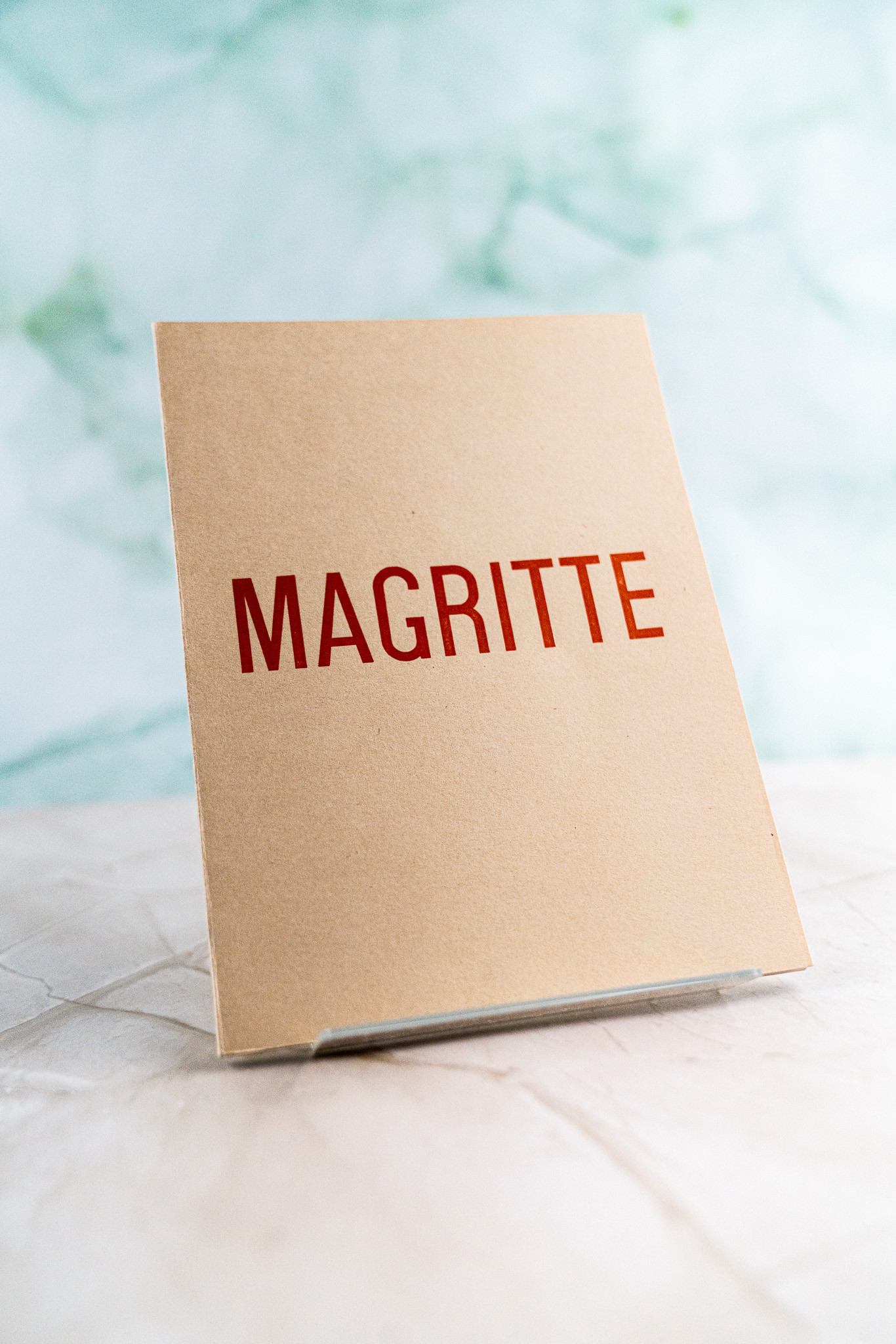
Mariën, Marcel · Magritte, René
Magritte
A rare Brussels wartime edition (1943). This monograph on Magritte is not an “ordinary” monograph or catalogue.
There are several reasons for this.
1) First recognized monograph
This is the first widely recognized monograph devoted to René Magritte. By 1943 Magritte was established in Belgium and had some international visibility through exhibitions, but this is the first fully illustrated publication devoted exclusively to him, with particular attention to works from the early 1940s.
2) War years and occupation
Published in 1943, in the midst of the war and under German occupation. For (Belgian) Surrealists this meant censorship, surveillance, and very limited public visibility; Surrealism was classified by the Nazis as “degenerate art.” As a result, exhibitions and publications were few, often semi-clandestine, sometimes under pseudonyms and with cautious, coded language. There were even instances of direct interference (for example, the premature closure of Raoul Ubac’s photographic exhibition in Brussels in 1941). That Marcel Mariën and Magritte brought this book out during the occupation shows both courage and an intellectual act of resistance. It is plausible that the edition of 1,025 copies reached readers in stages, slowly and mainly locally.
3) Association copy: Henri Parisot
This copy bears an extensive inscribed presentation by Magritte to Henri Parisot, a key figure on the French Surrealist scene—poet, translator, and publisher of Antonin Artaud, Paul Éluard, Benjamin Péret, and André Breton. Parisot served as an essential cultural mediator, introducing visionary precursors such as Novalis and William Blake to a French readership. Through his bibliophile editions and journals he provided an independent space outside Breton’s strict authority and helped preserve Surrealism’s legacy while linking it to broader traditions of mysticism and poetic experiment.
4) The date “72-X-79231”
The presentation is cryptically dated: “72-X-79231.” This is not a slip, but a deliberate Surrealist play with time and sequence—fully consistent with Magritte’s concerns (think of La durée poignardée / Time Transfixed and his word/image inversions). Such a poetic, non-linear date makes the inscription itself conceptual: the envoi enacts what the work proclaims—unhinging time. The “X” acts as a hinge within the number string; the formula mirrors Magritte’s method of estranging the everyday through a subtle shift in conventions. As paratext, the date turns the inscription into a performative gesture: it does Surrealism rather than merely naming it.
Catalogue
€3,200

Ribemont-Dessaignes, Georges
Ariane
A remarkable copy of *Ariane*, published in the *Les Cahiers Nouveaux* series, inscribed with a poetic and enigmatic message by Ribemont-Dessaignes to Jacques Matarasso. This deluxe Japan paper edition was elegantly rebound in 1994 by Georges Leroux, in a restrained style that echoes the work’s Dadaist spirit.
Book
€1,100

When a Signature Becomes Provenance
A signature confirms; a dedication connects; an association copy tells a story.

The Fragile Meaning of ‘Complet’
In auction descriptions, “complete” often sounds reassuring — but it is only meaningful when verified against the colophon, the justification, and the bibliography. For The Hidden Page, clarity begins where vague market language ends.

The Avant-Garde and the Illustrated Word
How the Twentieth Century Recast the Book as an Artistic and Ideological Medium