


Dix portraits
*Dix portraits* is an exceptional modernist portrait book in which Gertrude Stein brings together her English prose portraits with French translations by Georges Hugnet and Virgil Thomson. Published in 1930 by Éditions de La Montagne, with a preface by Pierre de Massot, the edition forms a compact cartography of Stein’s Parisian circle. The ten illustrations by Picasso, Tchelitchew, Bérard, Tonny and Berman make the volume a collective portrait of a milieu rather than a merely illustrated collection. This copy is no. 91, belonging to the illustrated series on vélin d’Arches, and is signed on the justification by Gertrude Stein, Georges Hugnet and Virgil Thomson, with a fourth unidentified inscription or paraph. Edward Wasserman’s bookplate adds a later collector’s provenance. The later orange binding gives the book an almost object-like presence, while its contents preserve a subtle network of friendship, modernism and portraiture. This copy is additionally enriched with a drawing in blue ink and wash on the page accompanying the portrait of Christian Bérard, apparently signed ‘Christian Bérard’. The attribution to Bérard rests on style, colour and signature and remains subject to independent confirmation. This addition is described separately from the edition’s ten illustrations.
Quantity


Stein, Gertrude
Picasso, Pablo
Tchelitchew, Pavel
Bérard, Christian
Tonny, Kristians
Berman, Eugene
Dix portraits
1930 | Paris | Éditions de La Montagne
Signed illustrated copy no. 91 on vélin d’Arches, with Edward Wasserman’s bookplate and a later orange binding. The drawing attributed to Christian Bérard gives this copy particular research and collecting interest; the attribution remains subject to independent confirmation.
*Dix portraits* is an exceptional modernist portrait book in which Gertrude Stein brings together her English prose portraits with French translations by Georges Hugnet and Virgil Thomson. Published in 1930 by Éditions de La Montagne, with a preface by Pierre de Massot, the edition forms a compact cartography of Stein’s Parisian circle. The ten illustrations by Picasso, Tchelitchew, Bérard, Tonny and Berman make the volume a collective portrait of a milieu rather than a merely illustrated collection. This copy is no. 91, belonging to the illustrated series on vélin d’Arches, and is signed on the justification by Gertrude Stein, Georges Hugnet and Virgil Thomson, with a fourth unidentified inscription or paraph. Edward Wasserman’s bookplate adds a later collector’s provenance. The later orange binding gives the book an almost object-like presence, while its contents preserve a subtle network of friendship, modernism and portraiture.
This copy is additionally enriched with a drawing in blue ink and wash on the page accompanying the portrait of Christian Bérard, apparently signed ‘Christian Bérard’. The attribution to Bérard rests on style, colour and signature and remains subject to independent confirmation. This addition is described separately from the edition’s ten illustrations.
€2,100
Condition Report:
In-Depth Study
References & Bibliography
Format
In-8 (Octavo) approx. 20 × 26 cm
Edition Particulars
Copy no. 91, belonging to the illustrated series on vélin d’Arches, with 10 illustrations by Picasso, Tchelitchew, Bérard, Tonny and Berman; signed by Gertrude Stein, Georges Hugnet and Virgil Thomson, with a fourth unidentified inscription/paraph and Edward Wasserman bookplate.
This copy is additionally enriched with a drawing in blue ink and wash on the page accompanying the portrait of Christian Bérard, apparently signed ‘Christian Bérard’. The attribution to Bérard rests on style, colour and signature and remains subject to independent confirmation. This addition is described separately from the edition’s ten illustrations.
Print Run
65
Copy Number
No. 91
Paper
vélin d’Arches
Inscription
Signed by the Author
Product DETAIL
The volume contains ten prose portraits written by Gertrude Stein between 1913 and 1929. Their subjects belong to her artistic and literary milieu, including Picasso, Apollinaire, Erik Satie, Pavel Tchelitchew, Virgil Thomson, Christian Bérard, Bernard Faÿ, Kristians Tonny, Georges Hugnet and Eugene Berman. Stein does not describe them psychologically in the conventional sense, but through rhythm, repetition, voice, proximity and small shifts of language. The French translation makes this often resistant English portraiture available to a French readership, while the images recast the sitters in a visual register. The book therefore has no linear plot, but a sequence of encounters in which persons are built through text and image. Its central question is how a modern portrait can function when likeness matters less than presence, tone and relation. The illustrations strengthen that structure by introducing different hands and artistic temperaments from Stein’s circle.
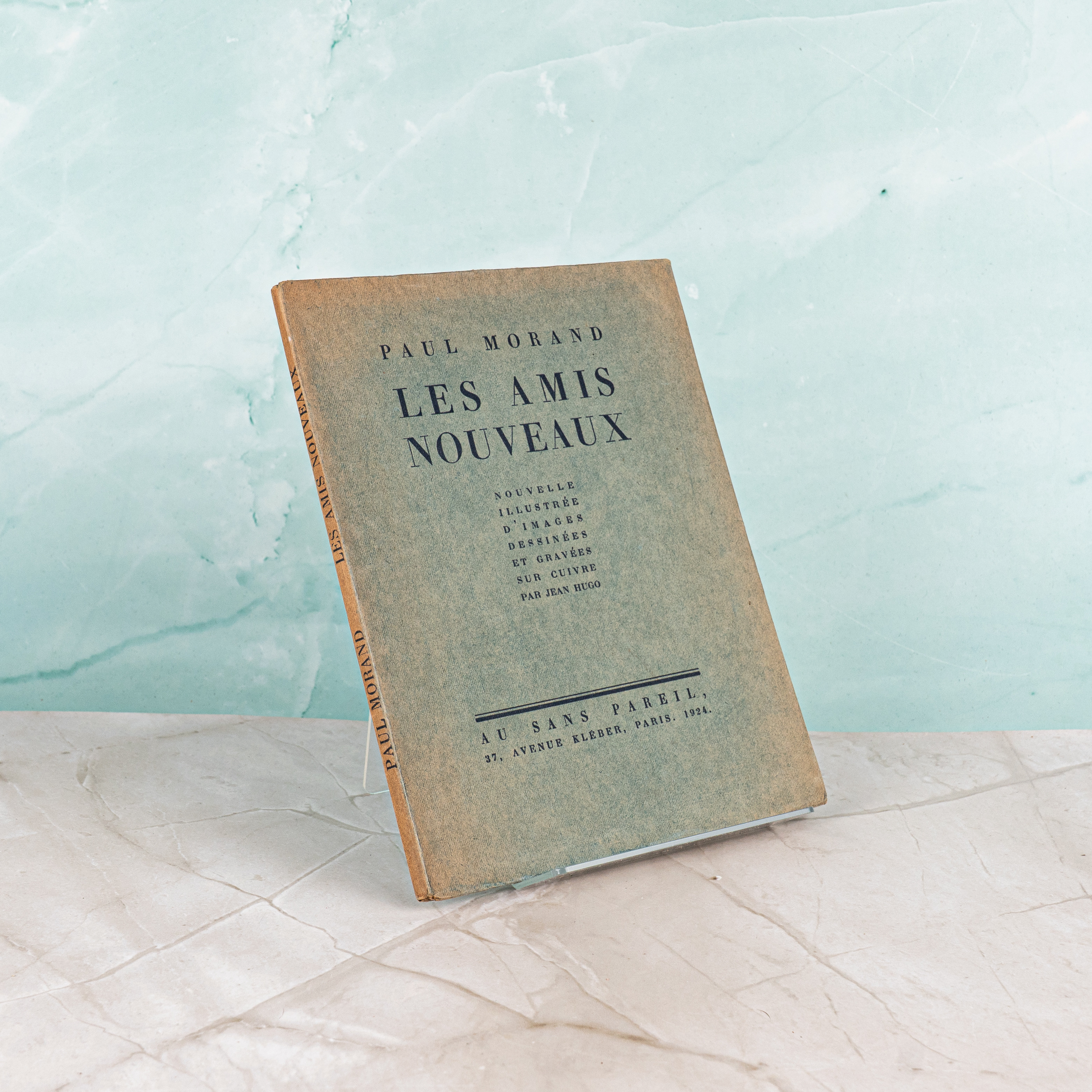
Morand, Paul · Hugo, Jean
Les Amis nouveaux
This first separate edition of *Les Amis nouveaux* combines Paul Morand’s swift, ironic prose with nine original copper drypoints by Jean Hugo. The brief novella compresses a love triangle into the tense intimacy of a single dinner. Morand’s controlled dialogue and incisive observations reveal how rivalry can unexpectedly turn into mutual understanding. Hugo accompanies the text with a refined linear vocabulary that heightens its worldly lightness and psychological ambiguity. The bistre or sanguine tones give the prints a warm, almost intimate presence on the page. As a numbered large-paper copy on vergé d’Arches, the book has considerable bibliophilic appeal.
Illustrated Book
€260

Brillat-Savarin, Jean-Anthelme · Dufy, Raoul
Aphorismes et variétés.
An elegant *livre d’artiste* pairing Brillat-Savarin’s witty gastronomic aphorisms with twenty full-page original etchings by Raoul Dufy. Dufy’s airy, musical line lends the text a radiant cadence, turning the maxims into vignettes of conviviality and taste. Limited to 200 copies on Rives wove; this is no. 19, for the subscriber Mr Bernard-Beaumaine. Untrimmed copy with original covers and spine preserved, luxuriously rebound by F. Rousseau in 2001. Clear provenance enhances its appeal. Wrapper slightly toned; box with only the faintest rubbing. A refined encounter between culinary letters and modernist design.
Illustrated Book
€1,900

Michaux, Henri · Bettencourt, Pierre
Arriver à se réveiller
A rare first edition of Arriver à se réveiller, written by Henri Michaux in the tremulous post-war years. The text unfolds as an inward journey toward lucidity, where sleep and waking mirror each other. Printed and published by Pierre Bettencourt in his own workshop, the edition’s small run preserves the work’s intimacy. The title-page vignette, a linocut by Bettencourt, sets a spare, rhythmic visual key that amplifies Michaux’s vigilant, vulnerable tone. This copy is handsomely bound in brown morocco with balsa boards by Miguet, a tactile nod to lightness under tension. For bibliophiles, it is an exemplary union of poetry, craft, and experiment. The volume embodies the independence of the post-war small press and Michaux’s radical sensitivity.
Illustrated Book
€680
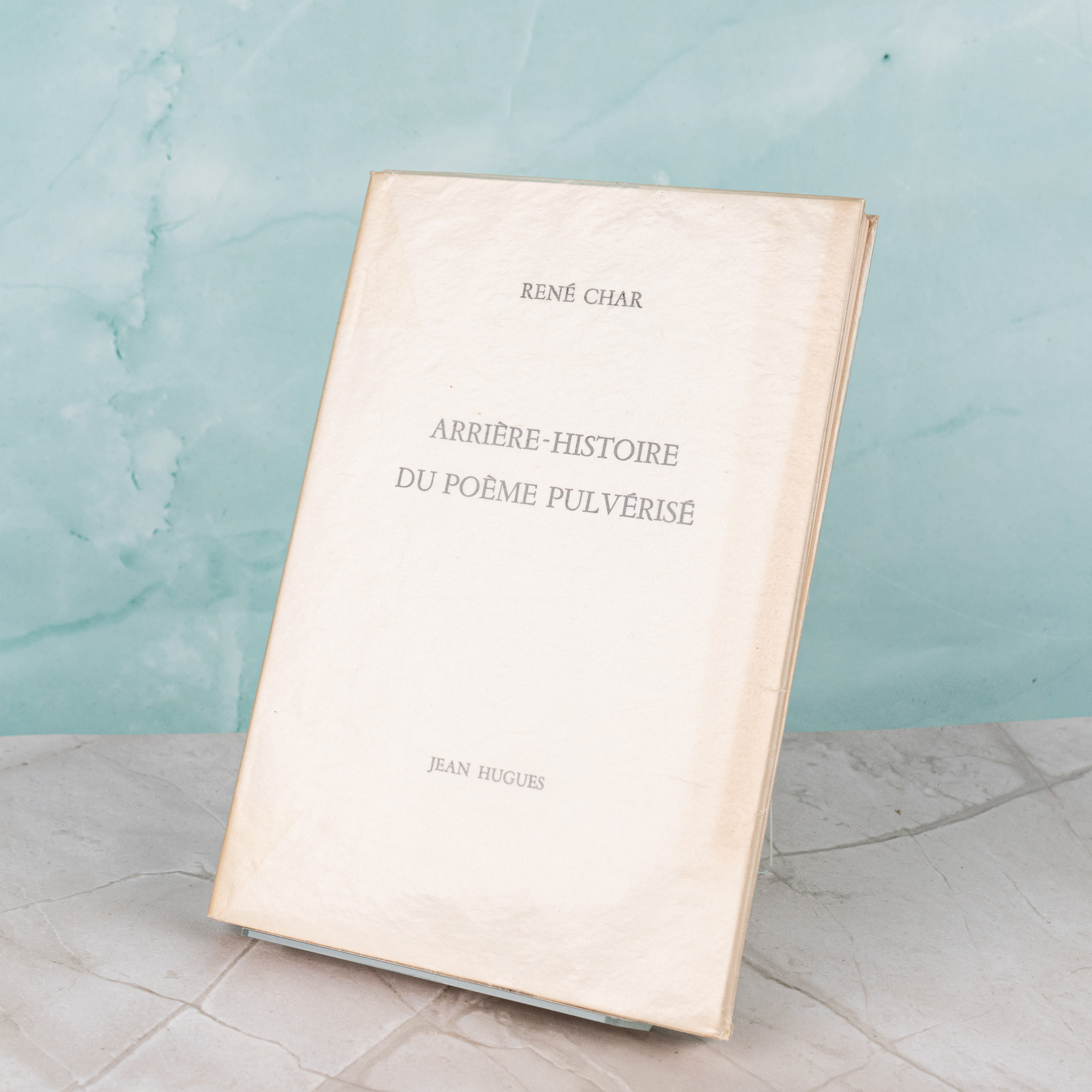
Char, Rene · Stael, Nicolas de
Arrière-histoire du poème pulvérisé
*Arrière-histoire du poème pulvérisé* is a later illustrated edition of a key text in which René Char looks back on the genesis and inner background of *Le Poème pulvérisé*. Published in 1972 by Imprimerie Union, it opens with a colour frontispiece by Nicolas de Staël. The pairing of Char and de Staël is especially charged: two post-war voices, each seeking concentration, clarity, and rupture in his own medium. This copy is one of only six hors commerce copies on Arches and is signed. The autograph presentation inscription to Doctor Marcel Zara, with poetic quotation and October 1972 dating, makes it a deeply personal copy.
Illustrated Book
€920

When a Signature Becomes Provenance
A signature confirms; a dedication connects; an association copy tells a story.

The Fragile Meaning of ‘Complet’
In auction descriptions, “complete” often sounds reassuring — but it is only meaningful when verified against the colophon, the justification, and the bibliography. For The Hidden Page, clarity begins where vague market language ends.

The Avant-Garde and the Illustrated Word
How the Twentieth Century Recast the Book as an Artistic and Ideological Medium