


Ensemble de trois volumes clandestins et publics des Éditions de Minuit (1943...
This set of three slim octavo pamphlets captures the book’s wartime double life: two clandestine Éditions de Minuit publications issued under the Occupation, followed by a “first public edition” after Liberation. It comprises *Le Musée Grévin* (Aragon, under the pseudonym François La Colère; achevé d’imprimer 6 October 1943) and *Le Temps Mort* (Claude Aveline, under Minervois; achevé d’imprimer 1 June 1944), both printed “aux dépens de quelques lettrés patriotes” and regarded as the original clandestine editions. Completing the trio is *La Marque de l’homme* (Claude Morgan, under Mortagne), published in 1946 as the “première édition publique,” in a limited run of 2,000 numbered copies—this copy being No. 1, the first off the presses. Together, the volumes trace Minuit’s passage from perilous secrecy to postwar legitimacy, while retaining the urgency of the Resistance moment. Condition is notably fine: original wrappers preserved, two covers lightly sunned, interiors immaculate.
Quantity


Aragon, Louis
Aveline, Claude
Morgan, Claude
ILLUSTRATORS
ILLUSTRATORS
ILLUSTRATORS
Ensemble de trois volumes clandestins et publics des Éditions de Minuit (1943–1946)
1943 | Paris | Edition de Minuit
Three Minuit pamphlets charting the move from clandestinity to public memory—crowned by an exceptional 1946 No. 1 copy.
This set of three slim octavo pamphlets captures the book’s wartime double life: two clandestine Éditions de Minuit publications issued under the Occupation, followed by a “first public edition” after Liberation. It comprises *Le Musée Grévin* (Aragon, under the pseudonym François La Colère; achevé d’imprimer 6 October 1943) and *Le Temps Mort* (Claude Aveline, under Minervois; achevé d’imprimer 1 June 1944), both printed “aux dépens de quelques lettrés patriotes” and regarded as the original clandestine editions. Completing the trio is *La Marque de l’homme* (Claude Morgan, under Mortagne), published in 1946 as the “première édition publique,” in a limited run of 2,000 numbered copies—this copy being No. 1, the first off the presses. Together, the volumes trace Minuit’s passage from perilous secrecy to postwar legitimacy, while retaining the urgency of the Resistance moment. Condition is notably fine: original wrappers preserved, two covers lightly sunned, interiors immaculate.
€400
Condition Report:
In-Depth Study
References & Bibliography
Format
In-8 (Octavo) approx. 20 × 26 cm
Edition Particulars
Set comprising: (1) Louis Aragon (pseud. François La Colère), *Le Musée Grévin*, achevé d’imprimer 6 Oct 1943, 28 pp. + 1 leaf; (2) Claude Aveline (pseud. Minervois), *Le Temps Mort*, achevé d’imprimer 1 Jun 1944, 74 pp. + 2 leaves; (3) Claude Morgan (pseud. Mortagne), *La Marque de l’homme*, 1946, 86 pp. + 1 leaf, limited to 2,000 numbered copies; this copy No. 1 (first off the press). Very good condition; original wrappers preserved; two covers slightly sunned; interiors immaculate.
Inscription
No inscription
1
Edition Particulars:
We welcome private inquiries, collaborations with institutions, and acquisition requests. Each message is treated with discretion and respect. We welcome private inquiries, collaborations with institutions, and acquisition requests.
1
Print Run:
Condition Report:
1
Copy Number:
Condition Report:
1
Paper:
Condition Report:
1
Signed:
Condition Report:
Product DETAIL
Aragon’s *Le Musée Grévin* is a landmark of clandestine poetry: a cutting denunciation in which the Occupation’s brutality is condensed into charged images and names. It is striking for one of the earliest literary evocations of Auschwitz, figured as a hellish place whose very name “hisses.” Aveline’s *Le Temps Mort* shifts register toward meditative tension—stasis, waiting, moral pressure—written under a pseudonym for restricted circulation. Morgan’s *La Marque de l’homme* (1946) moves into the public sphere, reflecting on what war and clandestinity inscribe in the human. Read together, the three volumes form a triptych: accusation, inner resistance, and postwar reckoning.
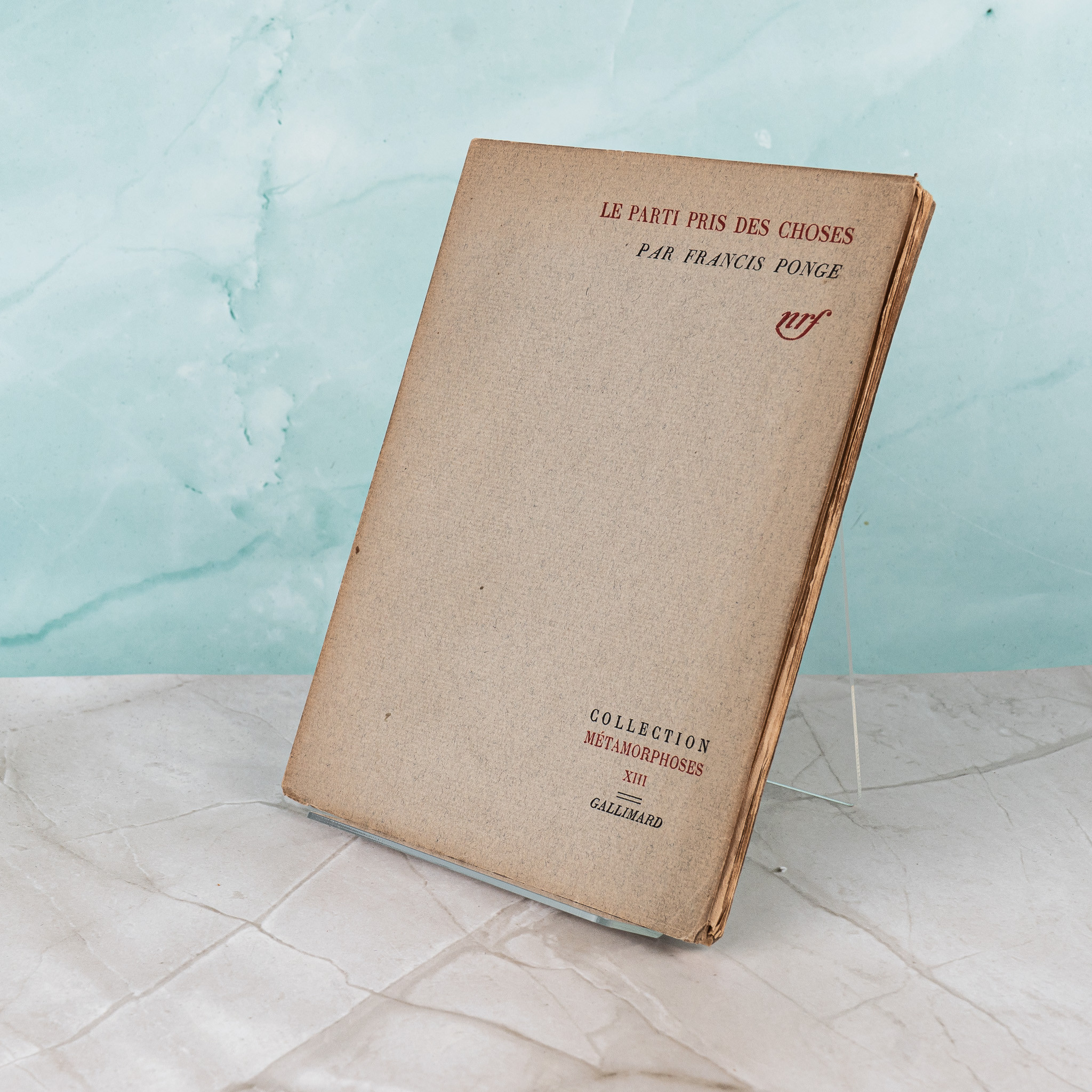
Ponge, Francis
Le Parti pris des choses
These two copies of Le Parti pris des choses form a remarkable paired witness to Francis Ponge’s visit to Zurich in March 1949. The book itself is one of the decisive prose works of French modernity: not lyrical confession, but a precise encounter with the mute dignity of things. Ponge gives ordinary objects — soap, bread, an oyster, a pebble, a cigarette — a language at once exact, ironic and sensuous. The double inscription to Frank Thiessing and to Madame Frank Thiessing gives the pair a strongly personal resonance. Frank C. Thiessing belonged to the Swiss world of graphic design, publishing and visual modernism, notably in relation to Hans Erni. These copies therefore connect Ponge’s literary materialism with the artistic and typographic networks of post-war Zurich.
Book
€1,300
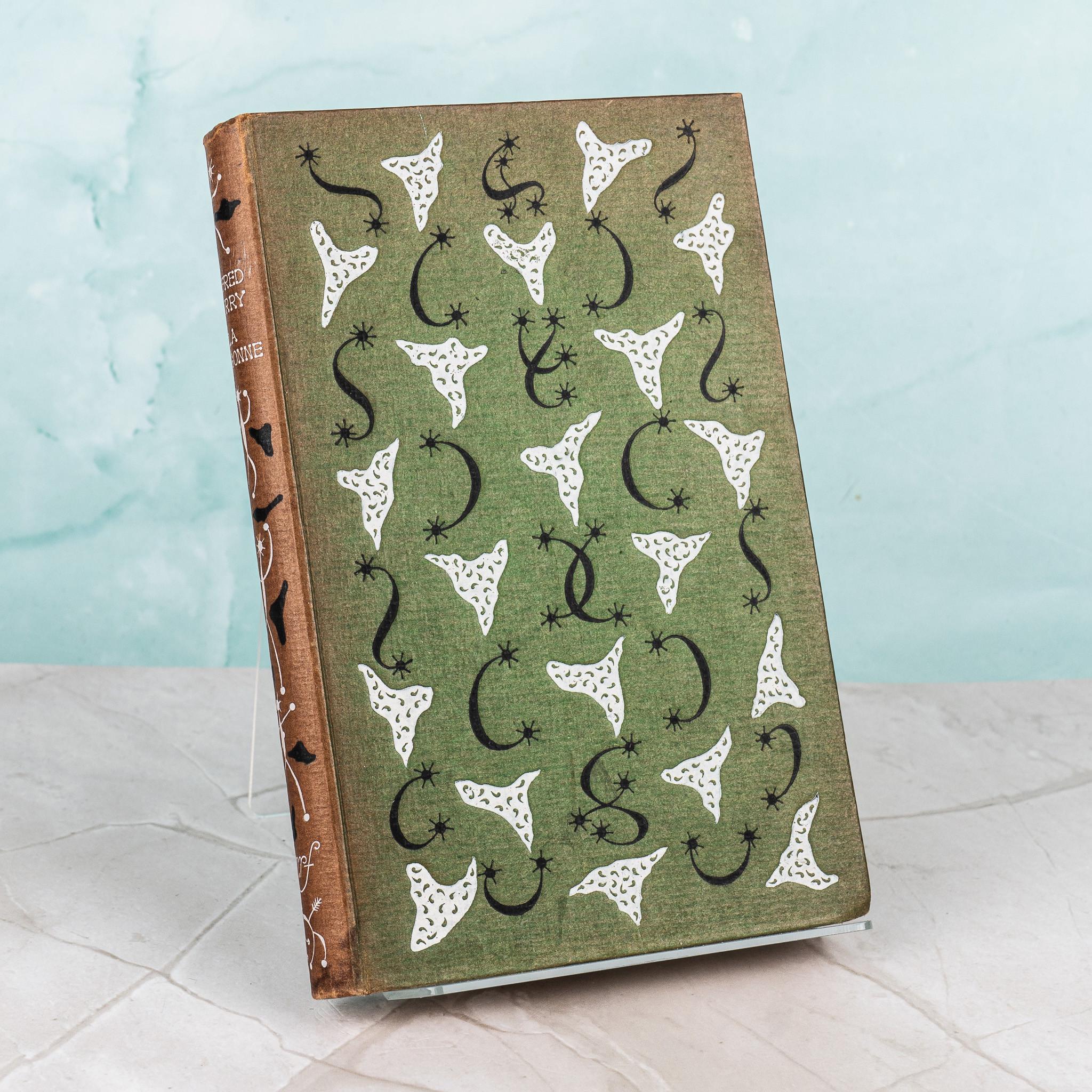
Jarry, Alfred
La Dragonne
La Dragonne is the posthumous first edition of Alfred Jarry’s final novel, published in 1943 by Gallimard/N.R.F. with a preface by Jean Saltas. The book carries the tension of a text that long remained suspended between completion and fragment before taking printed form decades after Jarry’s death. It reveals Jarry’s late imaginative world through autobiographical echoes, Breton legend and Symbolist narrative structures. This copy is further distinguished by its green publisher’s decorated boards, designed after a model by Mario Prassinos, placing it within the bibliophile culture of NRF bindings. The combination of a posthumous Jarry text, an artist-designed binding and a numbered copy on Alfa Mousse gives the volume particular appeal. It is not an illustrated artist’s book in the strict sense, but an object in which literature, publishing history and binding design meet with unusual tact.
Book
€280
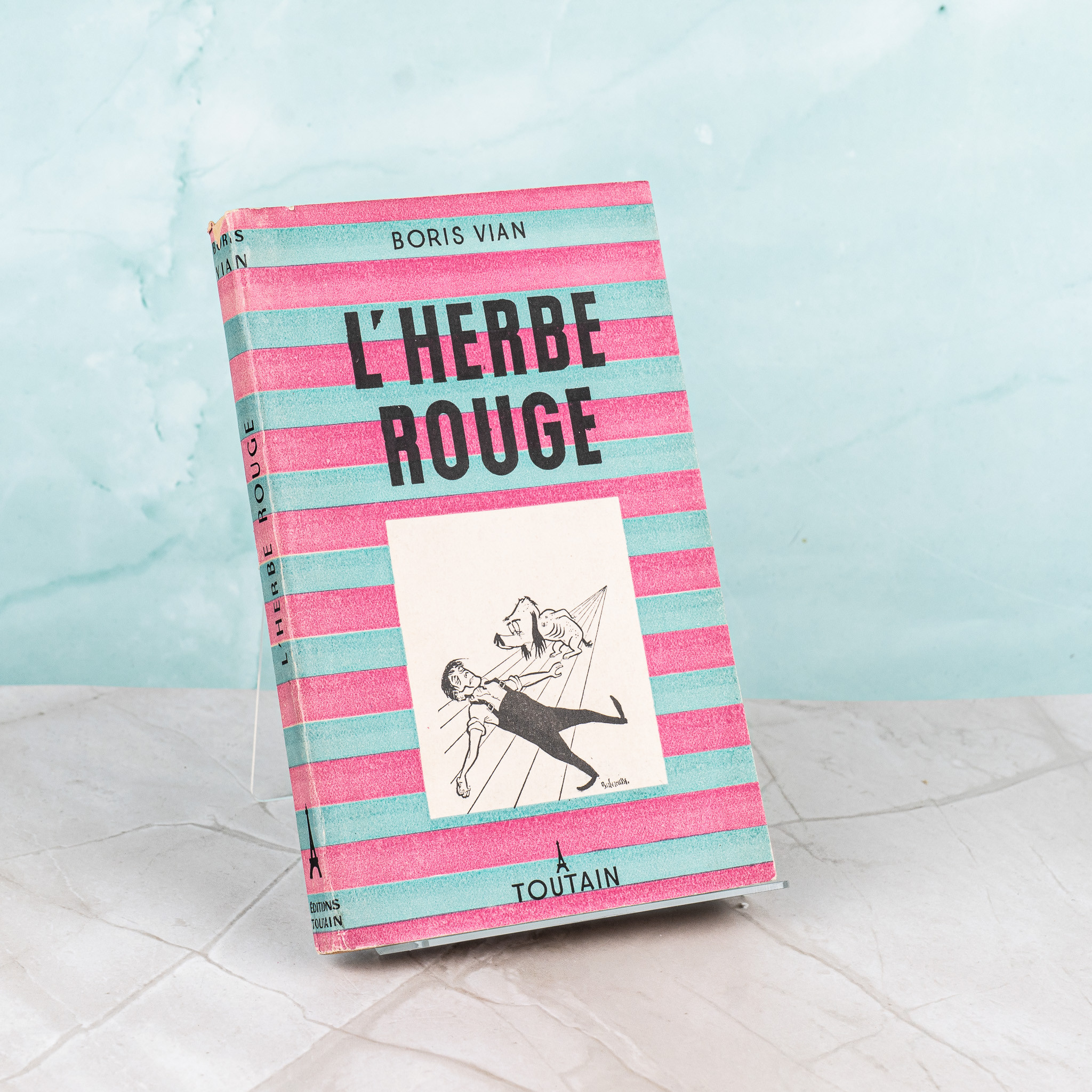
Vian, Boris
L’Herbe rouge
L’Herbe rouge is one of Boris Vian’s most singular novels, born of the nervous imagination of post-war Saint-Germain-des-Prés. The first edition appeared in 1950 with Toutain and belongs to the group of Vian publications that often met with limited success during his lifetime before acquiring cult status. The book combines science-fiction-like invention, existential anxiety, absurdist humour and emotional disarray. That mixture makes it especially relevant to The Hidden Page: it is not part of a strict historical avant-garde, but it breathes the pataphysical and experimental spirit of post-war literature. This copy is materially weak, with a reglued spine, pasted-down first leaf and lacking final blank. It nevertheless remains bibliographically and literarily meaningful as the original edition of a central Vian text.
Book
€250
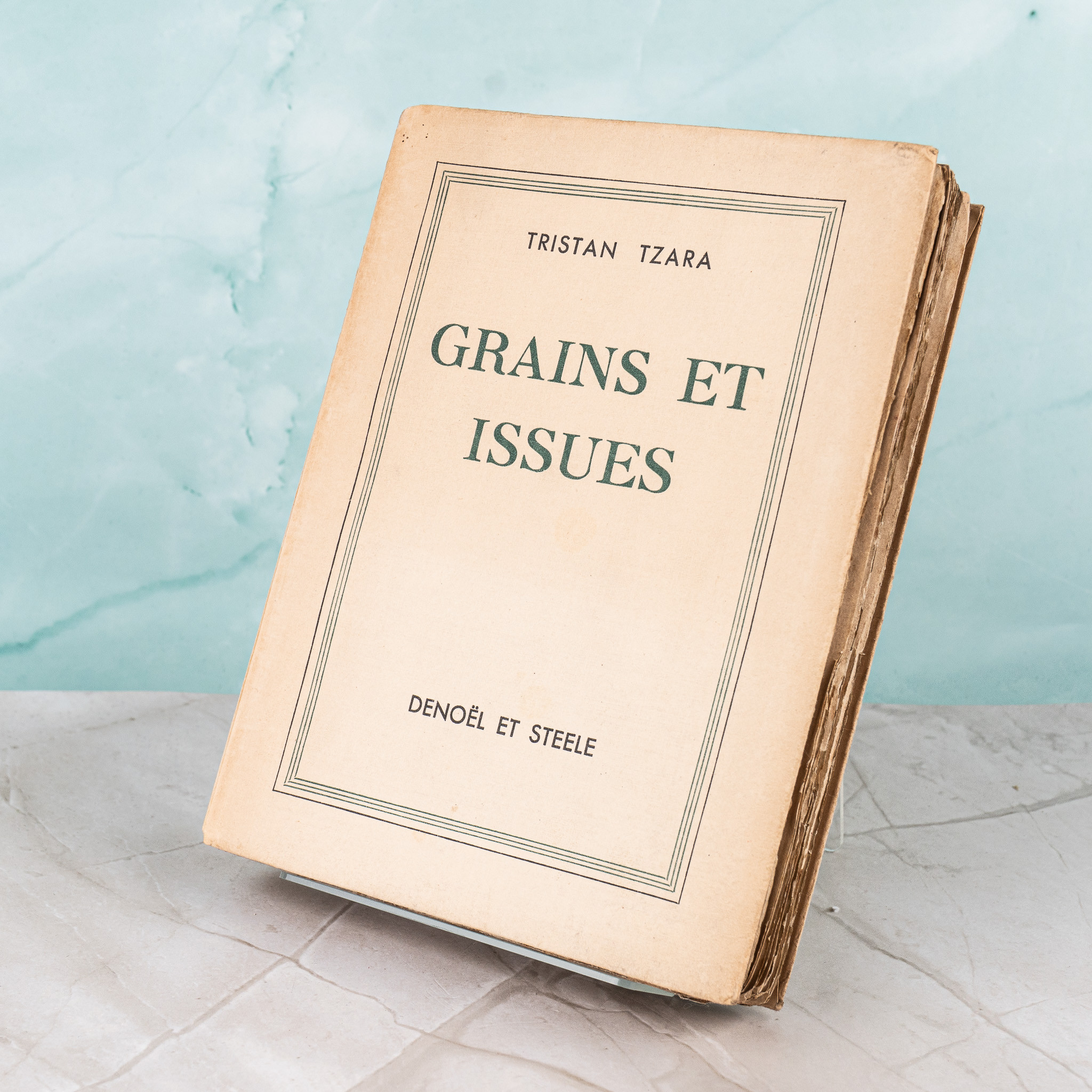
Tzara, Tristan
Grains et issues
Grains et issues is a key publication in Tristan Tzara’s passage from Dadaist disruption to Surrealist and revolutionary reflection. The book appeared in 1935 with Denoël et Steele, at a moment when poetry, politics and theory were becoming increasingly intertwined within the avant-garde. Tzara, once the voice and organizer of Dada in Zurich and Paris, no longer seeks only the explosion of meaning, but also a dialectic between dream, matter, history and liberation. This original edition is bibliophilically notable as a large-paper copy: one of the copies on vergé d’Arches, signed by the author. Its unopened state preserves the tension between the book as an instrument of reading and the book as an untouched object. For The Hidden Page, it is an exceptionally strong match: a major historical avant-garde author, a key text and a scarce signed deluxe variant.

