


Ethnologie des Maramouts
Ethnologie des Maramouts is a posthumous and highly characteristic publication by Jean Ferry within the world of the Cymbalum Pataphysicum. The work presents itself as an imaginary ethnological study of the “Maramouts”, yet beneath that quasi-scientific form lies a fully pataphysical game with classification, ethnography, drawing and fictive seriousness. Ferry’s own drawings give the dossier a direct, almost manuscript-like presence. The edition appeared on 9 Haha CIV, corresponding to 14 October 1976, as the first volume of the Collection Maramoutéenne. Its material form is striking: not an ordinary bound book, but a dossier of loose leaves printed recto only, accompanied by a separate N.B. or errata-like leaf concerning the difficulty of reproducing Ferry’s handwriting and drawings. This copy is housed in the green folder and bears the printed Ferry emblem marked “n° 2”. As one of the 44 exemplaires de chapelle, it belongs to the most intimate and desirable category of this small pataphysical ethnography.
Quantity


Ferry, Jean
Ethnologie des Maramouts
1976 | Cymbalum Pataphysicum
No. 2 of 44 exemplaires de chapelle: Ferry’s imaginary people as a loose-leaf pataphysical relic.
Ethnologie des Maramouts is a posthumous and highly characteristic publication by Jean Ferry within the world of the Cymbalum Pataphysicum. The work presents itself as an imaginary ethnological study of the “Maramouts”, yet beneath that quasi-scientific form lies a fully pataphysical game with classification, ethnography, drawing and fictive seriousness. Ferry’s own drawings give the dossier a direct, almost manuscript-like presence. The edition appeared on 9 Haha CIV, corresponding to 14 October 1976, as the first volume of the Collection Maramoutéenne. Its material form is striking: not an ordinary bound book, but a dossier of loose leaves printed recto only, accompanied by a separate N.B. or errata-like leaf concerning the difficulty of reproducing Ferry’s handwriting and drawings. This copy is housed in the green folder and bears the printed Ferry emblem marked “n° 2”. As one of the 44 exemplaires de chapelle, it belongs to the most intimate and desirable category of this small pataphysical ethnography.
€320
Condition Report:
In-Depth Study
References & Bibliography
Format
In-4 (Quarto) approx. 25 × 32 cm
Edition Particulars
One of 44 exemplaires de chapelle, in a green folder or wrapper, with printed Ferry emblem marked “n° 2”.
Print Run
44
Copy Number
No. 2
Inscription
No inscription
Product DETAIL
The work describes the imaginary “Maramouts” as though they were the subject of a serious ethnological inquiry. Ferry uses the language of observation, description and classification to make a fictive people or phenomenon both credible and absurd. The loose leaves combine text and drawings, giving the reader the impression of consulting field notes, a dossier or a scientific appendix. There is no conventional plot; the core consists of pseudo-documentary fragments that bring the Maramouts into being as an object of study. The separate N.B. leaf about reproduction difficulties heightens the impression of authenticity, as if one were close to Ferry’s original manuscript material. The humour arises from the collision between academic form and wholly invented content. Ethnology is thus transformed into pataphysical science fiction.
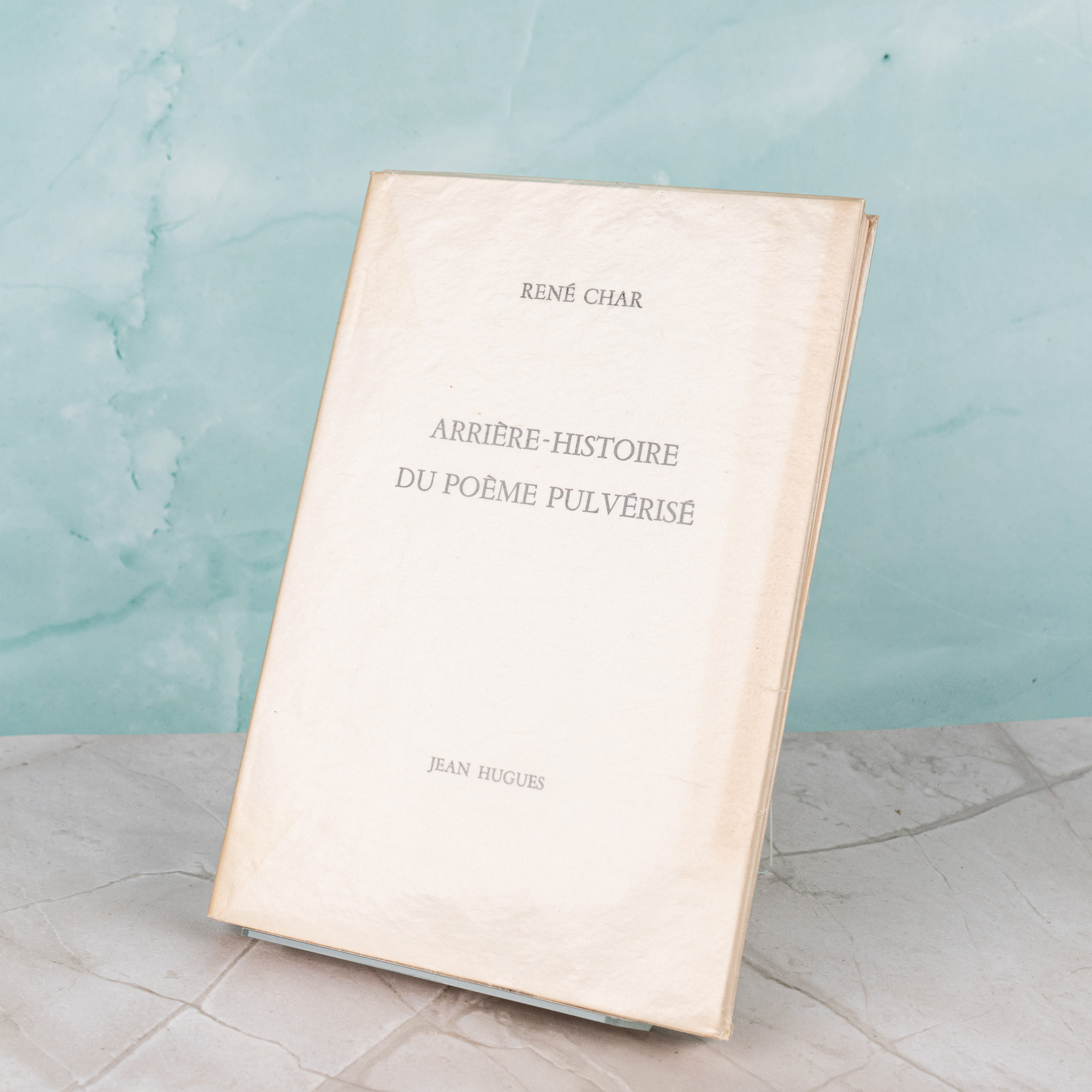
Char, Rene · Stael, Nicolas de
Arrière-histoire du poème pulvérisé
*Arrière-histoire du poème pulvérisé* is a later illustrated edition of a key text in which René Char looks back on the genesis and inner background of *Le Poème pulvérisé*. Published in 1972 by Imprimerie Union, it opens with a colour frontispiece by Nicolas de Staël. The pairing of Char and de Staël is especially charged: two post-war voices, each seeking concentration, clarity, and rupture in his own medium. This copy is one of only six hors commerce copies on Arches and is signed. The autograph presentation inscription to Doctor Marcel Zara, with poetic quotation and October 1972 dating, makes it a deeply personal copy.
Illustrated Book
€920
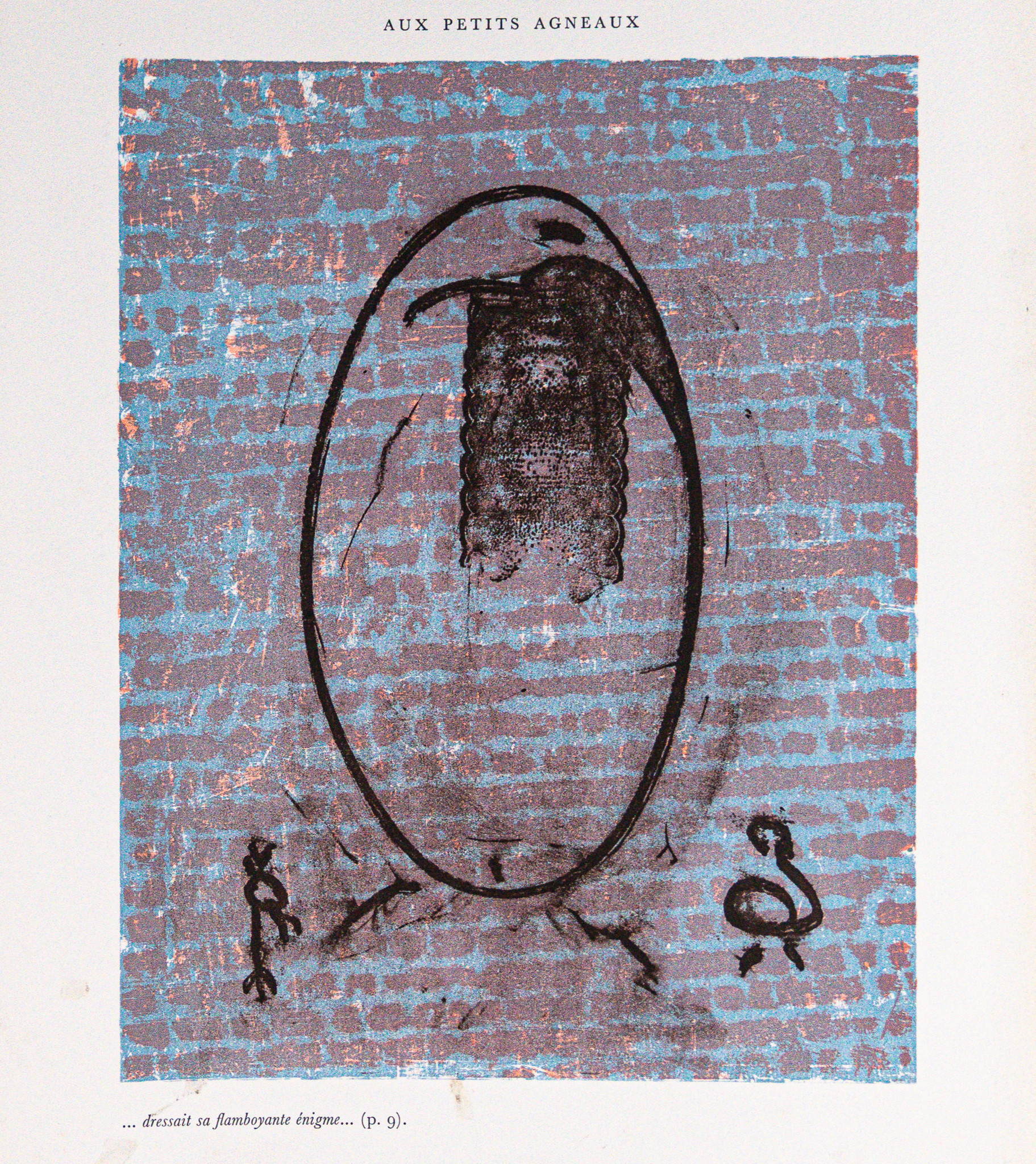
Waldberg, Patrick · Ernst, Max
Aux Petits Agneaux
A artist’s book resulting from the collaboration between writer Patrick Waldberg and surrealist master Max Ernst. This first edition includes 19 original lithographs printed on luxurious vélin d'Arches. Published in Paris in 1971 in a limited edition of 174 copies signed by both author and artist, and presented in a custom publisher’s box.
Illustrated Book
€2,200

Bédouin, Jean-Louis · Hallart, Guy
L'arbre descend du singe
L'Arbre descend du singe is a beautifully illustrated edition that highlights the collaboration between the poet Jean-Louis Bedouin and the artist Guy Hallart. The work, published in a limited edition, is characterized by a rich dialogue between poetry and image, where the visual compositions reflect the dreamy and often cryptic nature of Bedouin's texts. The book is a tangible testament to the artistic symbiosis between the two creators and offers a unique insight into a creative dialogue from the mid-1970s.
Illustrated Book
€700

Michaux, Henri · Bettencourt, Pierre
Arriver à se réveiller
A rare first edition of Arriver à se réveiller, written by Henri Michaux in the tremulous post-war years. The text unfolds as an inward journey toward lucidity, where sleep and waking mirror each other. Printed and published by Pierre Bettencourt in his own workshop, the edition’s small run preserves the work’s intimacy. The title-page vignette, a linocut by Bettencourt, sets a spare, rhythmic visual key that amplifies Michaux’s vigilant, vulnerable tone. This copy is handsomely bound in brown morocco with balsa boards by Miguet, a tactile nod to lightness under tension. For bibliophiles, it is an exemplary union of poetry, craft, and experiment. The volume embodies the independence of the post-war small press and Michaux’s radical sensitivity.
Illustrated Book
€680

The Architecture of Absurdity: Alfred Jarry, Pataphysics and the Destructive Aesthetics of the Ubu Cycle
From schoolyard prank to cultural revolution: how Alfred Jarry created Père Ubu and the science of pataphysics, permanently transforming modern theater, literature, and philosophy.