


Fatras. Avec cinquante-sept images composées par l’auteur
Fatras belongs to Jacques Prévert’s late, free-form books, where poem, note, wordplay and visual montage constantly intersect. The title already announces a deliberate disorder: a heap of fragments, finds, voices and visual inventions that together form a recognisably Prévertian world. Its particular interest lies in the 57 black-and-white images composed by Prévert himself, so that the poet also appears here as an image-maker. These collages are not mere additions to the text, but part of the same method of collision, surprise and poetic disruption. The book was published in 1966 by Gallimard/NRF in the Le Point du Jour series. This copy also has the character of a service de presse copy and bears Prévert’s inscription to Monsieur Perset. It therefore gains, beyond its place in Prévert’s printed oeuvre, an immediate personal presence.
Quantity


Prévert, Jacques
Fatras. Avec cinquante-sept images composées par l’auteur
1966 | Paris | Gallimard (NRF)
Fatras is a key book for understanding Prévert not only as a poet of popular lines, but also as a maker of images and montages. This copy adds a personal trace to the first edition through its service de presse character and inscription. The result is a lively and tangible Prévert object from his late creative period.
Fatras belongs to Jacques Prévert’s late, free-form books, where poem, note, wordplay and visual montage constantly intersect. The title already announces a deliberate disorder: a heap of fragments, finds, voices and visual inventions that together form a recognisably Prévertian world. Its particular interest lies in the 57 black-and-white images composed by Prévert himself, so that the poet also appears here as an image-maker. These collages are not mere additions to the text, but part of the same method of collision, surprise and poetic disruption. The book was published in 1966 by Gallimard/NRF in the Le Point du Jour series. This copy also has the character of a service de presse copy and bears Prévert’s inscription to Monsieur Perset. It therefore gains, beyond its place in Prévert’s printed oeuvre, an immediate personal presence.
€380
Condition Report:
In-Depth Study
References & Bibliography
Format
In-12 (Duodecimo) approx. 17 × 22 cm
Edition Particulars
One of 3,100 numbered copies; the colophon records 100 hors-commerce copies numbered 3001–3100. This copy is a service de presse copy with inscription: “Pour Monsieur Perset / Jacques Prévert”.
Print Run
3100
Inscription
Envoi
Product DETAIL
Fatras is not a continuous story, but a broad gathering of poems, short texts, sayings, scenes, wordplay and visual montages. Prévert brings together everyday observation, memory, social criticism, love, childlike wonder and black humour. The reader moves from brief verbal discoveries to longer poetic passages, from playful aphorisms to images carrying sharper political or existential charge. The collages interrupt and intensify this movement: they juxtapose disparate elements just as the language itself creates unexpected connections. The structure is deliberately fragmentary and follows no classical narrative, but a rhythm of association and contrast. The book presents Prévert as a poet of the street, the theatre, chance and the clash between tenderness and refusal.
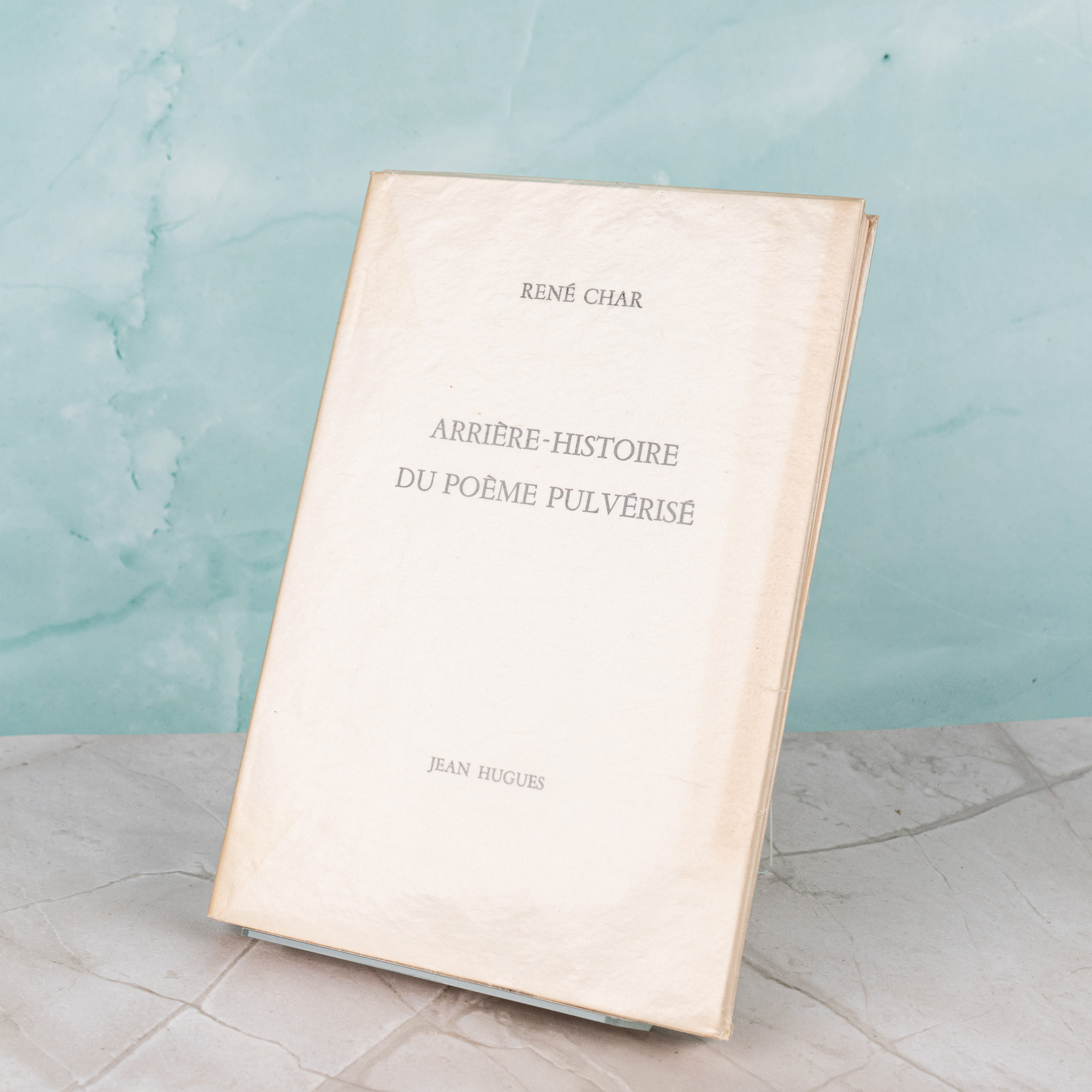
Char, Rene · Stael, Nicolas de
Arrière-histoire du poème pulvérisé
*Arrière-histoire du poème pulvérisé* is a later illustrated edition of a key text in which René Char looks back on the genesis and inner background of *Le Poème pulvérisé*. Published in 1972 by Imprimerie Union, it opens with a colour frontispiece by Nicolas de Staël. The pairing of Char and de Staël is especially charged: two post-war voices, each seeking concentration, clarity, and rupture in his own medium. This copy is one of only six hors commerce copies on Arches and is signed. The autograph presentation inscription to Doctor Marcel Zara, with poetic quotation and October 1972 dating, makes it a deeply personal copy.
Illustrated Book
€920
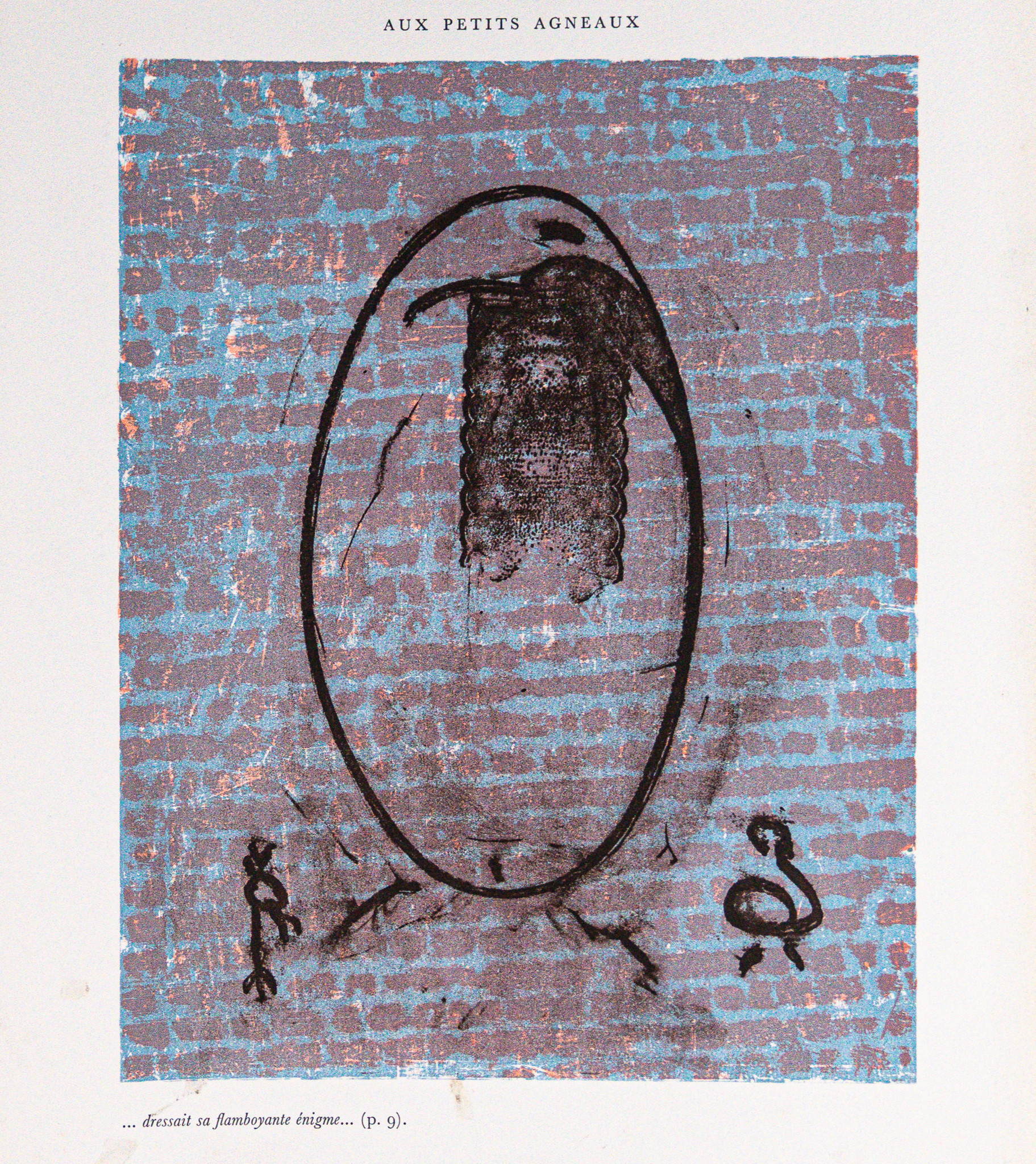
Waldberg, Patrick · Ernst, Max
Aux Petits Agneaux
A artist’s book resulting from the collaboration between writer Patrick Waldberg and surrealist master Max Ernst. This first edition includes 19 original lithographs printed on luxurious vélin d'Arches. Published in Paris in 1971 in a limited edition of 174 copies signed by both author and artist, and presented in a custom publisher’s box.
Illustrated Book
€2,200

Derain, André
Amis & Amille. Mystère du XIVe siècle.
This sumptuously bound book brings a medieval mystery to life through a rare collaboration between ancient literature and modern illustration. The geometric box design on garnet morocco provides striking contrast. André Derain’s 22 color lithographs – including one double and three full-page – enhance the narrative with expressive visual force. Printed on Rives vellum in an edition of 180 numbered copies, this copy (No. 72) was made for Baroness Vaxelaire and includes a suite on fine Japanese paper. The binding by Lucie Weill exemplifies artisanal excellence. A harmonious blend of narrative tradition and graphic daring.
Illustrated Book
€1,460

Bédouin, Jean-Louis · Hallart, Guy
L'arbre descend du singe
L'Arbre descend du singe is a beautifully illustrated edition that highlights the collaboration between the poet Jean-Louis Bedouin and the artist Guy Hallart. The work, published in a limited edition, is characterized by a rich dialogue between poetry and image, where the visual compositions reflect the dreamy and often cryptic nature of Bedouin's texts. The book is a tangible testament to the artistic symbiosis between the two creators and offers a unique insight into a creative dialogue from the mid-1970s.
Illustrated Book
€700

When a Signature Becomes Provenance
A signature confirms; a dedication connects; an association copy tells a story.

The Fragile Meaning of ‘Complet’
In auction descriptions, “complete” often sounds reassuring — but it is only meaningful when verified against the colophon, the justification, and the bibliography. For The Hidden Page, clarity begins where vague market language ends.

The Avant-Garde and the Illustrated Word
How the Twentieth Century Recast the Book as an Artistic and Ideological Medium