


Héliogabale ou l’Anarchiste couronné
With Héliogabale ou l’Anarchiste couronné, Antonin Artaud wrote one of his most feverish and idiosyncratic historical books. The young Roman emperor Heliogabalus is not treated as the subject of calm biography, but as a focal point for power, ritual, sexuality, religion and decomposition. The book appeared in 1934 from Denoël & Steele, with six wood-engraved vignettes by André Derain. These modest illustrative interventions give the volume a tension that is both archaic and modern. Artaud approaches antiquity as a mirror for anarchy and sacred reversal, not as antiquarian reconstruction. The work remains an exceptional meeting point of literature, historical imagination and avant-garde obsession.
Quantity


Artaud, Antonin
Derain, André
Héliogabale ou l’Anarchiste couronné
1934 | Paris | Denoël
This edition brings together Artaud’s visionary historical imagination and Derain’s austere woodcut aesthetic.
With Héliogabale ou l’Anarchiste couronné, Antonin Artaud wrote one of his most feverish and idiosyncratic historical books. The young Roman emperor Heliogabalus is not treated as the subject of calm biography, but as a focal point for power, ritual, sexuality, religion and decomposition. The book appeared in 1934 from Denoël & Steele, with six wood-engraved vignettes by André Derain. These modest illustrative interventions give the volume a tension that is both archaic and modern. Artaud approaches antiquity as a mirror for anarchy and sacred reversal, not as antiquarian reconstruction. The work remains an exceptional meeting point of literature, historical imagination and avant-garde obsession.
€400
Condition Report:
In-Depth Study
References & Bibliography
Format
In-8 (Octavo) approx. 20 × 26 cm
Edition Particulars
Ordinary issue on papier courant, illustrated with six vignettes by André Derain.
Paper
papier courant
Inscription
No inscription
Product DETAIL
Héliogabale ou l’Anarchiste couronné deals with the life and legend of the Roman emperor Heliogabalus, who came to power at a very young age in the third century. Artaud follows his Syrian origins, his cult of the sun god Elagabal, his arrival in Rome and his collision with the political and religious order of the Empire. The book describes how the emperor fuses ritual, priestly power, sexual provocation and imperial authority. These events provoke growing hostility from the army, the Senate and the court, ending in Heliogabalus’s violent fall. Artaud uses the historical material to present a ruler who is at once priest, rebel, actor and sacrificial victim. By the end, Heliogabalus appears above all as a figure of sacred anarchy and destructive consistency.

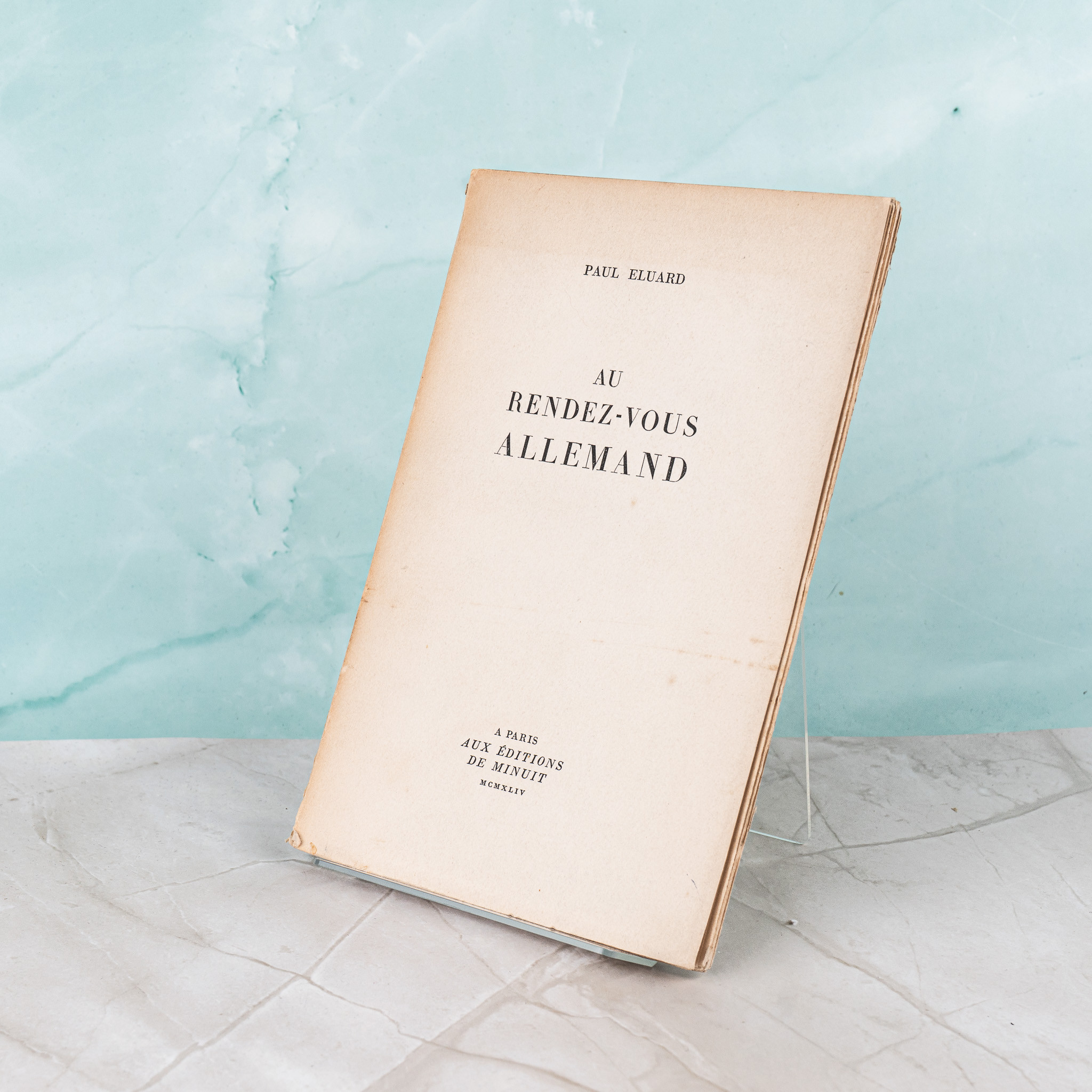
Éluard, Paul
Au rendez-vous allemand
Au rendez-vous allemand is one of the emblematic collections of Éluard’s wartime poetry. The book appeared in 1944 from Les Éditions de Minuit, the publishing house that, under the Occupation, became a moral landmark of the French literary Resistance. The volume gathers poems in which love, mourning, revolt and hope appear not as abstractions but as immediate necessities under German rule. The frontispiece, a portrait of the poet after Picasso, gives the book a powerful artistic signature: two voices of modern France, poet and artist, stand here in the same struggle. This is an ordinary, unnumbered copy, but signed by Éluard on the first page. That signature makes the book more than a Resistance document: it becomes a tangible witness to literary presence in a historically charged year. For the collector, it unites the clandestine aura of Minuit, Picasso’s name and Éluard’s own hand.
Illustrated Book
€350
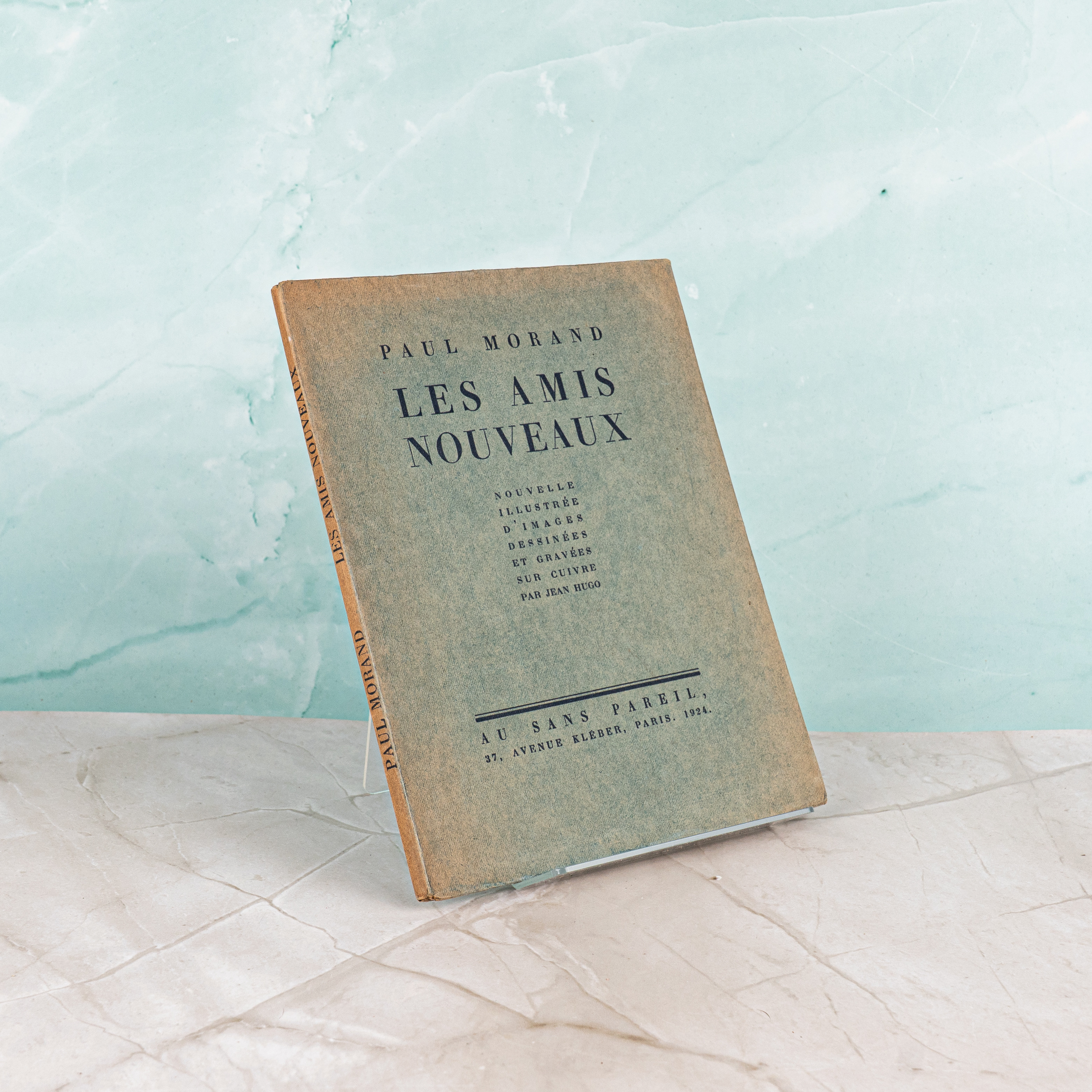
Morand, Paul · Hugo, Jean
Les Amis nouveaux
This first separate edition of *Les Amis nouveaux* combines Paul Morand’s swift, ironic prose with nine original copper drypoints by Jean Hugo. The brief novella compresses a love triangle into the tense intimacy of a single dinner. Morand’s controlled dialogue and incisive observations reveal how rivalry can unexpectedly turn into mutual understanding. Hugo accompanies the text with a refined linear vocabulary that heightens its worldly lightness and psychological ambiguity. The bistre or sanguine tones give the prints a warm, almost intimate presence on the page. As a numbered large-paper copy on vergé d’Arches, the book has considerable bibliophilic appeal.
Illustrated Book
€260

Brillat-Savarin, Jean-Anthelme · Dufy, Raoul
Aphorismes et variétés.
An elegant *livre d’artiste* pairing Brillat-Savarin’s witty gastronomic aphorisms with twenty full-page original etchings by Raoul Dufy. Dufy’s airy, musical line lends the text a radiant cadence, turning the maxims into vignettes of conviviality and taste. Limited to 200 copies on Rives wove; this is no. 19, for the subscriber Mr Bernard-Beaumaine. Untrimmed copy with original covers and spine preserved, luxuriously rebound by F. Rousseau in 2001. Clear provenance enhances its appeal. Wrapper slightly toned; box with only the faintest rubbing. A refined encounter between culinary letters and modernist design.
Illustrated Book
€1,900

When a Signature Becomes Provenance
A signature confirms; a dedication connects; an association copy tells a story.

The Fragile Meaning of ‘Complet’
In auction descriptions, “complete” often sounds reassuring — but it is only meaningful when verified against the colophon, the justification, and the bibliography. For The Hidden Page, clarity begins where vague market language ends.

The Avant-Garde and the Illustrated Word
How the Twentieth Century Recast the Book as an Artistic and Ideological Medium