


L'Éternelle Revue, n° 1 et 2
L'Éternelle Revue stands as a monument of intellectual resistance during the Occupation of France. Compiled by Paul Éluard and published in the summer of 1944, these issues served as a moral beacon for the underground literary world. Printed clandestinely, they were originally intended to be dropped by parachute over occupied territory. The project bears witness to the indestructible power of the free spirit against oppression. For the bibliophile, these fascicles represent the ultimate symbiosis between poetry and political engagement. This specific lot contains the exceedingly rare first two issues in their original state. The fragile nature of the paper underscores the precarious conditions under which this work was produced.
Quantity


Éluard, Paul
ILLUSTRATORS
ILLUSTRATORS
ILLUSTRATORS
L'Éternelle Revue, n° 1 et 2
1944 | Parijs | s.e. (sans éditeur)
This lot constitutes a tangible testimony to literary resistance in France. The combination of rarity and historical depth makes it an essential component of any collection on the Second World War. It is a tribute to the unyielding human spirit.
L'Éternelle Revue stands as a monument of intellectual resistance during the Occupation of France. Compiled by Paul Éluard and published in the summer of 1944, these issues served as a moral beacon for the underground literary world. Printed clandestinely, they were originally intended to be dropped by parachute over occupied territory. The project bears witness to the indestructible power of the free spirit against oppression. For the bibliophile, these fascicles represent the ultimate symbiosis between poetry and political engagement. This specific lot contains the exceedingly rare first two issues in their original state. The fragile nature of the paper underscores the precarious conditions under which this work was produced.
€600
Condition Report:
In-Depth Study
References & Bibliography
Format
In-16 (approx. 16,6 x 13,5 cm)
Edition Particulars
Both issues present; number 2 is uncut.
Paper
papier de guerre /war Paper
Inscription
No inscription
1
Edition Particulars:
We welcome private inquiries, collaborations with institutions, and acquisition requests. Each message is treated with discretion and respect. We welcome private inquiries, collaborations with institutions, and acquisition requests.
1
Print Run:
Condition Report:
1
Copy Number:
Condition Report:
1
Paper:
Condition Report:
1
Signed:
Condition Report:
Product DETAIL
The content of L'Éternelle Revue is imbued with the urgency of Liberation and the defense of human dignity. Paul Éluard gathered texts that voiced the spirit of Free France while the conflict was still ongoing. Themes oscillate between hope, resistance, and the necessity of intellectual solidarity. The second issue, published in July 1944, anticipates imminent freedom with a lyrical yet determined tone. These texts are not merely literary; they function as moral manifestos. It is a rare period document marking the transition from oppression to liberation. The somber typography reflects the gravity of the message. In these issues, one finds the very essence of French Resistance literature.

Collective
Toutes ces dames au salon !
This sharp postwar intervention belongs to the primary printed matter of the Internationale Lettriste, on the threshold of the Debord milieu and the genealogy of Situationism. *Toutes ces dames au salon !* responds to the Brussels exhibition “L’Industrie du pétrole vue par des artistes” (2–14 June 1956), targeting the moral veneer of the salon system sustained by corporate patronage. The sheet operates as direct action: a text that does not merely speak about art but intervenes in the social field. The convergence of Paris (Internationale Lettriste), Brussels (Les Lèvres Nues) and Milan (Movimento Arte Nucleare) turns it into a rare node of transnational neo-avant-garde exchange. This set is especially desirable because it brings together two material variants: the well-known large two-column placard and the narrow one-column version that also circulates on its own. Ephemera of this kind was made to vanish, and its survival—here in duplicate form—is exactly what gives it bibliophilic force.
Pamflet
€750
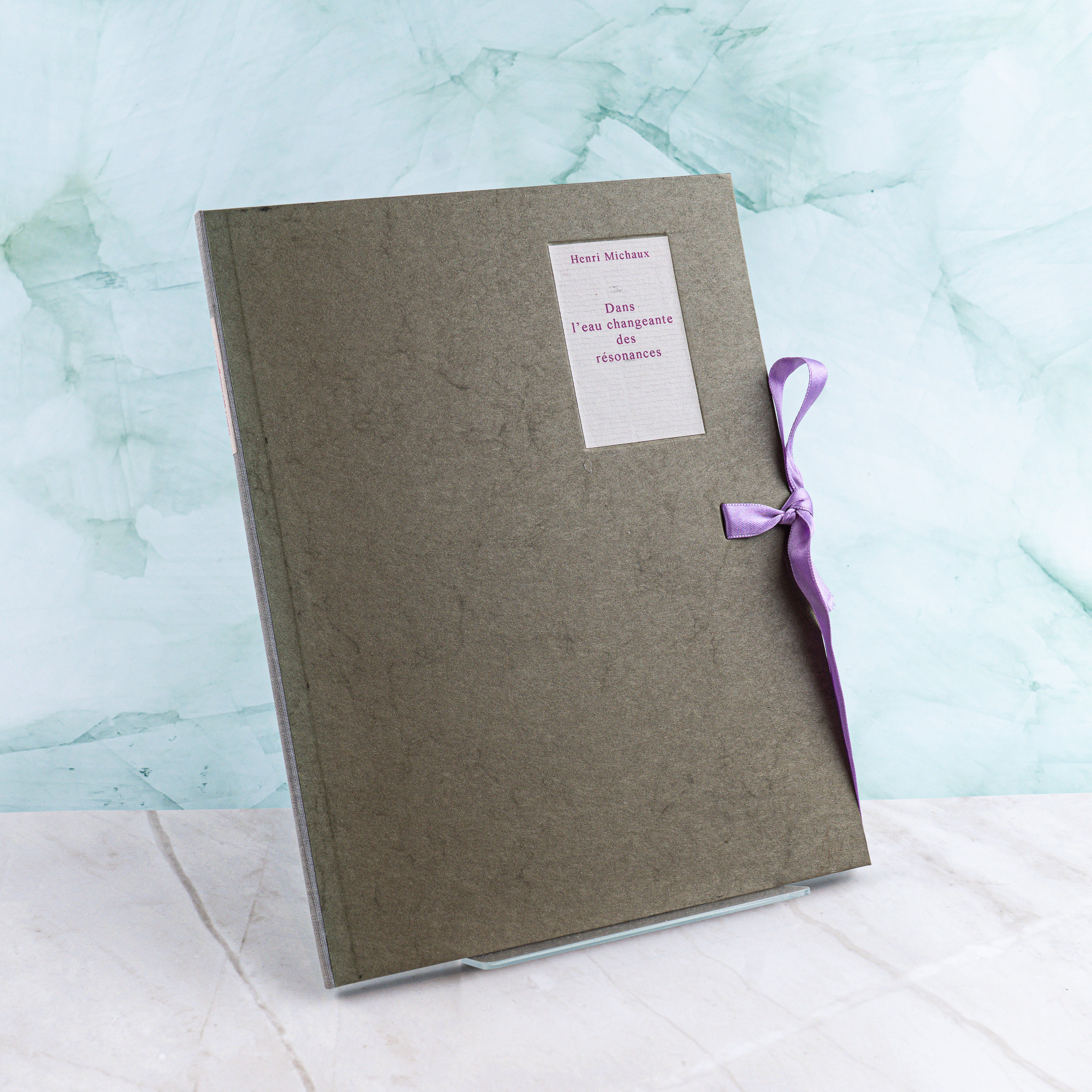
Michaux, Henri
Dans l’eau changeante des résonances
Scarce édition originale as an offprint from Les Cahiers du Chemin no. 22 (1974), produced in small numbers. A meditative piece on listening, vibration, and the resonant body. This copy carries a signed author’s inscription and several textual corrections, very likely in Michaux’s hand (not formally confirmed). The stripped, pamphlet-like presentation suits the taut clarity of the essay. The later Gillot chemise–slipcase reflects careful collection stewardship.
Pamflet
€540
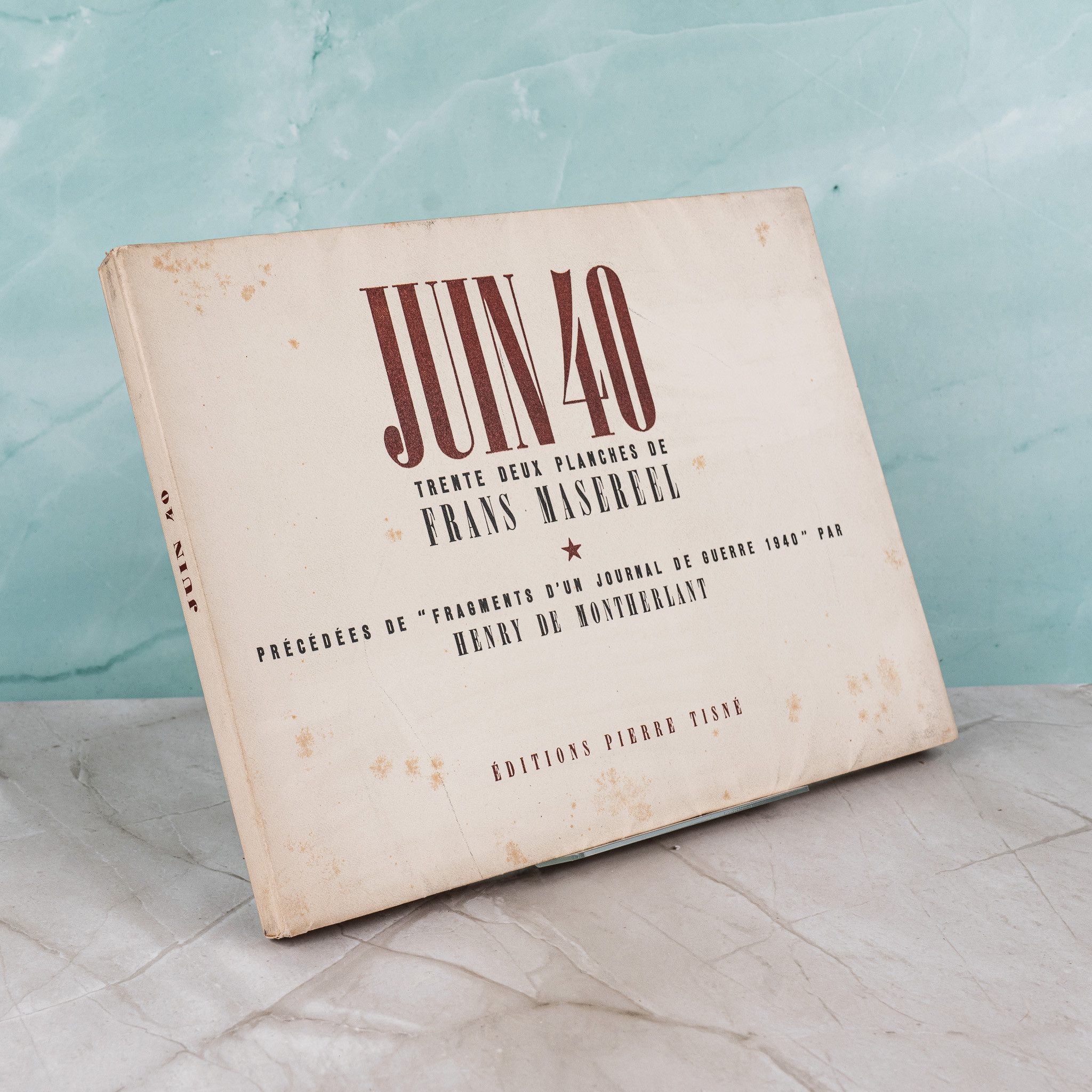
Montherlant, Henry de · Masereel, Frans
Juin 40
Juin 40 is a powerful illustrated war book in which Frans Masereel gives visual form, through 32 plates, to the French defeat and disarray of June 1940. The plates are preceded by Henry de Montherlant’s Fragments d’un journal de guerre 1940, so that text and image together create a double testimony: literary, historical and moral. Masereel, renowned for his woodcuts and wordless novels, here brings his expressive black-and-white drama to bear on an immediate historical trauma. The oblong format gives the plates a horizontal, almost cinematic space in which flight, soldiers, civilians and destruction can unfold. The book appeared in Paris with Pierre Tisné in 1942, in the midst of the war, giving it a special tension between memory, censorship, mourning and visual urgency. This copy, n°16, belongs to the first 350 copies on vélin Lana Bélier within a total edition of 1,550. It is an early and materially attractive copy of a book in which Masereel’s humanist graphic art retains its historical edge.
Ill Book
€420
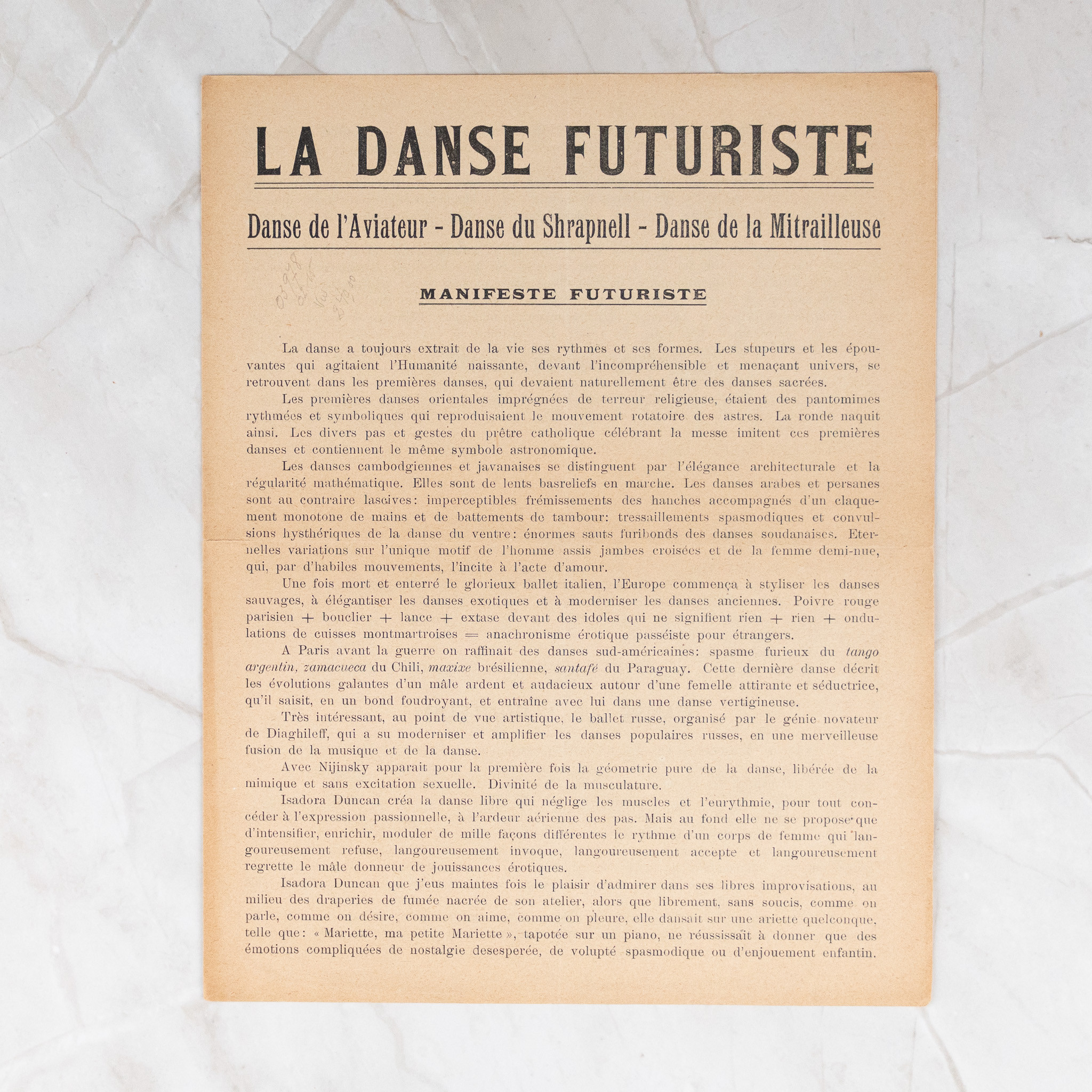
Marinetti, Filippo Tommaso
La Danse Futuriste. Danse de l’aviateur – Danse du shrapnell – Danse de la mitrailleuse. Manifeste futuriste
La Danse Futuriste is one of the key texts of Italian Futurism in its most direct, militant, and performative form. It is a separately issued French manifesto by Filippo Tommaso Marinetti, founder and tireless propagandist of the movement. Rather than a deluxe book, it is a tract, designed for the rapid circulation of ideas and for immediate impact. That modest physical form is precisely what makes it so faithful to Futurist practice, in which print was used as an instrument of artistic intervention. The text transfers the Futurist glorification of speed, violence, and mechanism into the realm of dance, doing so with the aggressive clarity that is so characteristic of Marinetti. As a separate French issue, the pamphlet is bibliographically intriguing, since specialists have catalogued it both as 1917 and as circa 1920. That uncertainty only adds to its interest rather than diminishing its importance. For collectors, this is above all a primary avant-garde document: scarce, fragile, and historically charged.
