


L’Étoile au front. Pièce en trois actes.
This first edition of L’Étoile au front is one of Raymond Roussel’s most characteristic theatrical books. Published after its turbulent première at the Théâtre du Vaudeville, the prose drama in three acts baffled and divided its audience. Rather than following a conventional plot, the play unfolds through explanations, embedded tales and the histories of curious objects, displaying the methodical marvels that made Roussel a cult figure. This copy is one of the rare luxury copies printed on Japon paper, the sole deluxe issue of the edition. Especially significant is the 16-page booklet La Critique et Raymond Roussel, bound at the beginning and gathering names such as Cocteau, Gide, Proust, Soupault, Éluard, Breton, Desnos, Aragon, Leiris and Tzara. The book is therefore both a dramatic text and a compact dossier on Roussel’s early reception. Uncut and with wide margins, it retains the quiet authority of an untouched bibliophile copy.
Quantity


Roussel, Raymond
L’Étoile au front. Pièce en trois actes.
1925 | Paris | Alphonse Lemerre
A rare Japon-paper copy preserving both Roussel’s theatrical disturbance and its first critical echoes.
This first edition of L’Étoile au front is one of Raymond Roussel’s most characteristic theatrical books. Published after its turbulent première at the Théâtre du Vaudeville, the prose drama in three acts baffled and divided its audience. Rather than following a conventional plot, the play unfolds through explanations, embedded tales and the histories of curious objects, displaying the methodical marvels that made Roussel a cult figure. This copy is one of the rare luxury copies printed on Japon paper, the sole deluxe issue of the edition. Especially significant is the 16-page booklet La Critique et Raymond Roussel, bound at the beginning and gathering names such as Cocteau, Gide, Proust, Soupault, Éluard, Breton, Desnos, Aragon, Leiris and Tzara. The book is therefore both a dramatic text and a compact dossier on Roussel’s early reception. Uncut and with wide margins, it retains the quiet authority of an untouched bibliophile copy.
€1,400
Condition Report:
In-Depth Study
References & Bibliography
Format
In-8 (Octavo) approx. 20 × 26 cm
Edition Particulars
One of the rare copies on Japon paper, the sole deluxe issue, complete with the 16-page booklet La Critique et Raymond Roussel.
Print Run
303
Paper
papier Japon
Product DETAIL
L’Étoile au front is a prose play in three acts built around collections, antiquities and the narratives attached to objects. Trézel, a collector and scholar, and Joussac, an antique dealer, stand near the centre of a world in which each object can generate a new tale. Other characters include Claude, Gaston, Çahoud, Lissandreau, Geneviève, Madame Joussac, Meljah, Élise and the Indian twins Zéoug and Leidjé. The first two acts take place at Marly, while the final act is set in Paris, in an early twentieth-century milieu. The action does not progress through conventional dramatic conflict and resolution, but through successive explanations, revelations and strange anecdotes. Objects become gateways to exotic, historical or pseudo-scientific episodes. Conversation, inventory and narrative gradually merge. The play’s central fascination lies in language’s power to multiply reality and in the solemn exactitude with which marvels are presented as facts.

Ribemont-Dessaignes, Georges
Ariane
A remarkable copy of *Ariane*, published in the *Les Cahiers Nouveaux* series, inscribed with a poetic and enigmatic message by Ribemont-Dessaignes to Jacques Matarasso. This deluxe Japan paper edition was elegantly rebound in 1994 by Georges Leroux, in a restrained style that echoes the work’s Dadaist spirit.
Book
€1,100
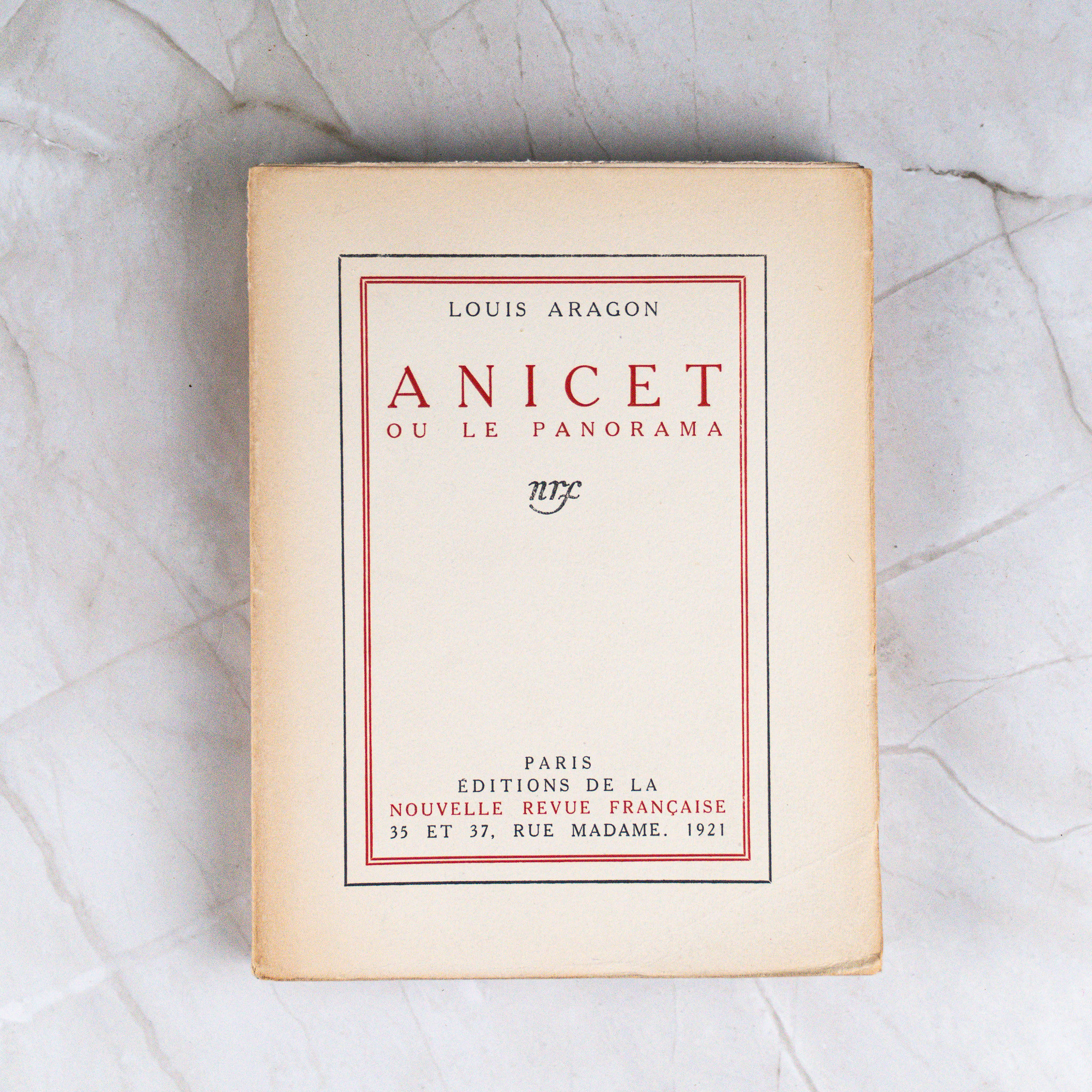
Aragon, Louis
Anicet ou le panorama
With *Anicet ou le panorama* (Paris, NRF, 1921), Louis Aragon delivers an early, deliberately hybrid novel written at the hinge between Dada disruption and the rise of Surrealism. The book proceeds by visions and sequences—a “panorama” in which identity, desire, and the act of looking continually shift. In this bibliophile form (“tirage de tête” reserved for NRF bibliophiles), the novel also becomes a collectible object intended for a small inner circle. This copy is specifically designated “pour le Dr. Sourdel” and numbered XLVIII, underscoring the selective, personalized nature of the issue. Published under the NRF imprint, Aragon is anchored in the literary center while keeping the book’s formal audacity intact. A key item for understanding the nervous modernity of the early 1920s.
Book
€1,150

Cocteau, Jean · Marie Laurencin
Poésies. 1917-1920
*Poésies. 1917-1920* gathers poems from a decisive period in Jean Cocteau’s development, at the intersection of poetry, music and the Parisian avant-garde. The collection was published in 1920 by Éditions de la Sirène, a house closely associated with Cocteau during these years. The poems belong to the period of his involvement with Erik Satie, the Groupe des Six and artists connected with Cubism, although Cocteau himself resisted identification with any single movement. Marie Laurencin contributed the printed illustration for the original wrapper, giving the volume a significant visual dimension. In this copy that wrapper has been preserved within an attractive contemporary half-leather binding. Most notably, Cocteau inscribed the book to a friend named Marcelle, possibly the pianist Marcelle Meyer, potentially connecting this individual copy with the artistic circle in which the work originated.
Book
€950

Éluard, Paul · PERET, Benjamin
152 Proverbes mis au goût du jour
With *152 Proverbes mis au goût du jour*, Paul Éluard and Benjamin Péret published in 1925 one of the most characteristic linguistic experiments of the first phase of organized Surrealism. The book takes one of the most familiar forms of collective wisdom, the proverb, and subjects it to systematic disruption. Familiar expressions are shifted, crossed and rewritten so that their apparently self-evident logic gives way to unexpected meanings. The collaboration brings together two central voices of the young Surrealist movement in a text where humour and poetic subversion are inseparable. The work appeared in the immediate orbit of *La Révolution surréaliste*, the periodical that from late 1924 served as a major organ of the movement. It is also bibliographically significant as the first title of the Éditions Surréalistes, recorded as Sebbag, no. 1 and also referenced as Lhermitte 236. This copy belongs to the ordinary issue on edition paper. As an early independent Surrealist publication, the book has both literary and documentary importance.
Book
€250

When a Signature Becomes Provenance
A signature confirms; a dedication connects; an association copy tells a story.

The Fragile Meaning of ‘Complet’
In auction descriptions, “complete” often sounds reassuring — but it is only meaningful when verified against the colophon, the justification, and the bibliography. For The Hidden Page, clarity begins where vague market language ends.

The Avant-Garde and the Illustrated Word
How the Twentieth Century Recast the Book as an Artistic and Ideological Medium