


La Belle et la Bête. Journal d’un film
La Belle et la Bête. Journal d’un film is one of the finest encounters between book, cinema and poetic self-reflection in Cocteau’s oeuvre. It appeared in 1946, the same year in which his filmed fairy tale gave decisive form to the post-war imagination. In this journal Cocteau records the practical, bodily and magical labour behind the film: fatigue, sets, actors, technical constraints and moments of unexpected grace. The 24 hors-texte photogravure plates make the book not only a written testimony, but also a visual film object. They preserve the atmosphere of shadow, metamorphosis and theatrical enchantment that made the film famous. This copy is especially desirable as hors-commerce n°U on vélin pur fil Lafuma-Navarre within the large-paper issue. Its unopened state further strengthens its aura of untouched bibliophilic preservation.
Quantity


Cocteau, Jean
La Belle et la Bête. Journal d’un film
1946 | Paris | J. B. Janin
An exceptional Cocteau film book, large-paper and hors-commerce, in which diary, fairy tale and photogravure form a tangible poetics of cinema. Its unopened state makes the copy still more alluring.
La Belle et la Bête. Journal d’un film is one of the finest encounters between book, cinema and poetic self-reflection in Cocteau’s oeuvre. It appeared in 1946, the same year in which his filmed fairy tale gave decisive form to the post-war imagination. In this journal Cocteau records the practical, bodily and magical labour behind the film: fatigue, sets, actors, technical constraints and moments of unexpected grace. The 24 hors-texte photogravure plates make the book not only a written testimony, but also a visual film object. They preserve the atmosphere of shadow, metamorphosis and theatrical enchantment that made the film famous. This copy is especially desirable as hors-commerce n°U on vélin pur fil Lafuma-Navarre within the large-paper issue. Its unopened state further strengthens its aura of untouched bibliophilic preservation.
€850
Condition Report:
In-Depth Study
References & Bibliography
Format
In-12 (Duodecimo) approx. 17 × 22 cm
Edition Particulars
Hors-commerce copy n°U within the large-paper issue on vélin pur fil Lafuma-Navarre, illustrated with 24 hors-texte photogravure plates and preserved unopened.
Copy Number
No. U
Paper
vélin pur fil Lafuma-Navarre
Inscription
No inscription
Product DETAIL
La Belle et la Bête. Journal d’un film is Cocteau’s diary of the making of his film based on the tale of Beauty and the Beast. The text does not follow the film’s plot itself, but its production: shooting days, technical difficulties, bodily exhaustion, improvisations, actors and the fragile collaboration between poetry and cinematic technique. Cocteau describes how the fairy-tale world is gradually built from sets, make-up, light, gestures and camera effects. The figures of Beauty, the Beast and their enchanted surroundings therefore appear both as fictional characters and as the result of artisanal labour. The book shows how cinema is born from obstacles: illness, delays, material problems and the need to create wonder with limited means. The photogravures bring concrete images from the film into dialogue with the diary entries. The whole is a production record, but also a poetics of metamorphosis.

Michaux, Henri · Bettencourt, Pierre
Arriver à se réveiller
A rare first edition of Arriver à se réveiller, written by Henri Michaux in the tremulous post-war years. The text unfolds as an inward journey toward lucidity, where sleep and waking mirror each other. Printed and published by Pierre Bettencourt in his own workshop, the edition’s small run preserves the work’s intimacy. The title-page vignette, a linocut by Bettencourt, sets a spare, rhythmic visual key that amplifies Michaux’s vigilant, vulnerable tone. This copy is handsomely bound in brown morocco with balsa boards by Miguet, a tactile nod to lightness under tension. For bibliophiles, it is an exemplary union of poetry, craft, and experiment. The volume embodies the independence of the post-war small press and Michaux’s radical sensitivity.
Illustrated Book
€680

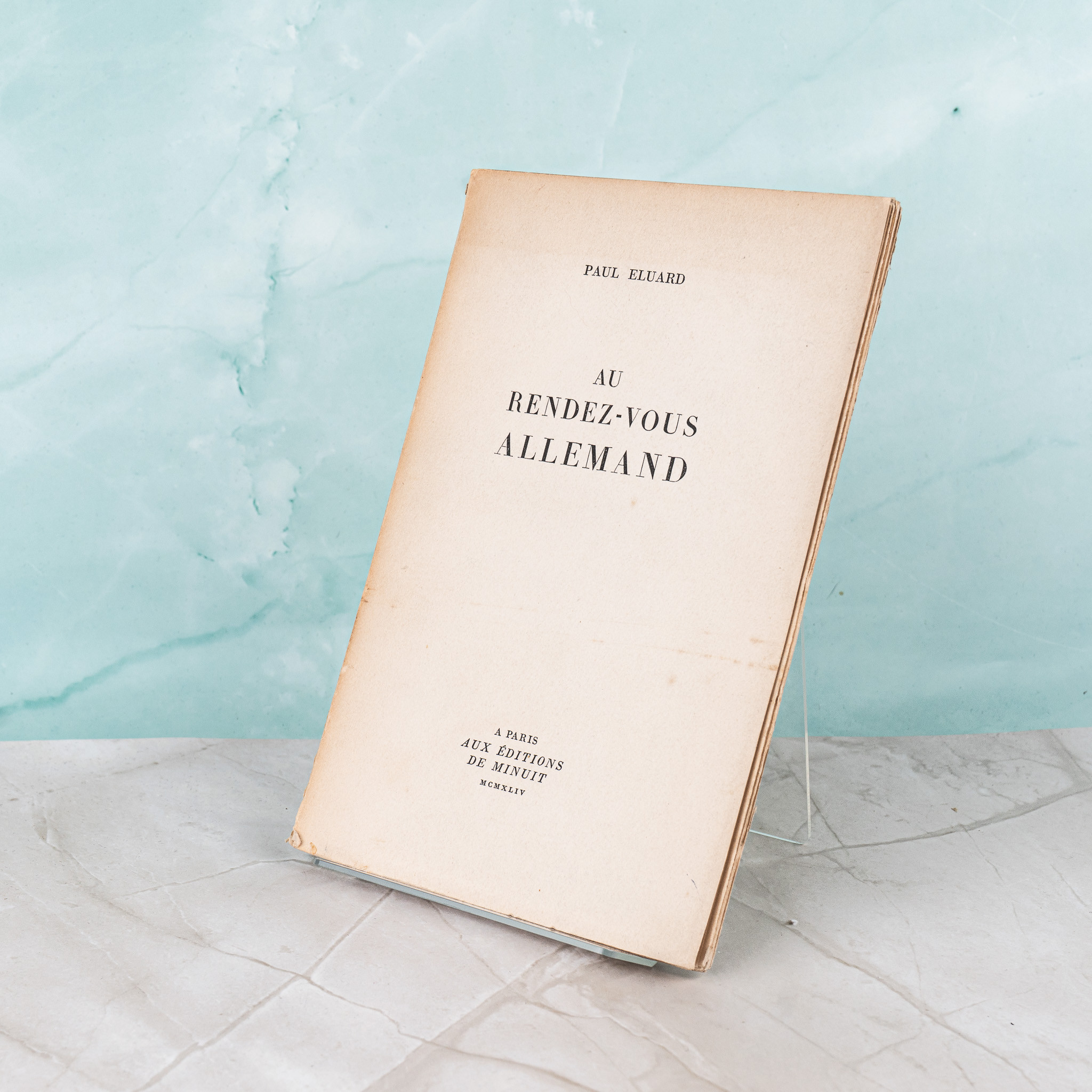
Éluard, Paul
Au rendez-vous allemand
Au rendez-vous allemand is one of the emblematic collections of Éluard’s wartime poetry. The book appeared in 1944 from Les Éditions de Minuit, the publishing house that, under the Occupation, became a moral landmark of the French literary Resistance. The volume gathers poems in which love, mourning, revolt and hope appear not as abstractions but as immediate necessities under German rule. The frontispiece, a portrait of the poet after Picasso, gives the book a powerful artistic signature: two voices of modern France, poet and artist, stand here in the same struggle. This is an ordinary, unnumbered copy, but signed by Éluard on the first page. That signature makes the book more than a Resistance document: it becomes a tangible witness to literary presence in a historically charged year. For the collector, it unites the clandestine aura of Minuit, Picasso’s name and Éluard’s own hand.
Illustrated Book
€350

Gracq, Julien · Bellmer, Hans
André Breton. Quelques aspects de l'écrivain.
A rare homage by Julien Gracq to André Breton, published by José Corti in a limited edition of 70 copies. This essay is both a powerful literary portrait and a visual tribute, thanks to Hans Bellmer’s iconic line portrait on the cover. Bellmer, known for his surrealist and psychosexual art, ties the book to the avant-garde movements of the 20th century. Gracq’s analysis is rigorous and insightful, reflecting his close engagement with Breton’s ideas. The collaboration between these two major figures and the fine print quality make this a coveted item for collectors of surrealist literature.
Illustrated Book
€500

When a Signature Becomes Provenance
A signature confirms; a dedication connects; an association copy tells a story.

The Fragile Meaning of ‘Complet’
In auction descriptions, “complete” often sounds reassuring — but it is only meaningful when verified against the colophon, the justification, and the bibliography. For The Hidden Page, clarity begins where vague market language ends.

The Avant-Garde and the Illustrated Word
How the Twentieth Century Recast the Book as an Artistic and Ideological Medium