


La Femme 100 têtes
La Femme 100 têtes by Max Ernst, published in 1929, is a milestone in the history of modern art and Surrealism. It is the first 'collage-novel' ever created, establishing the foundation for an entirely new literary and visual genre. This rare book is a visual dizziness in which Ernst, with the hand of an alchemist and the mind of a dreamer, created 147 collages. The collages are based on nineteenth-century and early twentieth-century engravings, lending images from a bourgeois past a subversive, dreamlike new meaning. The edition is notable for its deluxe printing, emphasizing the ambition of this early Surrealist masterpiece.
Quantity


Ernst, Max
La Femme 100 têtes
1929 | Paris | Editions du Carrefour
The pioneering first 'collage-novel' that transformed Surrealism into a visual narrative art.
La Femme 100 têtes by Max Ernst, published in 1929, is a milestone in the history of modern art and Surrealism. It is the first 'collage-novel' ever created, establishing the foundation for an entirely new literary and visual genre. This rare book is a visual dizziness in which Ernst, with the hand of an alchemist and the mind of a dreamer, created 147 collages. The collages are based on nineteenth-century and early twentieth-century engravings, lending images from a bourgeois past a subversive, dreamlike new meaning. The edition is notable for its deluxe printing, emphasizing the ambition of this early Surrealist masterpiece.
€1,800
Condition Report:
In-Depth Study
References & Bibliography
Format
In-4 (Quarto) approx. 25 × 32 cm
Edition Particulars
One of 900 copies on tinted wove paper, after 12 on Japon and 88 on Hollande.
Print Run
900
Copy Number
528
Paper
Vélin d’Arches
Inscription
No inscription
Product DETAIL
The work tells the story of Princess Henriette, La Femme 100 têtes (The Woman with 100 Heads), in a sequence of 147 collages, each accompanied by a 'poème-légende' (poem-caption) composed by Ernst himself. The narratives and images move between logic and the absurd, often interrupted by strange figures like Loplop, the bird superior. The volume is an investigation into dream logic, the subconscious, and the power of unexpected image juxtaposition. Although the narrative is fragmentary and hermetic, it challenges traditional notions of a 'novel' and functions as a visual and poetic exploration of human psychology. André Breton's brief introduction places the work directly at the heart of Surrealist theory.
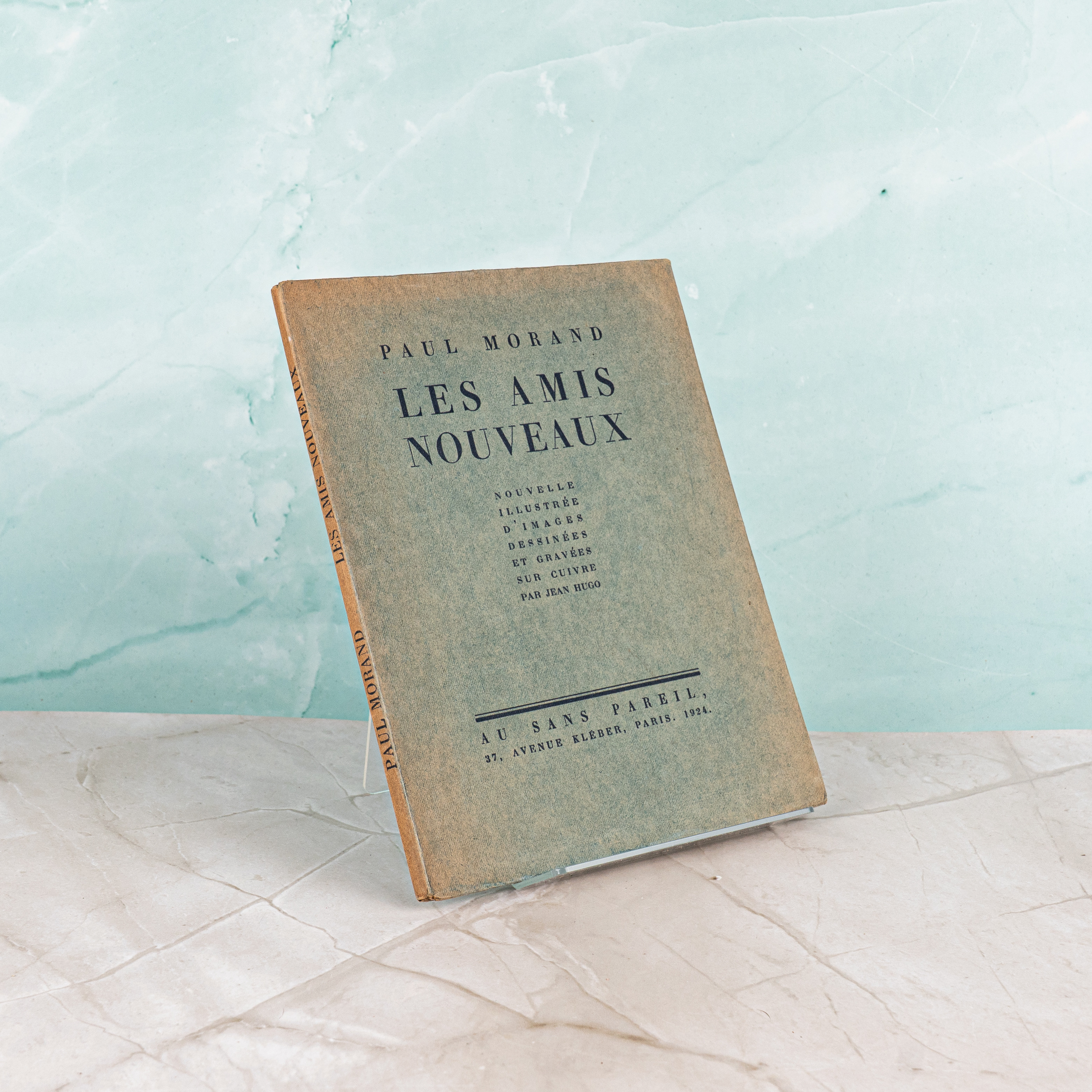
Morand, Paul · Hugo, Jean
Les Amis nouveaux
This first separate edition of *Les Amis nouveaux* combines Paul Morand’s swift, ironic prose with nine original copper drypoints by Jean Hugo. The brief novella compresses a love triangle into the tense intimacy of a single dinner. Morand’s controlled dialogue and incisive observations reveal how rivalry can unexpectedly turn into mutual understanding. Hugo accompanies the text with a refined linear vocabulary that heightens its worldly lightness and psychological ambiguity. The bistre or sanguine tones give the prints a warm, almost intimate presence on the page. As a numbered large-paper copy on vergé d’Arches, the book has considerable bibliophilic appeal.
Illustrated Book
€260

Michaux, Henri · Bettencourt, Pierre
Arriver à se réveiller
A rare first edition of Arriver à se réveiller, written by Henri Michaux in the tremulous post-war years. The text unfolds as an inward journey toward lucidity, where sleep and waking mirror each other. Printed and published by Pierre Bettencourt in his own workshop, the edition’s small run preserves the work’s intimacy. The title-page vignette, a linocut by Bettencourt, sets a spare, rhythmic visual key that amplifies Michaux’s vigilant, vulnerable tone. This copy is handsomely bound in brown morocco with balsa boards by Miguet, a tactile nod to lightness under tension. For bibliophiles, it is an exemplary union of poetry, craft, and experiment. The volume embodies the independence of the post-war small press and Michaux’s radical sensitivity.
Illustrated Book
€680
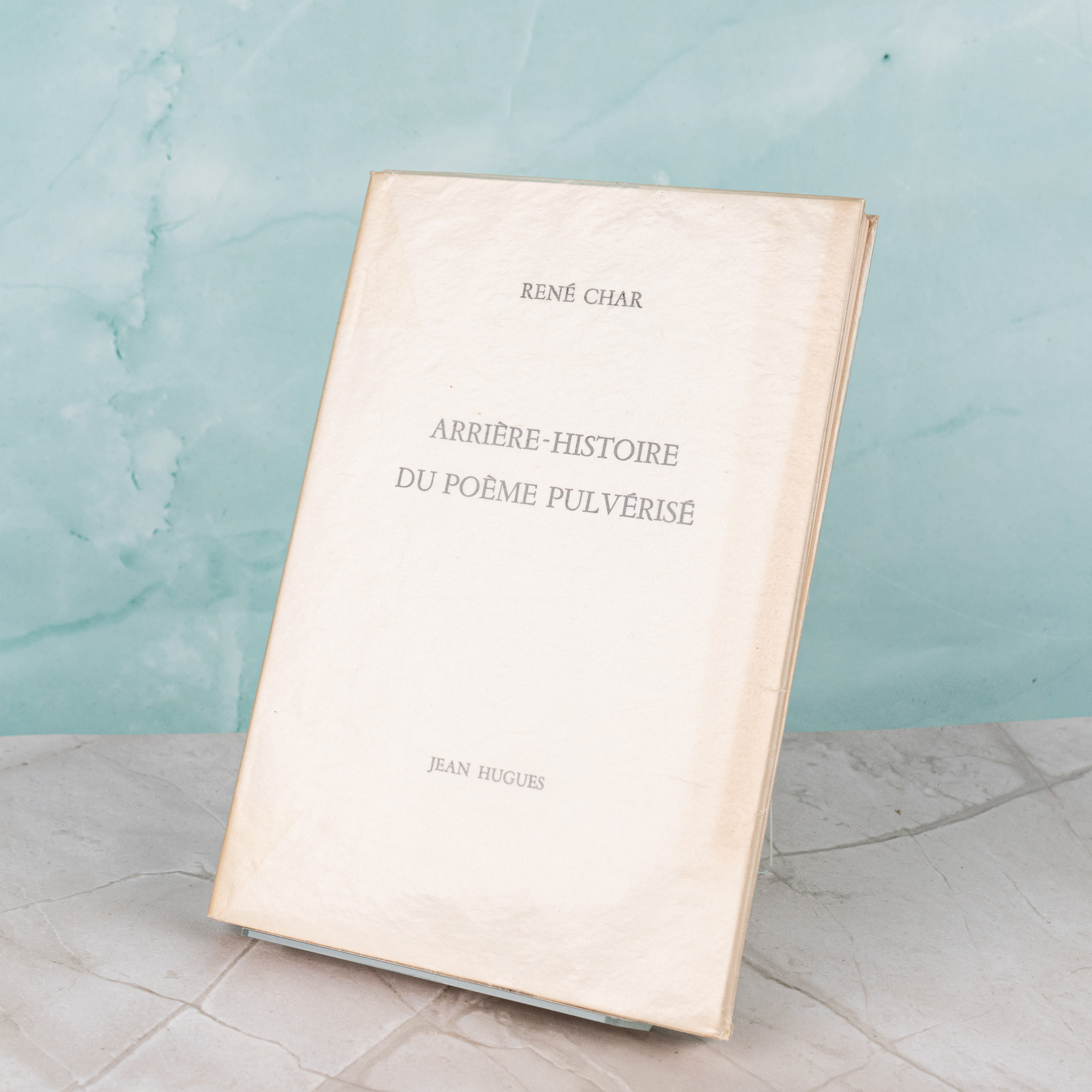
Char, Rene · Stael, Nicolas de
Arrière-histoire du poème pulvérisé
*Arrière-histoire du poème pulvérisé* is a later illustrated edition of a key text in which René Char looks back on the genesis and inner background of *Le Poème pulvérisé*. Published in 1972 by Imprimerie Union, it opens with a colour frontispiece by Nicolas de Staël. The pairing of Char and de Staël is especially charged: two post-war voices, each seeking concentration, clarity, and rupture in his own medium. This copy is one of only six hors commerce copies on Arches and is signed. The autograph presentation inscription to Doctor Marcel Zara, with poetic quotation and October 1972 dating, makes it a deeply personal copy.
Illustrated Book
€920


When a Signature Becomes Provenance
A signature confirms; a dedication connects; an association copy tells a story.

The Fragile Meaning of ‘Complet’
In auction descriptions, “complete” often sounds reassuring — but it is only meaningful when verified against the colophon, the justification, and the bibliography. For The Hidden Page, clarity begins where vague market language ends.

The Avant-Garde and the Illustrated Word
How the Twentieth Century Recast the Book as an Artistic and Ideological Medium