


La Lampe dans l'horloge
A rare and poetic 1948 publication in which André Breton re-tunes his Surrealist credo after the war. The oblong format and careful typography give the book an object quality aligned with its themes of time and light. Toyen's original lithograph acts as a visual hinge, staging a dream image of swallows and a sundial. The pairing of a black impression with an additional sepia proof evokes cyclical motion and recurrence. Issued by Robert Marin in the L'Âge d'Or series directed by Henri Parisot, it exemplifies postwar Parisian bibliophily. This copy is uncut with wide margins that show the texture of Arches wove. The green illustrated cover with a clock motif echoes the title and Breton's fascination with mechanisms of chance. The text, part prose and part statement of poetics, explores objective chance, love, and perception. Toyen, the Czech Surrealist, contributes a subtle yet forceful pictorial counterpoint. Comprising 71 pages, the book is finely set. It is the original edition, numbered on Arches, with an extra sepia proof of the lithograph. For collectors of Breton and Toyen it is a key piece where literature and printmaking meet.
Quantity


Breton, André
Toyen
La Lampe dans l'horloge
1948 | Paris | Éditions Robert Marin
A key piece in which Breton's text meets Toyen's lithograph with precision.
A rare and poetic 1948 publication in which André Breton re-tunes his Surrealist credo after the war. The oblong format and careful typography give the book an object quality aligned with its themes of time and light. Toyen's original lithograph acts as a visual hinge, staging a dream image of swallows and a sundial. The pairing of a black impression with an additional sepia proof evokes cyclical motion and recurrence. Issued by Robert Marin in the L'Âge d'Or series directed by Henri Parisot, it exemplifies postwar Parisian bibliophily. This copy is uncut with wide margins that show the texture of Arches wove. The green illustrated cover with a clock motif echoes the title and Breton's fascination with mechanisms of chance. The text, part prose and part statement of poetics, explores objective chance, love, and perception. Toyen, the Czech Surrealist, contributes a subtle yet forceful pictorial counterpoint. Comprising 71 pages, the book is finely set. It is the original edition, numbered on Arches, with an extra sepia proof of the lithograph. For collectors of Breton and Toyen it is a key piece where literature and printmaking meet.
€1,450
Condition Report:
In-Depth Study
References & Bibliography
Format
Oblong
Edition Particulars
Numbered copy on Arches wove with additional sepia proof of Toyen's lithograph.
Print Run
250
Copy Number
158
Paper
Arches
Inscription
No inscription
Product DETAIL
Breton offers a lyrical essay in which lamp, clock and gaze become emblems. Themes revolve around the experience of time, love, and the marvelous in the everyday. Prose fragments alternate with aphoristic notes that elaborate objective chance. Toyen's lithograph works as a sign-image that paces the reading. The oblong format reads like a horizontal timeline, heightening contemplation. Precise vocabulary and unexpected associations open the inner landscape. The work speaks to readers of poetry and to bibliophiles while remaining approachable. The 71 pages are compact yet airy, carefully composed. The sundial metaphor links instinct, memory, and nocturnal light. The result is a meditative unity of text and image.

Michaux, Henri · Bettencourt, Pierre
Arriver à se réveiller
A rare first edition of Arriver à se réveiller, written by Henri Michaux in the tremulous post-war years. The text unfolds as an inward journey toward lucidity, where sleep and waking mirror each other. Printed and published by Pierre Bettencourt in his own workshop, the edition’s small run preserves the work’s intimacy. The title-page vignette, a linocut by Bettencourt, sets a spare, rhythmic visual key that amplifies Michaux’s vigilant, vulnerable tone. This copy is handsomely bound in brown morocco with balsa boards by Miguet, a tactile nod to lightness under tension. For bibliophiles, it is an exemplary union of poetry, craft, and experiment. The volume embodies the independence of the post-war small press and Michaux’s radical sensitivity.
Illustrated Book
€680

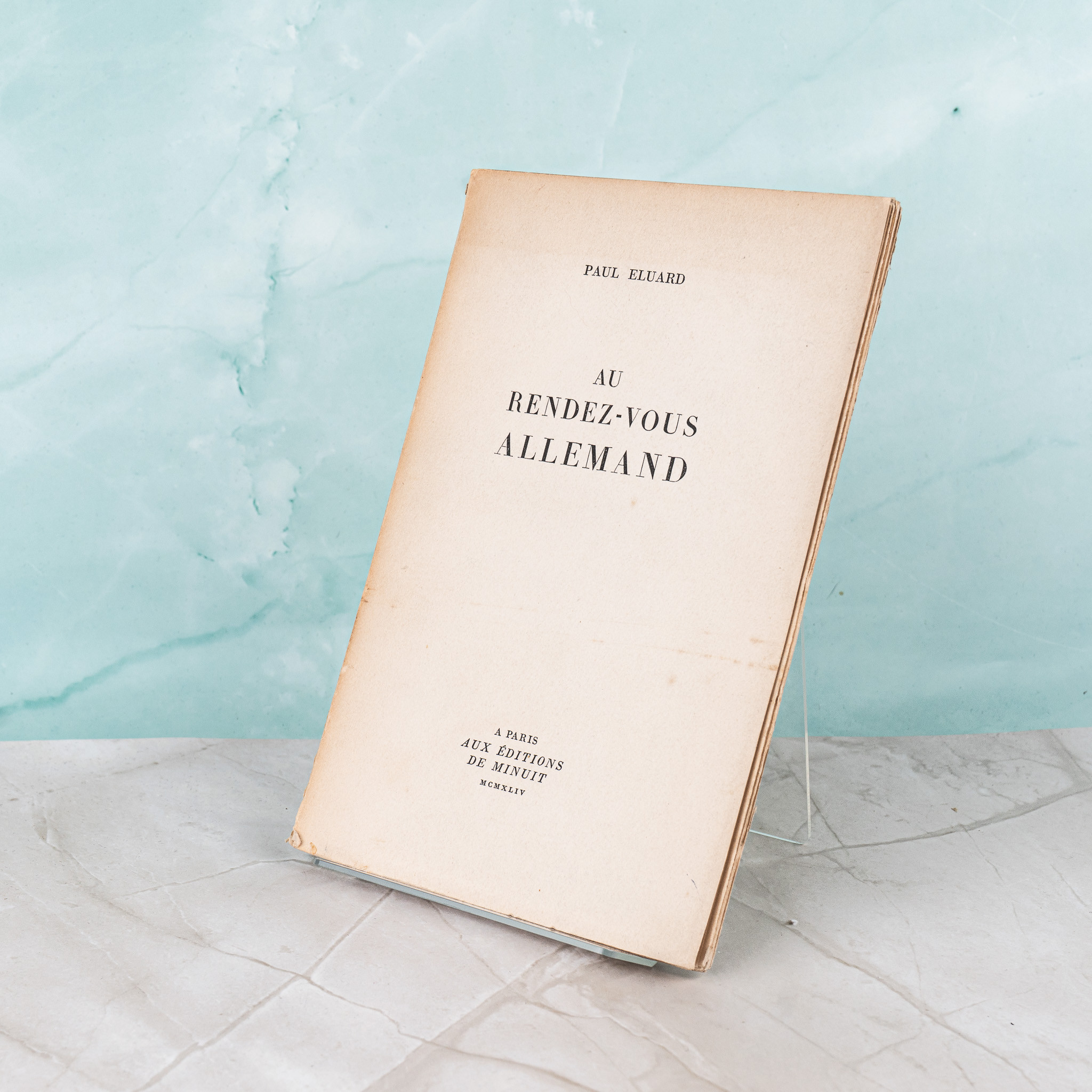
Éluard, Paul
Au rendez-vous allemand
Au rendez-vous allemand is one of the emblematic collections of Éluard’s wartime poetry. The book appeared in 1944 from Les Éditions de Minuit, the publishing house that, under the Occupation, became a moral landmark of the French literary Resistance. The volume gathers poems in which love, mourning, revolt and hope appear not as abstractions but as immediate necessities under German rule. The frontispiece, a portrait of the poet after Picasso, gives the book a powerful artistic signature: two voices of modern France, poet and artist, stand here in the same struggle. This is an ordinary, unnumbered copy, but signed by Éluard on the first page. That signature makes the book more than a Resistance document: it becomes a tangible witness to literary presence in a historically charged year. For the collector, it unites the clandestine aura of Minuit, Picasso’s name and Éluard’s own hand.
Illustrated Book
€350

Derain, André
Amis & Amille. Mystère du XIVe siècle.
This sumptuously bound book brings a medieval mystery to life through a rare collaboration between ancient literature and modern illustration. The geometric box design on garnet morocco provides striking contrast. André Derain’s 22 color lithographs – including one double and three full-page – enhance the narrative with expressive visual force. Printed on Rives vellum in an edition of 180 numbered copies, this copy (No. 72) was made for Baroness Vaxelaire and includes a suite on fine Japanese paper. The binding by Lucie Weill exemplifies artisanal excellence. A harmonious blend of narrative tradition and graphic daring.
Illustrated Book
€1,460

When a Signature Becomes Provenance
A signature confirms; a dedication connects; an association copy tells a story.

The Fragile Meaning of ‘Complet’
In auction descriptions, “complete” often sounds reassuring — but it is only meaningful when verified against the colophon, the justification, and the bibliography. For The Hidden Page, clarity begins where vague market language ends.

The Avant-Garde and the Illustrated Word
How the Twentieth Century Recast the Book as an Artistic and Ideological Medium