


La Noce massacrée
La Noce massacrée belongs to Jean Cocteau’s early, sharply modernist phase, shortly after Parade and in close proximity to Raymond Radiguet. The book appeared in 1921 with À la Sirène, a publisher closely connected with the Parisian artistic avant-garde and literary modernism. The presence of a vignette after Picasso reinforces that context, although this is not an illustrated artist’s book in the strict sense. Cocteau writes from a milieu in which literature, theatre, ballet, visual art and social polemic constantly intersected. The printed dedication to Radiguet also makes the book a witness to a decisive friendship and intellectual alliance. This copy, n°XIX, belongs to the first 40 copies on vergé d’Arches, the most desirable form of the edition.
Quantity


Cocteau, Jean
La Noce massacrée
1921 | Paris | Éditions de la Sirène
An early Cocteau in the most desirable paper issue, with Radiguet and Picasso as immediate modernist coordinates. It is not a spectacular livre de peintre, but a subtle and highly charged Parisian object from 1921.
La Noce massacrée belongs to Jean Cocteau’s early, sharply modernist phase, shortly after Parade and in close proximity to Raymond Radiguet. The book appeared in 1921 with À la Sirène, a publisher closely connected with the Parisian artistic avant-garde and literary modernism. The presence of a vignette after Picasso reinforces that context, although this is not an illustrated artist’s book in the strict sense. Cocteau writes from a milieu in which literature, theatre, ballet, visual art and social polemic constantly intersected. The printed dedication to Radiguet also makes the book a witness to a decisive friendship and intellectual alliance. This copy, n°XIX, belongs to the first 40 copies on vergé d’Arches, the most desirable form of the edition.
€850
Condition Report:
In-Depth Study
References & Bibliography
Format
In-12 (Duodecimo) approx. 17 × 22 cm
Edition Particulars
Number XIX, one of the first 40 copies on vergé d’Arches, followed by 300 copies on vergé pur fil Corvol.
Print Run
340
Copy Number
No. XIX
Paper
vergé d’Arches
Inscription
No inscription
Product DETAIL
La Noce massacrée, with the contextual subtitle Souvenirs. I. Visites à Maurice Barrès, is conceived as a short memoiristic and reflective text around Cocteau’s visits to Maurice Barrès. The book is situated in the world of literary encounters, admiration, distance and generational self-awareness in early 1920s Paris. Cocteau does not merely offer anecdote, but uses the figure of Barrès to define his position in relation to fame, style, tradition and the role of the writer. The text moves between portrait, recollection and polemical self-positioning. The printed dedication to Raymond Radiguet places the work within Cocteau’s young modernist circle. Its core is not a plot, but an intellectual scene in which visit, conversation and memory become a literary gesture.

Ribemont-Dessaignes, Georges
Ariane
A remarkable copy of *Ariane*, published in the *Les Cahiers Nouveaux* series, inscribed with a poetic and enigmatic message by Ribemont-Dessaignes to Jacques Matarasso. This deluxe Japan paper edition was elegantly rebound in 1994 by Georges Leroux, in a restrained style that echoes the work’s Dadaist spirit.
Book
€1,100
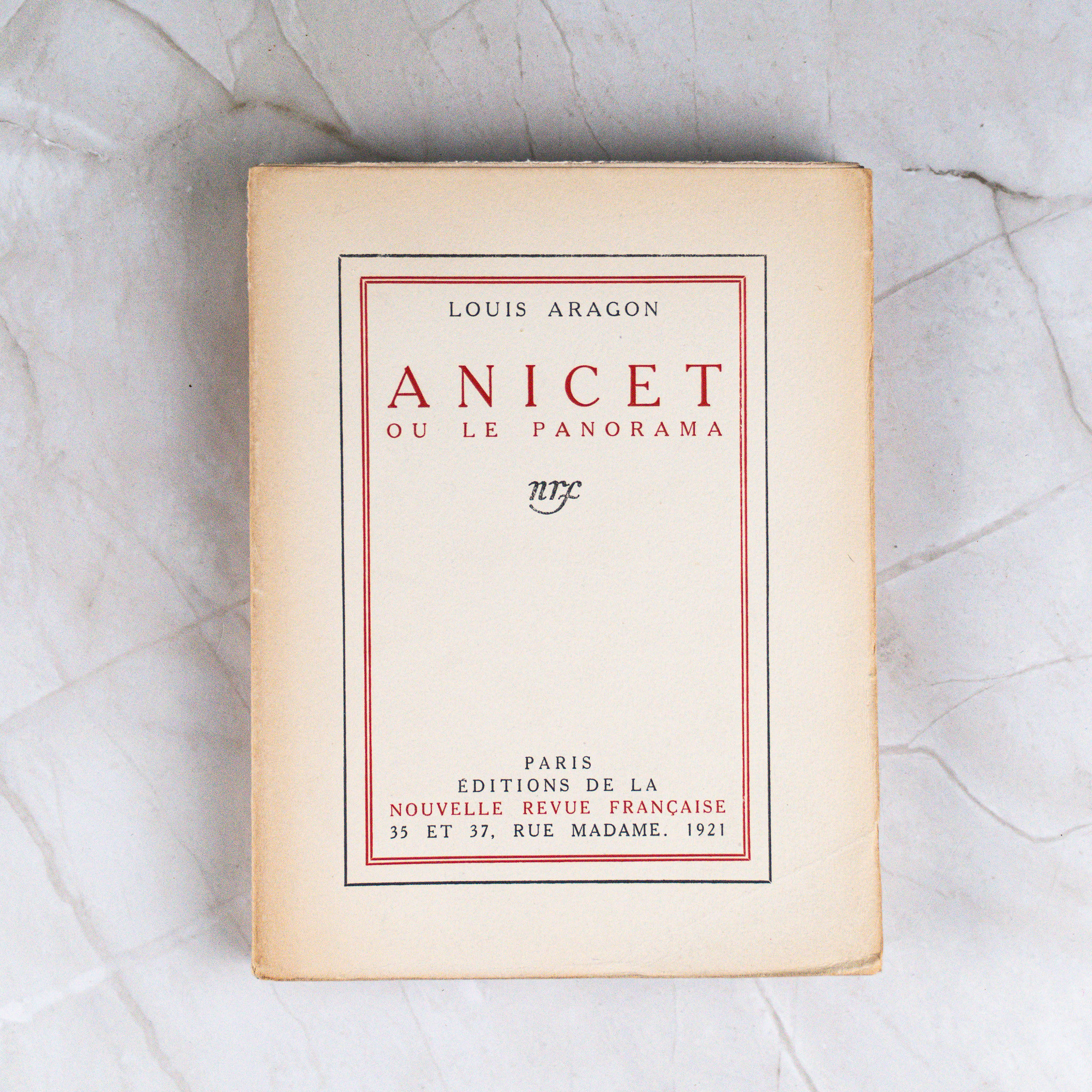
Aragon, Louis
Anicet ou le panorama
With *Anicet ou le panorama* (Paris, NRF, 1921), Louis Aragon delivers an early, deliberately hybrid novel written at the hinge between Dada disruption and the rise of Surrealism. The book proceeds by visions and sequences—a “panorama” in which identity, desire, and the act of looking continually shift. In this bibliophile form (“tirage de tête” reserved for NRF bibliophiles), the novel also becomes a collectible object intended for a small inner circle. This copy is specifically designated “pour le Dr. Sourdel” and numbered XLVIII, underscoring the selective, personalized nature of the issue. Published under the NRF imprint, Aragon is anchored in the literary center while keeping the book’s formal audacity intact. A key item for understanding the nervous modernity of the early 1920s.
Book
€1,150

Mallarmé, Stéphane
Un coup de dés jamais n’abolira le hasard. Poème
This first separate book edition of Un coup de dés jamais n’abolira le hasard is one of the decisive moments in the history of the modern book. Mallarmé turns the page from a neutral support into an active field in which silence, white space, type size and rhythm participate in meaning. The poem appeared here in 1914 from the Éditions de la Nouvelle Revue Française, shortly before the major typographic experiments of the twentieth century would unfold with full force. The restrained wrappers printed in black and red preserve the tension between classical French publishing culture and radical formal innovation. This ordinary copy on papier vergé d’édition represents the wider circulation of a work that must initially have seemed both enigmatic and prophetic. Even without deluxe paper or numbering, the book remains a milestone: the moment at which poetry becomes visible space. For collectors of the avant-garde, visual poetry and the artist’s book, it is a source-text.
Book
€580

Cocteau, Jean · Marie Laurencin
Poésies. 1917-1920
*Poésies. 1917-1920* gathers poems from a decisive period in Jean Cocteau’s development, at the intersection of poetry, music and the Parisian avant-garde. The collection was published in 1920 by Éditions de la Sirène, a house closely associated with Cocteau during these years. The poems belong to the period of his involvement with Erik Satie, the Groupe des Six and artists connected with Cubism, although Cocteau himself resisted identification with any single movement. Marie Laurencin contributed the printed illustration for the original wrapper, giving the volume a significant visual dimension. In this copy that wrapper has been preserved within an attractive contemporary half-leather binding. Most notably, Cocteau inscribed the book to a friend named Marcelle, possibly the pianist Marcelle Meyer, potentially connecting this individual copy with the artistic circle in which the work originated.
Book
€950

When a Signature Becomes Provenance
A signature confirms; a dedication connects; an association copy tells a story.

The Fragile Meaning of ‘Complet’
In auction descriptions, “complete” often sounds reassuring — but it is only meaningful when verified against the colophon, the justification, and the bibliography. For The Hidden Page, clarity begins where vague market language ends.

The Avant-Garde and the Illustrated Word
How the Twentieth Century Recast the Book as an Artistic and Ideological Medium