


La Parole en archipel
La Parole en archipel is one of the major collections of René Char’s mature period and was published by the NRF in Paris in 1962. It is not merely a new gathering of poems, but a collective edition bringing together several earlier sequences, sometimes in revised form or with variants. The volume thus takes on the character of a poetic constellation: not a closed cycle, but an archipelago of voices, flashes, and tensions. Its title expresses that principle perfectly, since Char allows the individual parts to coexist without dissolving their singularity. The result is a broad yet highly concentrated view of his poetry from the 1950s and early 1960s. The deluxe issue on Madagascar Navarre further underscores the bibliophile prestige of the first edition. This copy, number 12 of the 18 de tête, thus combines literary substance with marked rarity.
Quantity


Char, Rene
La Parole en archipel
1962 | Paris | NRF
A major work of Char’s maturity, in the sought-after 1962 collective edition and in the extremely scarce deluxe issue on Madagascar Navarre.
La Parole en archipel is one of the major collections of René Char’s mature period and was published by the NRF in Paris in 1962. It is not merely a new gathering of poems, but a collective edition bringing together several earlier sequences, sometimes in revised form or with variants. The volume thus takes on the character of a poetic constellation: not a closed cycle, but an archipelago of voices, flashes, and tensions. Its title expresses that principle perfectly, since Char allows the individual parts to coexist without dissolving their singularity. The result is a broad yet highly concentrated view of his poetry from the 1950s and early 1960s. The deluxe issue on Madagascar Navarre further underscores the bibliophile prestige of the first edition. This copy, number 12 of the 18 de tête, thus combines literary substance with marked rarity.
€1,400
Condition Report:
In-Depth Study
References & Bibliography
Format
In-8 (Octavo) approx. 20 × 26 cm
Edition Particulars
One of the 18 deluxe copies on Madagascar Navarre; wrappers slightly sunned.
Print Run
143
Copy Number
No. 12
Paper
Madagascar Navarre
Inscription
No inscription
Product DETAIL
This collective volume brings together several poetic groupings by René Char, including Lettera Amorosa, La Paroi et la prairie, Poèmes des Deux Années, La Bibliothèque est en feu et autres poèmes, Au-dessus du Vent, and Quitter, together with a few previously unpublished poems. There is no linear narrative and no fixed cast of characters; at the centre stands a lyric voice moving among love, nature, violence, memory, moral vigilance, and knowledge. Each section has its own rhythm and emphasis, yet together they form a broad field of experience and meditation. The poems shift between brief aphoristic concentration and more expansive lyrical passages. The result is a book that is both retrospective and new, since Char rearranges earlier work while placing it beside other poems. The reader is thus given not a simple selection but a carefully composed ordering of autonomous ensembles. Its dominant themes are tension, clarity, resistance, and an intense bond with the visible world.

Ribemont-Dessaignes, Georges
Ariane
A remarkable copy of *Ariane*, published in the *Les Cahiers Nouveaux* series, inscribed with a poetic and enigmatic message by Ribemont-Dessaignes to Jacques Matarasso. This deluxe Japan paper edition was elegantly rebound in 1994 by Georges Leroux, in a restrained style that echoes the work’s Dadaist spirit.
Book
€1,100

Gracq, Julien
Au château d'Argol
Julien Gracq’s debut novel, issued by José Corti, sets a gothic castle on the Breton coast as the stage for a charged, almost dream-logic encounter between three figures. The prose is musical and image-rich, favouring symbolic landscapes and metaphysical weather. Born near Surrealism yet distinctly independent, the book establishes Gracq’s lucid enchantment from the start. For bibliophiles this is a key title: an early Corti publication, scarce in appealing condition, and the opening note of a major twentieth-century voice. Its limited print-run and initially slow reception add to the sense of discovery. This copy is on publisher’s stock.
Book
€610

Dominique Fourcade, Pierre Buraglio · Buraglio, Pierre
Au travail ma chérie
First volume in the Préférence series: a focused encounter between Dominique Fourcade and Pierre Buraglio. The Imprimerie nationale produced an exemplary typographic edition on Rives wove, limited to 100 copies signed by both. Buraglio “illuminates” the book with spare, hand-made interventions—strokes, contours, accents—that let the page breathe. The plain wrappers in a sturdy case stress the workshop feel. This copy bears a presentation to Jacques Dauchez, adding a vivid bibliophilic provenance. A scarce, exact book where typography, gesture, and poetry hold each other in balance.
Book
€725
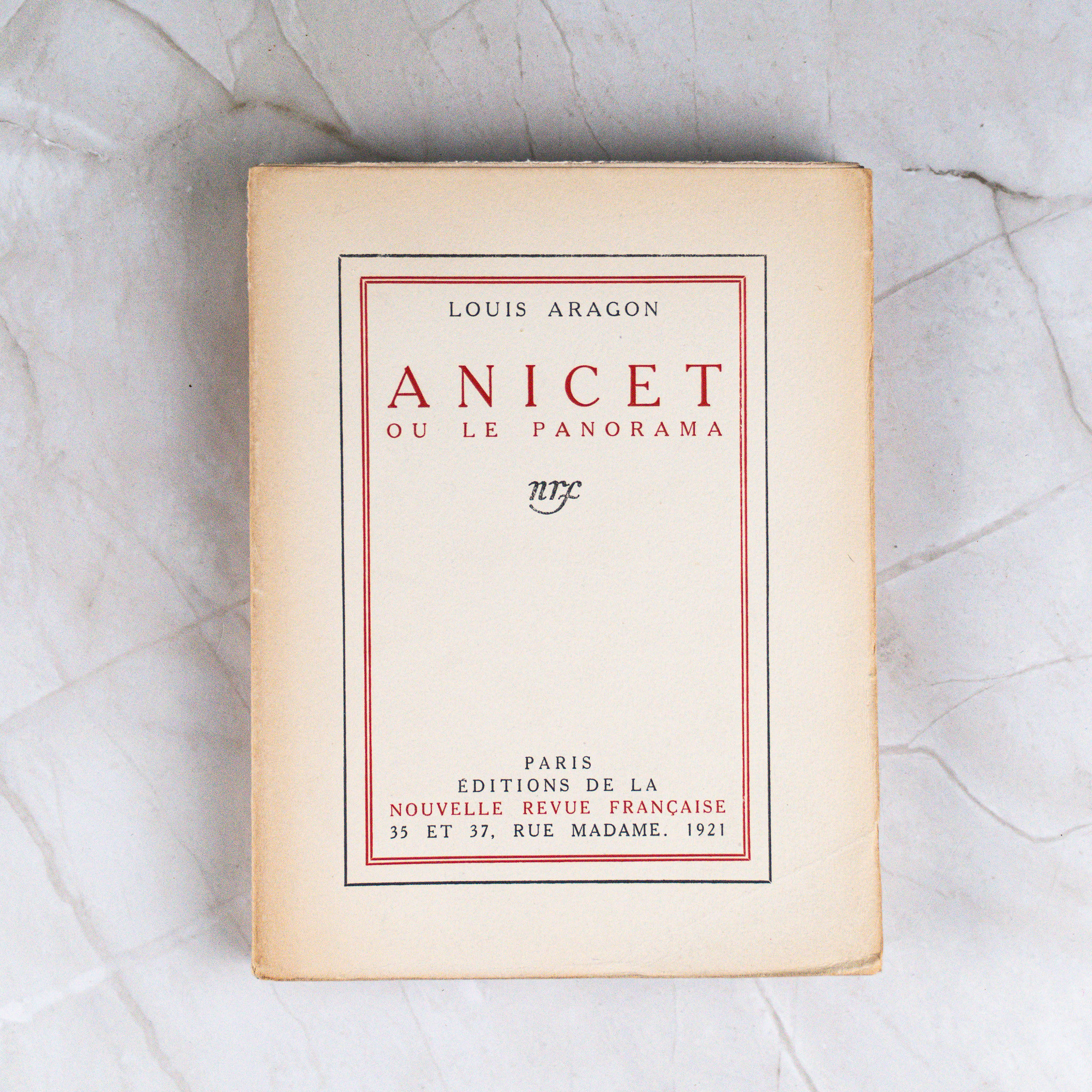
Aragon, Louis
Anicet ou le panorama
With *Anicet ou le panorama* (Paris, NRF, 1921), Louis Aragon delivers an early, deliberately hybrid novel written at the hinge between Dada disruption and the rise of Surrealism. The book proceeds by visions and sequences—a “panorama” in which identity, desire, and the act of looking continually shift. In this bibliophile form (“tirage de tête” reserved for NRF bibliophiles), the novel also becomes a collectible object intended for a small inner circle. This copy is specifically designated “pour le Dr. Sourdel” and numbered XLVIII, underscoring the selective, personalized nature of the issue. Published under the NRF imprint, Aragon is anchored in the literary center while keeping the book’s formal audacity intact. A key item for understanding the nervous modernity of the early 1920s.
Book
€1,150

When a Signature Becomes Provenance
A signature confirms; a dedication connects; an association copy tells a story.

The Fragile Meaning of ‘Complet’
In auction descriptions, “complete” often sounds reassuring — but it is only meaningful when verified against the colophon, the justification, and the bibliography. For The Hidden Page, clarity begins where vague market language ends.

The Avant-Garde and the Illustrated Word
How the Twentieth Century Recast the Book as an Artistic and Ideological Medium