


Lacerba. Periodico quindicinale. Anno I, nos. 5–24
This series of twenty original issues documents a decisive phase in the first year of *Lacerba*, a central periodical of Italian Futurism. It runs from no. 5, dated 1 March, through no. 24 of 15 December 1913, forming an almost continuous core of the year. The first four numbers are absent, so the series does not constitute the complete first year. Under the direction of Giovanni Papini and Ardengo Soffici, the journal brought together manifestos, polemics, literary experiment and visual art. Contributions by Marinetti, Apollinaire, Max Jacob and Picasso, among others, reveal the connection between Italian Futurism and a wider European avant-garde network. No. 18 contains Apollinaire’s *L’Antitradition futuriste*, while the issue of 15 October presents early examples of Futurist *parole in libertà*. As an ensemble, the series preserves not only the texts but also the rhythm, typography and polemical energy of the original periodical format. Its substantial scope, original state and historical coherence make it especially appealing to the bibliophile.
Quantity


Papini, Giovanni
Soffici, Ardengo
Marinetti, Filippo Tommaso
Apollinaire, Guillaume
Jacob, Max
Picasso, Pablo
Lacerba. Periodico quindicinale. Anno I, nos. 5–24
1913 | Firenze | Tipografia di A. Vallecchi e C
This series forms an exceptionally coherent document of *Lacerba* during its first and emphatically Futurist year. The separate original issues unite programmatic texts, experimental typography and international avant-garde contributions in their historical publication form.
This series of twenty original issues documents a decisive phase in the first year of *Lacerba*, a central periodical of Italian Futurism. It runs from no. 5, dated 1 March, through no. 24 of 15 December 1913, forming an almost continuous core of the year. The first four numbers are absent, so the series does not constitute the complete first year. Under the direction of Giovanni Papini and Ardengo Soffici, the journal brought together manifestos, polemics, literary experiment and visual art. Contributions by Marinetti, Apollinaire, Max Jacob and Picasso, among others, reveal the connection between Italian Futurism and a wider European avant-garde network. No. 18 contains Apollinaire’s *L’Antitradition futuriste*, while the issue of 15 October presents early examples of Futurist *parole in libertà*. As an ensemble, the series preserves not only the texts but also the rhythm, typography and polemical energy of the original periodical format. Its substantial scope, original state and historical coherence make it especially appealing to the bibliophile.
€1,250
Condition Report:
In-Depth Study
References & Bibliography
Format
In-4 Carré approx. 27×29 cm
Edition Particulars
Twenty originally stapled issues with the expected signs of age, overall in excellent condition; nos. 1–4 are absent.
Product DETAIL
The issues assemble essays, manifestos, polemics, poems, literary experiments and reproductions of works of art. At their centre are the debates through which Papini, Soffici and their contributors defined the position of Futurism in Italy during 1913. The sequence begins on 1 March, when direct collaboration with the Futurists became more intensive, and follows this development through 15 December. Marinetti and other Italian writers advocate new forms of language, typography and artistic action, while international figures such as Apollinaire, Max Jacob and Picasso broaden the journal’s perspective. No. 18 publishes Apollinaire’s *L’Antitradition futuriste*. The issue of 15 October contains early examples of *parole in libertà*, in which the arrangement of the printed page becomes part of the experiment. Together, the twenty numbers show literary conflict, visual innovation and international exchange operating side by side. Their prevailing atmosphere is provocative, polemical and programmatic.

Valentine, Hugo
La Danse. Numéro spécial consacré à la première saison des Ballets suédois de Rolf de Maré. Juin 1921
This special June issue of *La Danse* documents the first Paris season of Rolf de Maré’s Ballets Suédois. Under De Maré and choreographer Jean Börlin, the company emerged as the principal post-war parallel and rival to Diaghilev’s Ballets Russes. Its establishment at the Théâtre des Champs-Élysées gave this ambition a powerful symbolic continuity. Valentine Hugo designed the cover, lending the programme-periodical a distinct artistic identity. This copy retains the loose programme for the performances of 3, 7 and 12 June. Within it, *Jeux* provides a tangible link with the Ballets Russes repertoire: Debussy’s music and Nijinsky’s original scenario were combined with new choreography by Börlin and a setting by Pierre Bonnard. The issue therefore shows how the Diaghilev model was not merely imitated but reinterpreted by a younger modernist company. Preserving both the periodical and its separate programme, the ensemble is an important document of the transition between two major companies of the Parisian dance avant-garde.
Review
€230

Picasso, Pablo · Léon Bakst · Valentine, Hugo
La Danse, première année, n° 3, décembre 1920. Programme officiel des Ballets Russes. Théâtre des Champs-Élysées. Treizième saison russe
This original December issue of *La Danse* served as the official programme for the thirteenth Russian season at the Théâtre des Champs-Élysées. The publication combines the ephemeral nature of a theatre programme with the visual ambition of an avant-garde periodical. Its colour cover reproduces Picasso’s watercolour design for the Chinese costume in *Parade* and provides the issue’s immediately recognizable artistic focus. Inside are colour reproductions of costumes for *Shéhérazade* after Léon Bakst, a title illustration by Valentine Hugo and numerous photographs of dancers and productions. The issue records how Serge Diaghilev brought painting, music, choreography and publicity design together within a single modern conception of performance. The illustrations are reproductions rather than separate signed original prints. The red and grey-green typography remains crisp, while the cover colours show remarkably little fading for such a fragile publication. Despite its own signs of use, the surviving glassine has evidently protected the original wrappers.
Review
€520
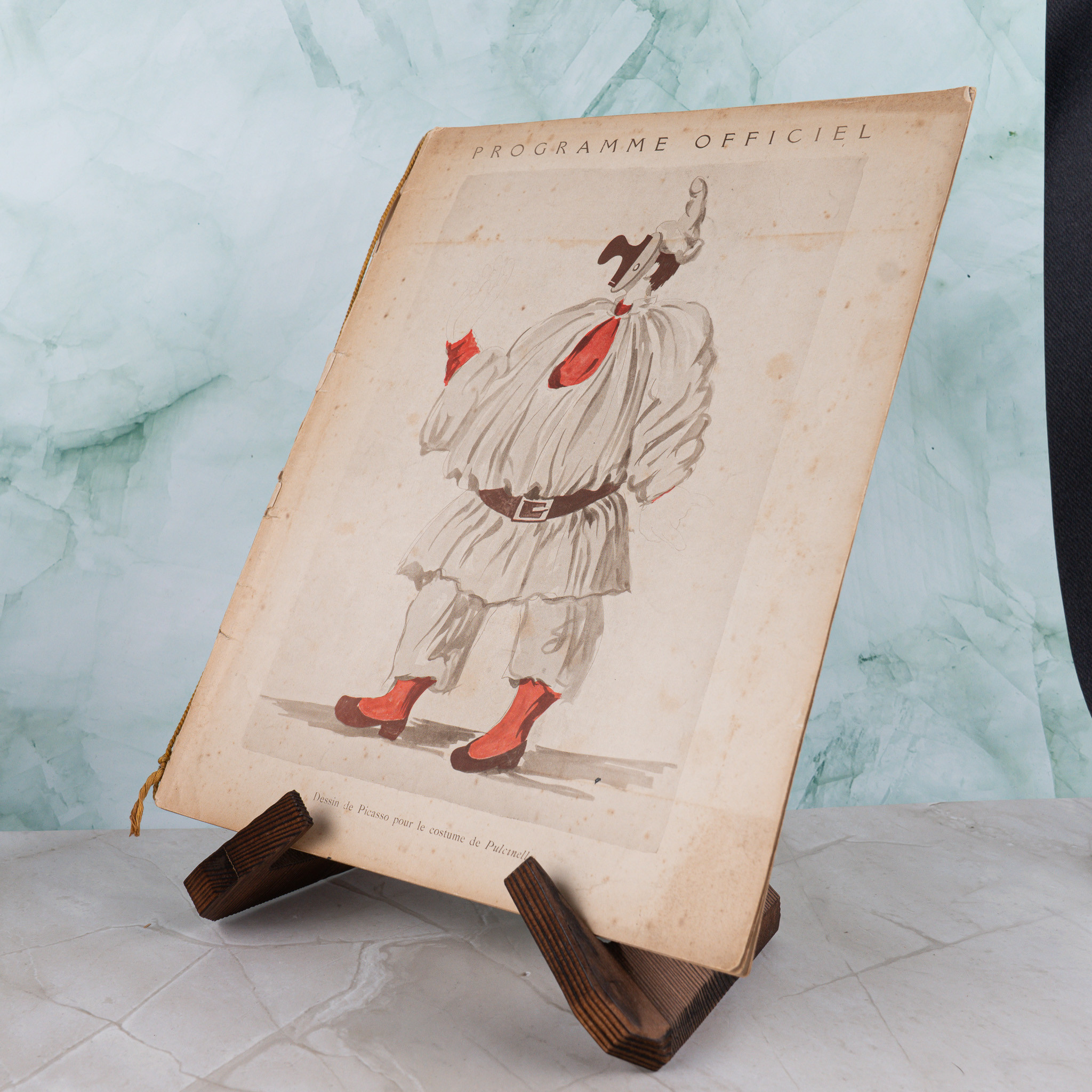
José-Maria Sert · Giorgio de Chirico · Matisse, Henri · Picasso, Pablo
Programmes Ballets Russes
Two original program booklets from Serge Diaghilev’s legendary Ballets Russes, featuring contributions by avant-garde artists such as Picasso, Matisse, Sert, and de Chirico. Rare artifacts of interdisciplinary modernism spanning dance, visual art, and typography during the interwar period.
Review
€450

Collectif, Collège de ’Pataphysique
Viridis Candela. Subsidia Pataphysica — Cahiers du Collège de ’Pataphysique, 3e & nouvelle série, n° 0–27/28
Viridis Candela. Subsidia Pataphysica is a complete run of the third and new series of the Cahiers du Collège de ’Pataphysique, issued between 93 and 102 E.P., corresponding to 1965–1975. The series forms one of the documentary backbones of the later activity of the Collège: it preserves texts, dossiers, commentaries, supplements and internal signals from a world in which literature, fictional science and institutional parody coincide. As the series n° 0–27/28, it is not a single book but a continuous pataphysical constellation. The index number n° 27/28 is especially important because it contains the index to the Cahiers, Dossiers and Subsidia. The run therefore functions both as publication and as access key to a larger corpus. For The Hidden Page this is a core object: not spectacular through luxury or signature, but through completeness, internal coherence and documentary weight. The narrow paperbound fascicles show the avant-garde as archive, ritual and network in printed form.

