


Le bal du comte d'Orgel
Raymond Radiguet's second and final novel, *Le bal du comte d'Orgel*, stands among the notable French psychological novels of the interwar period. Published posthumously by Bernard Grasset in 1924, it displays the remarkable control of a writer who died at only twenty. Against the fashionable Parisian world of the early 1920s, Radiguet dissects a love triangle in which desire, friendship and social convention continually collide. The classical clarity of his prose deliberately contrasts with the artistic ferment of the avant-garde circles around him. For the bibliophile, the first edition is especially desirable because of its carefully graded issue on luxury papers. This copy, number 122, is one of only 150 printed on Hollande and is bound in ivory vellum with the original wrappers and spine preserved.
Quantity


RADIGUET, Raymond
Le bal du comte d'Orgel
1924 | Paris | Bernard Grasset
An original edition of Radiguet's final novel, combining the author's extraordinary youth with remarkable classical control. Number 122 on Hollande belongs to the sought-after luxury-paper issue and retains its original wrappers and spine.
Raymond Radiguet's second and final novel, *Le bal du comte d'Orgel*, stands among the notable French psychological novels of the interwar period. Published posthumously by Bernard Grasset in 1924, it displays the remarkable control of a writer who died at only twenty. Against the fashionable Parisian world of the early 1920s, Radiguet dissects a love triangle in which desire, friendship and social convention continually collide. The classical clarity of his prose deliberately contrasts with the artistic ferment of the avant-garde circles around him. For the bibliophile, the first edition is especially desirable because of its carefully graded issue on luxury papers. This copy, number 122, is one of only 150 printed on Hollande and is bound in ivory vellum with the original wrappers and spine preserved.
€830
Condition Report:
In-Depth Study
References & Bibliography
Format
In-8 (Octavo) approx. 20 × 26 cm
Edition Particulars
One of 150 numbered copies on Hollande, the third paper after 10 on Chine and 25 on Japon.
Print Run
1100
Copy Number
No. 122
Paper
Hollande
Inscription
No inscription
Product DETAIL
Paris, 1920: the young François de Séryeuse befriends Count Anne d'Orgel and is drawn into his fashionable social circle. Through the count he meets Mahaut d'Orgel, with whom he falls almost immediately in love. François attempts to conceal his feelings while becoming an increasingly close friend of her husband. His growing intimacy with the couple makes the situation steadily more ambiguous, while Mahaut gradually realizes that her own feelings for François exceed ordinary friendship. Family connections, visits and the conventions of their social world continually bring the three characters closer without producing an open rupture. When Mahaut tries to resolve her emotional conflict by confiding in François's mother, the carefully contained feelings become increasingly difficult to hide. The novel derives its tension less from dramatic action than from psychological shifts, silences and misunderstandings within a society governed by self-control and propriety.

Ribemont-Dessaignes, Georges
Ariane
A remarkable copy of *Ariane*, published in the *Les Cahiers Nouveaux* series, inscribed with a poetic and enigmatic message by Ribemont-Dessaignes to Jacques Matarasso. This deluxe Japan paper edition was elegantly rebound in 1994 by Georges Leroux, in a restrained style that echoes the work’s Dadaist spirit.
Book
€1,100
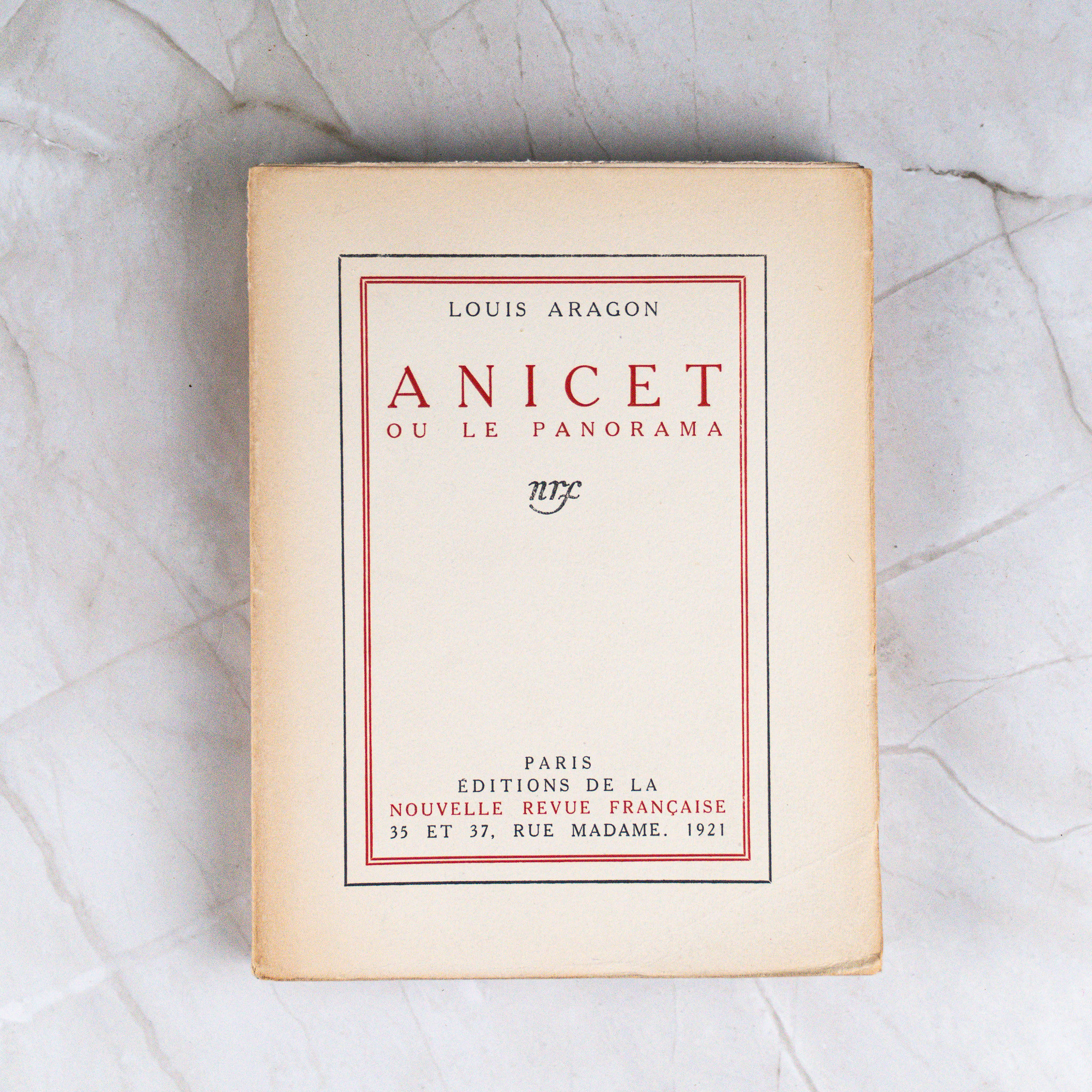
Aragon, Louis
Anicet ou le panorama
With *Anicet ou le panorama* (Paris, NRF, 1921), Louis Aragon delivers an early, deliberately hybrid novel written at the hinge between Dada disruption and the rise of Surrealism. The book proceeds by visions and sequences—a “panorama” in which identity, desire, and the act of looking continually shift. In this bibliophile form (“tirage de tête” reserved for NRF bibliophiles), the novel also becomes a collectible object intended for a small inner circle. This copy is specifically designated “pour le Dr. Sourdel” and numbered XLVIII, underscoring the selective, personalized nature of the issue. Published under the NRF imprint, Aragon is anchored in the literary center while keeping the book’s formal audacity intact. A key item for understanding the nervous modernity of the early 1920s.
Book
€1,150

Mallarmé, Stéphane
Un coup de dés jamais n’abolira le hasard. Poème
This first separate book edition of Un coup de dés jamais n’abolira le hasard is one of the decisive moments in the history of the modern book. Mallarmé turns the page from a neutral support into an active field in which silence, white space, type size and rhythm participate in meaning. The poem appeared here in 1914 from the Éditions de la Nouvelle Revue Française, shortly before the major typographic experiments of the twentieth century would unfold with full force. The restrained wrappers printed in black and red preserve the tension between classical French publishing culture and radical formal innovation. This ordinary copy on papier vergé d’édition represents the wider circulation of a work that must initially have seemed both enigmatic and prophetic. Even without deluxe paper or numbering, the book remains a milestone: the moment at which poetry becomes visible space. For collectors of the avant-garde, visual poetry and the artist’s book, it is a source-text.
Book
€580

Cocteau, Jean · Marie Laurencin
Poésies. 1917-1920
*Poésies. 1917-1920* gathers poems from a decisive period in Jean Cocteau’s development, at the intersection of poetry, music and the Parisian avant-garde. The collection was published in 1920 by Éditions de la Sirène, a house closely associated with Cocteau during these years. The poems belong to the period of his involvement with Erik Satie, the Groupe des Six and artists connected with Cubism, although Cocteau himself resisted identification with any single movement. Marie Laurencin contributed the printed illustration for the original wrapper, giving the volume a significant visual dimension. In this copy that wrapper has been preserved within an attractive contemporary half-leather binding. Most notably, Cocteau inscribed the book to a friend named Marcelle, possibly the pianist Marcelle Meyer, potentially connecting this individual copy with the artistic circle in which the work originated.

