


Le Barbare au Paradis
A spacious *livre d’artiste*: Michel Déon’s text is printed recto on large sheets and accompanied by seven original colour intaglio prints by Baltazar, each mounted/tipped in. Issued in grand in-folio and kept *en feuilles*, true to bibliophile practice. This copy belongs to the 70 numbered on vélin de Rives, signed by both author and artist. It stands out for its chemise and slipcase, heavily hand-worked by the artist—effectively unique. A full-page painted and inscribed presentation to Jacques Dauchez (dated 1988) crowns the volume. Two vintage silver-gelatin photographs of Michel Déon are loosely inserted, lending personal resonance.
Quantity


Déon, Michel
BALTAZAR JULIUS
Le Barbare au Paradis
1987 | Paris | Nicaise
Uniquely enriched copy from the 70 on Rives, with painted envoi and artist-worked housing.
A spacious *livre d’artiste*: Michel Déon’s text is printed recto on large sheets and accompanied by seven original colour intaglio prints by Baltazar, each mounted/tipped in. Issued in grand in-folio and kept *en feuilles*, true to bibliophile practice. This copy belongs to the 70 numbered on vélin de Rives, signed by both author and artist. It stands out for its chemise and slipcase, heavily hand-worked by the artist—effectively unique. A full-page painted and inscribed presentation to Jacques Dauchez (dated 1988) crowns the volume. Two vintage silver-gelatin photographs of Michel Déon are loosely inserted, lending personal resonance.
€980
Condition Report:
In-Depth Study
References & Bibliography
Format
In-folio (Folio) approx. 30 × 40 cm
Edition Particulars
One of 70 copies on vélin de Rives, signed by Michel Déon and Baltazar; chemise/slipcase richly hand-worked by the artist; with full-page painted presentation to Jacques Dauchez; two vintage photos and an artist’s note inserted.
Print Run
70
Copy Number
No. 28
Paper
vélin de Rives
Inscription
Signed by the Author,Signed by the Illustrator
Product DETAIL
Baltazar’s prints speak a lyrical abstraction—colour fields, signs, rhythmic burr lines—questioning Déon’s prose-poetic cadence rather than depicting it. The tipped-in mounting foregrounds paper and plate as matter, letting text and image run in parallel. The large sheets create deliberate pauses, visual breaths. The hand-worked portfolio and case push the work toward book-object and assemblage.

Michaux, Henri · Bettencourt, Pierre
Arriver à se réveiller
A rare first edition of Arriver à se réveiller, written by Henri Michaux in the tremulous post-war years. The text unfolds as an inward journey toward lucidity, where sleep and waking mirror each other. Printed and published by Pierre Bettencourt in his own workshop, the edition’s small run preserves the work’s intimacy. The title-page vignette, a linocut by Bettencourt, sets a spare, rhythmic visual key that amplifies Michaux’s vigilant, vulnerable tone. This copy is handsomely bound in brown morocco with balsa boards by Miguet, a tactile nod to lightness under tension. For bibliophiles, it is an exemplary union of poetry, craft, and experiment. The volume embodies the independence of the post-war small press and Michaux’s radical sensitivity.
Illustrated Book
€680
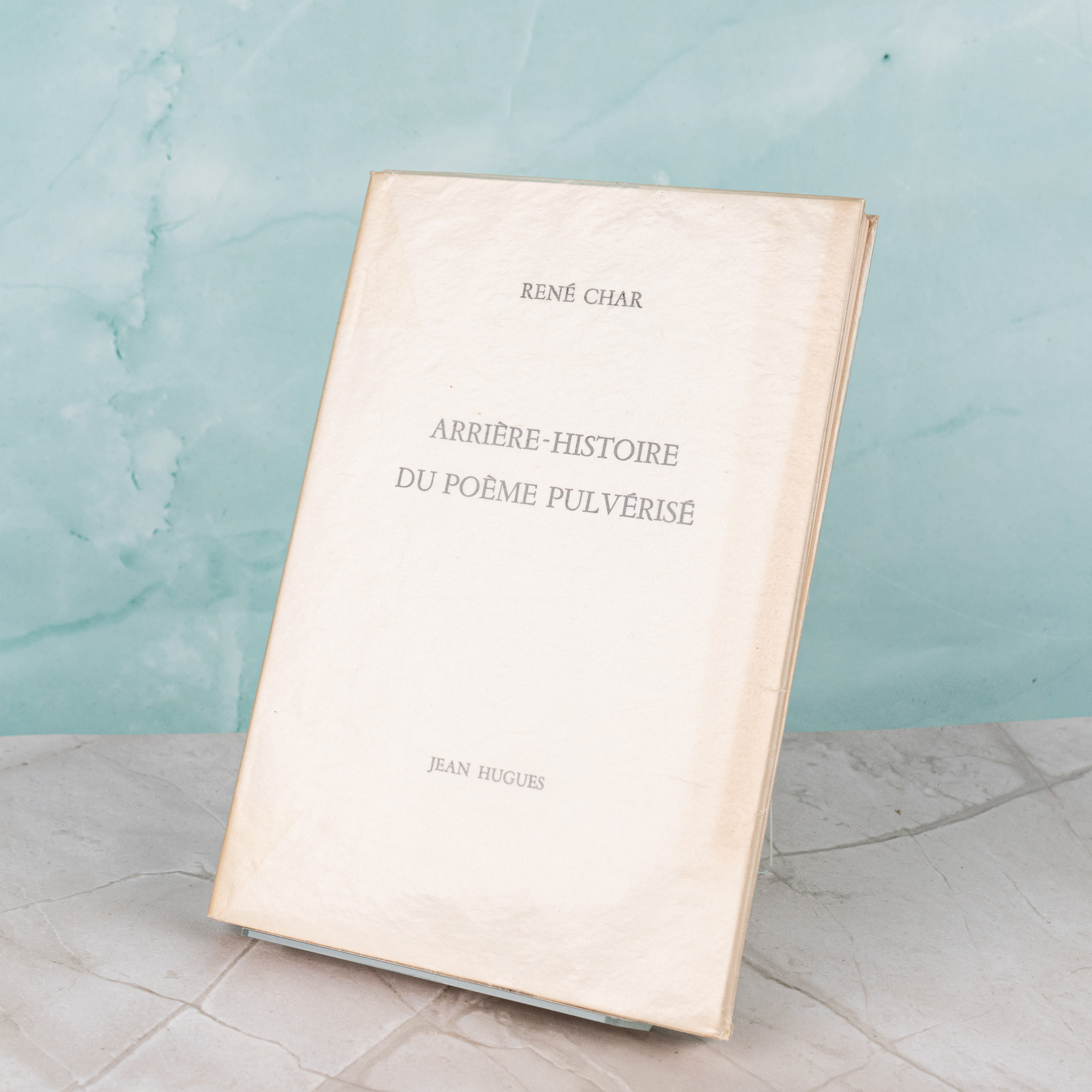
Char, Rene · Stael, Nicolas de
Arrière-histoire du poème pulvérisé
*Arrière-histoire du poème pulvérisé* is a later illustrated edition of a key text in which René Char looks back on the genesis and inner background of *Le Poème pulvérisé*. Published in 1972 by Imprimerie Union, it opens with a colour frontispiece by Nicolas de Staël. The pairing of Char and de Staël is especially charged: two post-war voices, each seeking concentration, clarity, and rupture in his own medium. This copy is one of only six hors commerce copies on Arches and is signed. The autograph presentation inscription to Doctor Marcel Zara, with poetic quotation and October 1972 dating, makes it a deeply personal copy.
Illustrated Book
€920

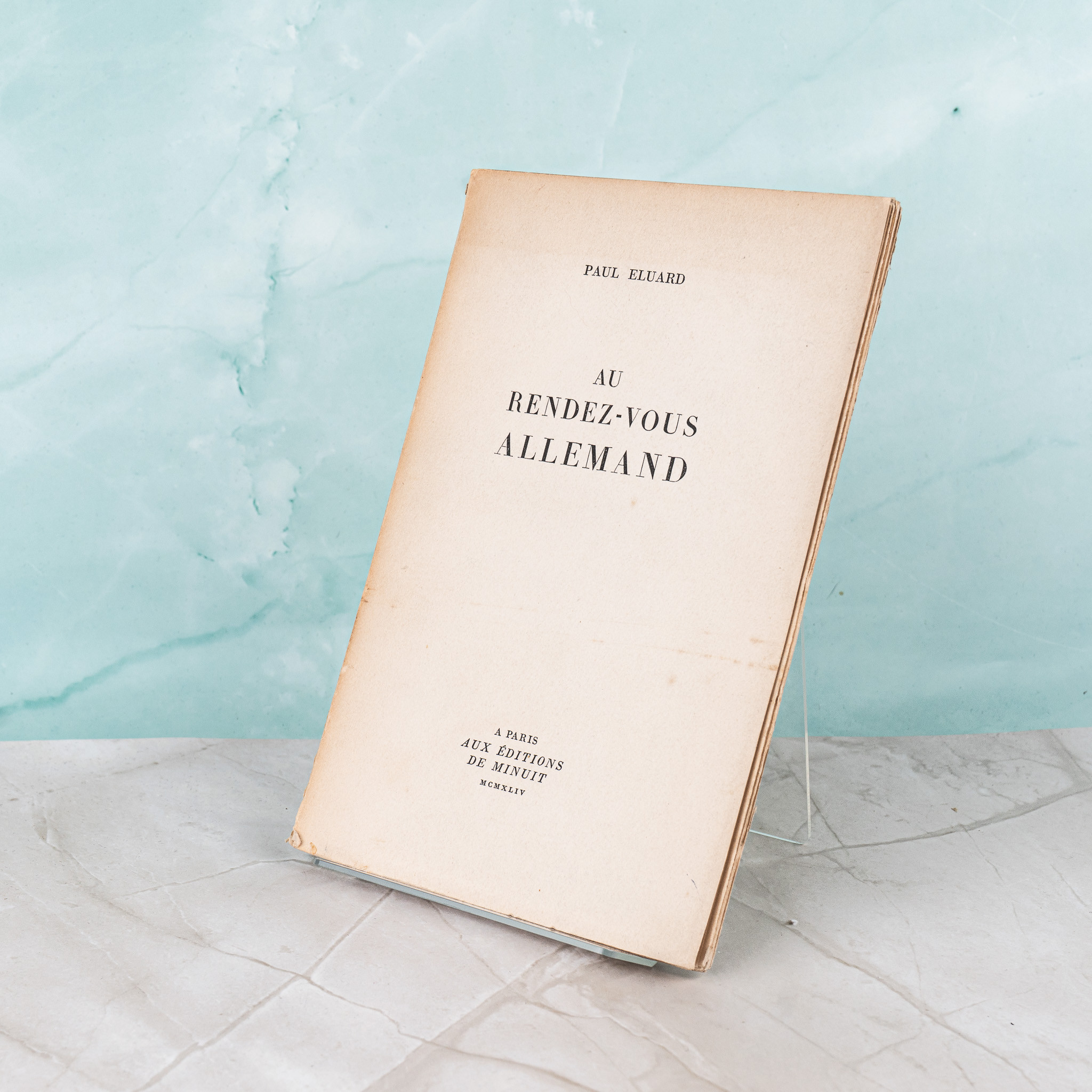
Éluard, Paul
Au rendez-vous allemand
Au rendez-vous allemand is one of the emblematic collections of Éluard’s wartime poetry. The book appeared in 1944 from Les Éditions de Minuit, the publishing house that, under the Occupation, became a moral landmark of the French literary Resistance. The volume gathers poems in which love, mourning, revolt and hope appear not as abstractions but as immediate necessities under German rule. The frontispiece, a portrait of the poet after Picasso, gives the book a powerful artistic signature: two voices of modern France, poet and artist, stand here in the same struggle. This is an ordinary, unnumbered copy, but signed by Éluard on the first page. That signature makes the book more than a Resistance document: it becomes a tangible witness to literary presence in a historically charged year. For the collector, it unites the clandestine aura of Minuit, Picasso’s name and Éluard’s own hand.