


Le Bestiaire ou Cortège d’Orphée
This imposing edition of *Le Bestiaire ou Cortège d’Orphée* pairs Guillaume Apollinaire’s canonical poetry with 33 original burin engravings by Tavy Notton. Published in 1962, more than half a century after the first appearance of Apollinaire’s bestiary, it is a distinctly postwar bibliophile reinterpretation of an early modernist text. Notton translates the brief emblematic poems into powerful black-and-white engravings, including nine double-page compositions. This copy is no. 119, one of 136 copies numbered 64–199 on vélin d’Arches. It belongs to the regular deluxe issue without an additional suite, while retaining all the original engravings created for the book. The edition represents the first printing of Notton’s illustrations, which were subsequently reused for a substantially larger edition. The interior grades Near Fine and the slipcase Very Good, giving an overall condition of Very Good+ to Near Fine. Its particular appeal lies in being a refined postwar bibliophilic reinterpretation of an avant-garde canonical text.
Quantity


Apollinaire, Guillaume
Tavy Notton
Le Bestiaire ou Cortège d’Orphée
1962 | Paris | Aux dépens de l’artiste
This edition unites a canonical text by Apollinaire with an ambitious postwar cycle of original burin engravings. Copy no. 119 is an attractive, well-preserved example of the first printing of Notton’s illustrations and forms a meaningful link between the historical avant-garde and later French bibliophilia.
This imposing edition of *Le Bestiaire ou Cortège d’Orphée* pairs Guillaume Apollinaire’s canonical poetry with 33 original burin engravings by Tavy Notton. Published in 1962, more than half a century after the first appearance of Apollinaire’s bestiary, it is a distinctly postwar bibliophile reinterpretation of an early modernist text. Notton translates the brief emblematic poems into powerful black-and-white engravings, including nine double-page compositions. This copy is no. 119, one of 136 copies numbered 64–199 on vélin d’Arches. It belongs to the regular deluxe issue without an additional suite, while retaining all the original engravings created for the book. The edition represents the first printing of Notton’s illustrations, which were subsequently reused for a substantially larger edition. The interior grades Near Fine and the slipcase Very Good, giving an overall condition of Very Good+ to Near Fine. Its particular appeal lies in being a refined postwar bibliophilic reinterpretation of an avant-garde canonical text.
€420
Condition Report:
In-Depth Study
References & Bibliography
Format
In-folio (Folio) approx. 30 × 40 cm
Edition Particulars
Copy no. 119, one of 136 copies numbered 64–199 on vélin d’Arches, without an additional suite.
Print Run
200
Copy Number
No. 119
Paper
vélin d’Arches
Inscription
No inscription
Product DETAIL
*Le Bestiaire ou Cortège d’Orphée* is a sequence of short poems, each centred on an animal, mythical creature or emblematic figure. Apollinaire draws upon the medieval bestiary tradition, in which animals are not merely described but endowed with moral, symbolic or spiritual significance. Orpheus acts as the unifying figure, turning the sequence into a poetic procession. Birds, fish, insects and mammals are linked to love, poetry, desire, religion and aspects of human character. Rather than forming a continuous narrative, the poems constitute a carefully arranged series of verbal emblems. Their brevity and visual intensity make them especially suitable for collaboration with graphic artists. In this edition, the poems are confronted with Tavy Notton’s monumental burin engravings. The work belongs to Apollinaire’s early modernist period, combining the ancient emblematic tradition with strikingly modern concision.
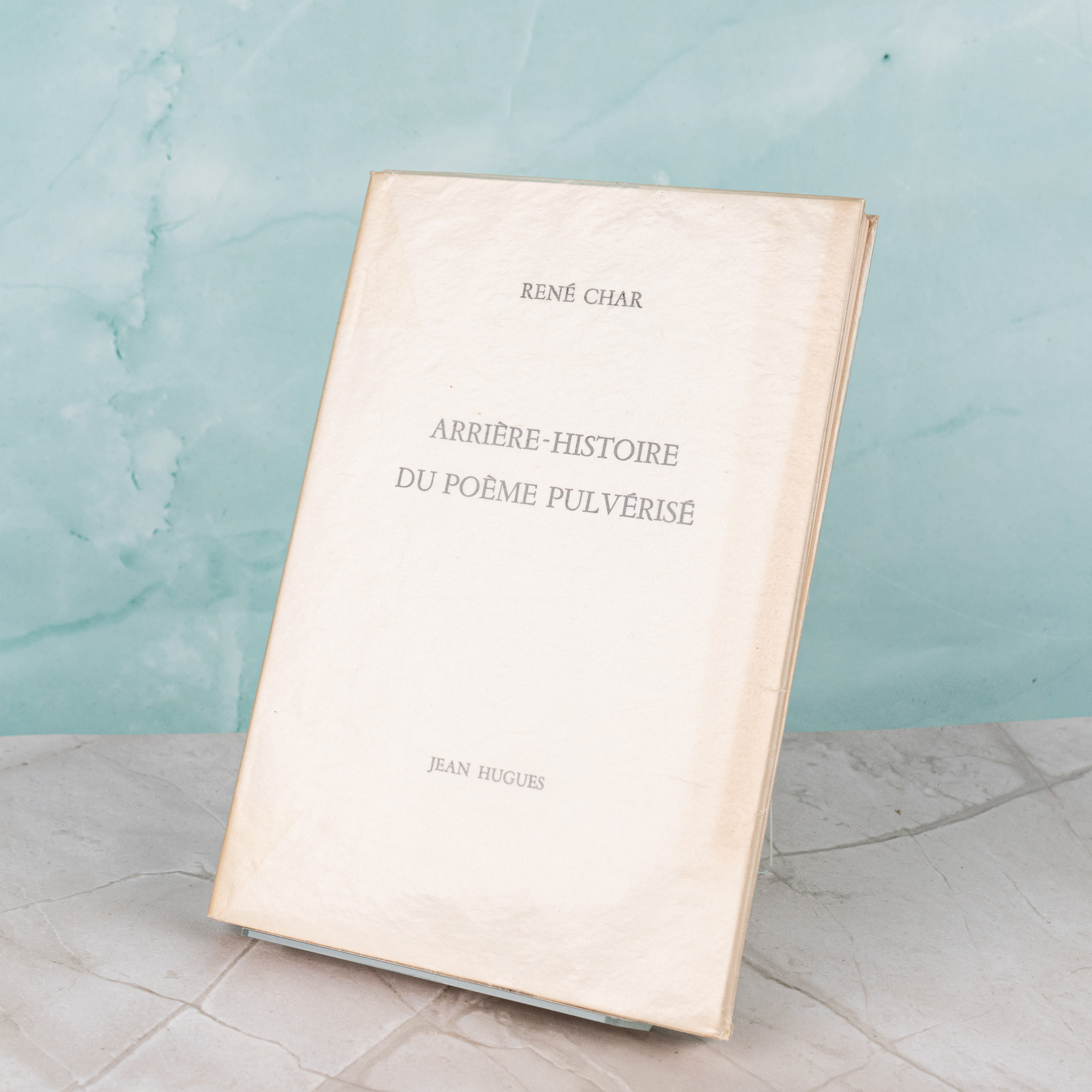
Char, Rene · Stael, Nicolas de
Arrière-histoire du poème pulvérisé
*Arrière-histoire du poème pulvérisé* is a later illustrated edition of a key text in which René Char looks back on the genesis and inner background of *Le Poème pulvérisé*. Published in 1972 by Imprimerie Union, it opens with a colour frontispiece by Nicolas de Staël. The pairing of Char and de Staël is especially charged: two post-war voices, each seeking concentration, clarity, and rupture in his own medium. This copy is one of only six hors commerce copies on Arches and is signed. The autograph presentation inscription to Doctor Marcel Zara, with poetic quotation and October 1972 dating, makes it a deeply personal copy.
Illustrated Book
€920

Derain, André
Amis & Amille. Mystère du XIVe siècle.
This sumptuously bound book brings a medieval mystery to life through a rare collaboration between ancient literature and modern illustration. The geometric box design on garnet morocco provides striking contrast. André Derain’s 22 color lithographs – including one double and three full-page – enhance the narrative with expressive visual force. Printed on Rives vellum in an edition of 180 numbered copies, this copy (No. 72) was made for Baroness Vaxelaire and includes a suite on fine Japanese paper. The binding by Lucie Weill exemplifies artisanal excellence. A harmonious blend of narrative tradition and graphic daring.
Illustrated Book
€1,460

Michaux, Henri · Bettencourt, Pierre
Arriver à se réveiller
A rare first edition of Arriver à se réveiller, written by Henri Michaux in the tremulous post-war years. The text unfolds as an inward journey toward lucidity, where sleep and waking mirror each other. Printed and published by Pierre Bettencourt in his own workshop, the edition’s small run preserves the work’s intimacy. The title-page vignette, a linocut by Bettencourt, sets a spare, rhythmic visual key that amplifies Michaux’s vigilant, vulnerable tone. This copy is handsomely bound in brown morocco with balsa boards by Miguet, a tactile nod to lightness under tension. For bibliophiles, it is an exemplary union of poetry, craft, and experiment. The volume embodies the independence of the post-war small press and Michaux’s radical sensitivity.
Illustrated Book
€680


When a Signature Becomes Provenance
A signature confirms; a dedication connects; an association copy tells a story.

The Fragile Meaning of ‘Complet’
In auction descriptions, “complete” often sounds reassuring — but it is only meaningful when verified against the colophon, the justification, and the bibliography. For The Hidden Page, clarity begins where vague market language ends.

The Avant-Garde and the Illustrated Word
How the Twentieth Century Recast the Book as an Artistic and Ideological Medium