


Le Musée Objectif ou les Voyeurs vus
In this playful yet razor-sharp book, Pol Bury flips the museum inside out: it is not the objects that are watched, but the watchers themselves. *Le Musée Objectif ou les Voyeurs vus* brings together Charles Henneghien’s photographs and Bury’s brief, dryly witty commentaries—vignettes where humour meets precise observation. The result is a “diary of looking”: poses, glances, and small rituals that gather around art. Published by Le Daily-Bul in La Louvière (1991), the book carries a distinctly Belgian strain of artistic irony—light, subversive, and exact. This deluxe head copy is one of only 40 numbered copies on Leykam, signed by both artist and photographer, and accompanied by an original Pol Bury screenprint, justified and pencil-signed (No. XIII). It also bears a warm inscription to André Stas, co-signed by Bury and Henneghien. A fully realised artist’s edition in which book, image, and handwriting form a single ensemble.
Quantity


Bury, Pol
Henneghien, Charles
Le Musée Objectif ou les Voyeurs vus
1991 | La Louvière | Le Daily-Bul
A masterful exercise in artistic voyeurism, elevated by the presence of an original silkscreen. The dedication to André Stas makes this copy a unique historical document of the Belgian avant-garde. An essential work for collectors of Bury and the Daily-Bul aesthetic.
In this playful yet razor-sharp book, Pol Bury flips the museum inside out: it is not the objects that are watched, but the watchers themselves. *Le Musée Objectif ou les Voyeurs vus* brings together Charles Henneghien’s photographs and Bury’s brief, dryly witty commentaries—vignettes where humour meets precise observation. The result is a “diary of looking”: poses, glances, and small rituals that gather around art. Published by Le Daily-Bul in La Louvière (1991), the book carries a distinctly Belgian strain of artistic irony—light, subversive, and exact. This deluxe head copy is one of only 40 numbered copies on Leykam, signed by both artist and photographer, and accompanied by an original Pol Bury screenprint, justified and pencil-signed (No. XIII). It also bears a warm inscription to André Stas, co-signed by Bury and Henneghien. A fully realised artist’s edition in which book, image, and handwriting form a single ensemble.
€550
Condition Report:
In-Depth Study
References & Bibliography
Format
In-4 Carré approx. 27×29 cm
Edition Particulars
One of 40 numbered deluxe copies on Leykam; signed by Pol Bury and Charles Henneghien; with an original Pol Bury screenprint, justified and pencil-signed (No. XIII); with inscription: “Pour André Stas, comme on a dit… Cordialement, Pol Bury (et) Charles Henneghien.”
Print Run
40
Copy Number
No. XIII
Paper
Leykam
Inscription
Signed by the Author,Signed by the Illustrator,Envoi
Product DETAIL
The photographs cast museum-goers as protagonists: watching, posing, comparing, whispering, or finding themselves mirrored in art. Bury’s comments act as sharp captions—short, exact, never moralising. Together, text and image make visible how “culture” can be theatre: a choreography of attention and status. The book reads as a sequence of behavioural snapshots, leaving room for irony as well as warmth. The museum becomes a social stage, and the spectator the real subject.

Michaux, Henri · Bettencourt, Pierre
Arriver à se réveiller
A rare first edition of Arriver à se réveiller, written by Henri Michaux in the tremulous post-war years. The text unfolds as an inward journey toward lucidity, where sleep and waking mirror each other. Printed and published by Pierre Bettencourt in his own workshop, the edition’s small run preserves the work’s intimacy. The title-page vignette, a linocut by Bettencourt, sets a spare, rhythmic visual key that amplifies Michaux’s vigilant, vulnerable tone. This copy is handsomely bound in brown morocco with balsa boards by Miguet, a tactile nod to lightness under tension. For bibliophiles, it is an exemplary union of poetry, craft, and experiment. The volume embodies the independence of the post-war small press and Michaux’s radical sensitivity.
Illustrated Book
€680
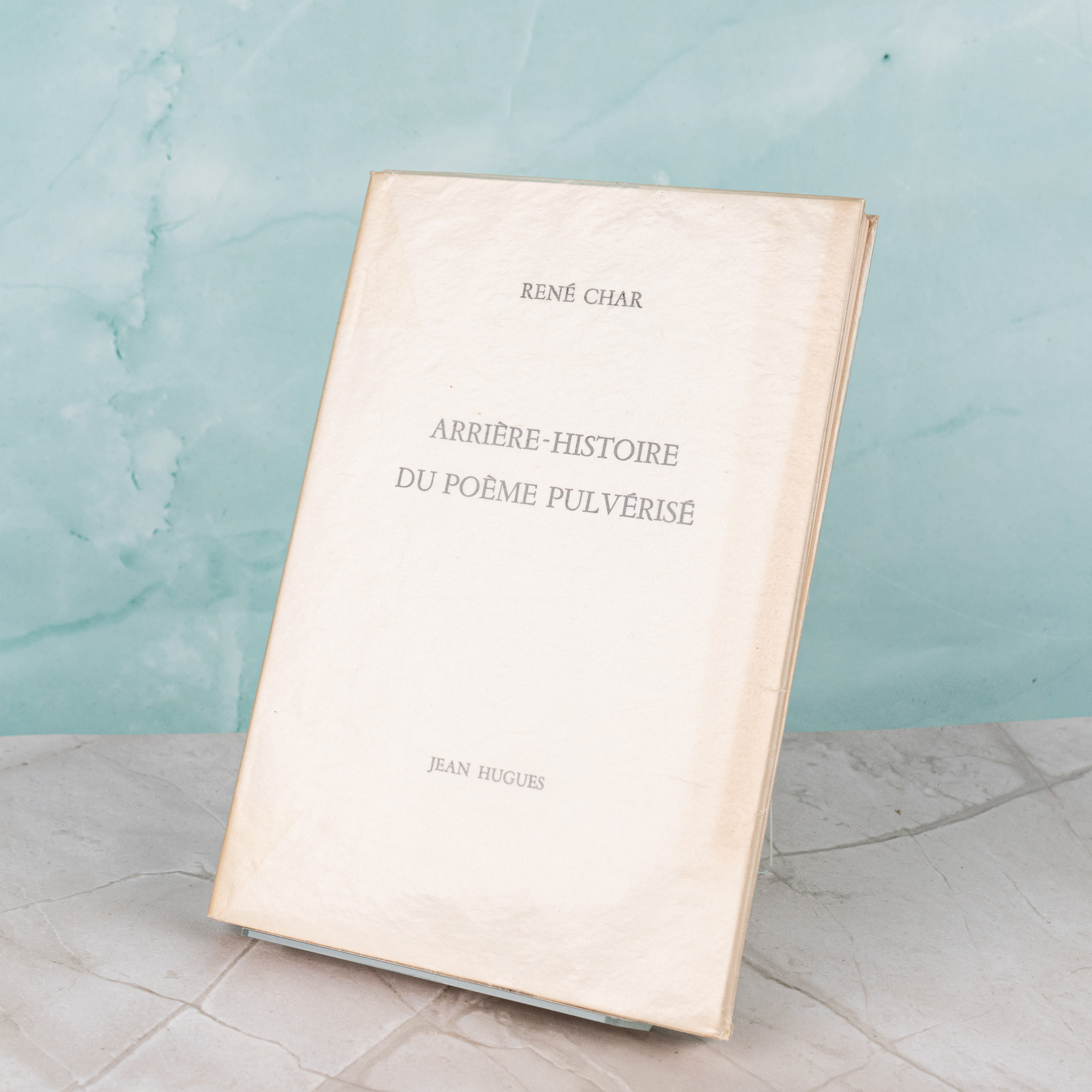
Char, Rene · Stael, Nicolas de
Arrière-histoire du poème pulvérisé
*Arrière-histoire du poème pulvérisé* is a later illustrated edition of a key text in which René Char looks back on the genesis and inner background of *Le Poème pulvérisé*. Published in 1972 by Imprimerie Union, it opens with a colour frontispiece by Nicolas de Staël. The pairing of Char and de Staël is especially charged: two post-war voices, each seeking concentration, clarity, and rupture in his own medium. This copy is one of only six hors commerce copies on Arches and is signed. The autograph presentation inscription to Doctor Marcel Zara, with poetic quotation and October 1972 dating, makes it a deeply personal copy.
Illustrated Book
€920

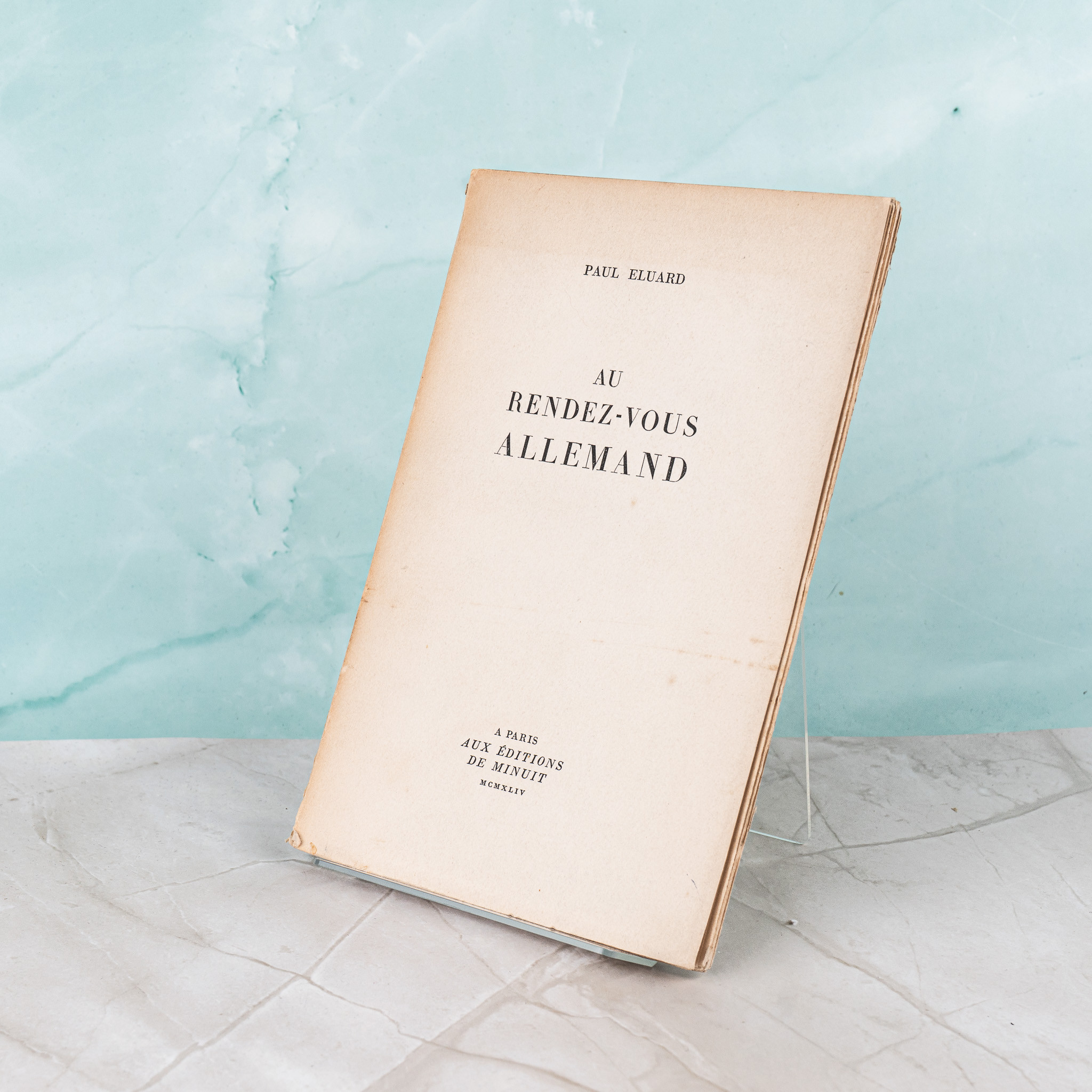
Éluard, Paul
Au rendez-vous allemand
Au rendez-vous allemand is one of the emblematic collections of Éluard’s wartime poetry. The book appeared in 1944 from Les Éditions de Minuit, the publishing house that, under the Occupation, became a moral landmark of the French literary Resistance. The volume gathers poems in which love, mourning, revolt and hope appear not as abstractions but as immediate necessities under German rule. The frontispiece, a portrait of the poet after Picasso, gives the book a powerful artistic signature: two voices of modern France, poet and artist, stand here in the same struggle. This is an ordinary, unnumbered copy, but signed by Éluard on the first page. That signature makes the book more than a Resistance document: it becomes a tangible witness to literary presence in a historically charged year. For the collector, it unites the clandestine aura of Minuit, Picasso’s name and Éluard’s own hand.
Illustrated Book
€350

When a Signature Becomes Provenance
A signature confirms; a dedication connects; an association copy tells a story.

The Fragile Meaning of ‘Complet’
In auction descriptions, “complete” often sounds reassuring — but it is only meaningful when verified against the colophon, the justification, and the bibliography. For The Hidden Page, clarity begins where vague market language ends.

The Avant-Garde and the Illustrated Word
How the Twentieth Century Recast the Book as an Artistic and Ideological Medium