


Le Testament d’Orphée : film
With *Le Testament d’Orphée*, Jean Cocteau published in 1961 the literary and visual counterpart to the film he conceived as his cinematic testament. The poet places himself at the centre of a dreamlike world where memories, mythological figures and characters from his own oeuvre encounter one another. The book reflects the exceptional unity of literature, visual art and cinema that defines Cocteau’s work. Lucien Clergue’s photographs reinforce its character as a tangible extension of the film. This first edition on ordinary paper is distinguished by a warm presentation inscription from Cocteau to ‘l’ami Malle’. The cinematic context and close overlap of professional circles make Louis Malle the very probable recipient. The copy thus creates a compelling association between two highly individual voices in French cinema at the beginning of the 1960s.
Quantity


Cocteau, Jean
Lucien Clergue
Le Testament d’Orphée : film
1961 | Monaco | Éditions du Rocher
An important late first edition in which Cocteau brings poetry, mythology and cinema together in a deliberate artistic testament. The inscription very probably addressed to Louis Malle also gives this copy exceptional association value within the history of French cinema.
With *Le Testament d’Orphée*, Jean Cocteau published in 1961 the literary and visual counterpart to the film he conceived as his cinematic testament. The poet places himself at the centre of a dreamlike world where memories, mythological figures and characters from his own oeuvre encounter one another. The book reflects the exceptional unity of literature, visual art and cinema that defines Cocteau’s work. Lucien Clergue’s photographs reinforce its character as a tangible extension of the film. This first edition on ordinary paper is distinguished by a warm presentation inscription from Cocteau to ‘l’ami Malle’. The cinematic context and close overlap of professional circles make Louis Malle the very probable recipient. The copy thus creates a compelling association between two highly individual voices in French cinema at the beginning of the 1960s.
€950
Condition Report:
In-Depth Study
References & Bibliography
Format
In-8 (Octavo) approx. 20 × 26 cm
Edition Particulars
Copy of the first edition on ordinary paper, with a signed presentation inscription ‘à l’ami Malle, de tout cœur, Jean Cocteau’, very probably addressed to filmmaker Louis Malle.
Paper
papier courant
Inscription
Association Copy
Product DETAIL
The work presents Cocteau himself as the poet, moving through a world in which time, reality and imagination continually merge. Characters from his earlier films and from the myth of Orpheus reappear and confront him with his own creations. The poet is judged by the Princess and Heurtebise before continuing his journey through a symbolic intermediate realm. Encounters with mythological figures, artists and apparitions from his personal universe turn the narrative into a retrospective of an entire creative life. Death appears not as a definitive ending but as a boundary the poet repeatedly crosses. The whole functions simultaneously as self-portrait, artistic credo and farewell. *Le Testament d’Orphée* therefore forms a synthesis of the principal mythological and autobiographical motifs of Cocteau’s work.

Derain, André
Amis & Amille. Mystère du XIVe siècle.
This sumptuously bound book brings a medieval mystery to life through a rare collaboration between ancient literature and modern illustration. The geometric box design on garnet morocco provides striking contrast. André Derain’s 22 color lithographs – including one double and three full-page – enhance the narrative with expressive visual force. Printed on Rives vellum in an edition of 180 numbered copies, this copy (No. 72) was made for Baroness Vaxelaire and includes a suite on fine Japanese paper. The binding by Lucie Weill exemplifies artisanal excellence. A harmonious blend of narrative tradition and graphic daring.
Illustrated Book
€1,460

Michaux, Henri · Bettencourt, Pierre
Arriver à se réveiller
A rare first edition of Arriver à se réveiller, written by Henri Michaux in the tremulous post-war years. The text unfolds as an inward journey toward lucidity, where sleep and waking mirror each other. Printed and published by Pierre Bettencourt in his own workshop, the edition’s small run preserves the work’s intimacy. The title-page vignette, a linocut by Bettencourt, sets a spare, rhythmic visual key that amplifies Michaux’s vigilant, vulnerable tone. This copy is handsomely bound in brown morocco with balsa boards by Miguet, a tactile nod to lightness under tension. For bibliophiles, it is an exemplary union of poetry, craft, and experiment. The volume embodies the independence of the post-war small press and Michaux’s radical sensitivity.
Illustrated Book
€680
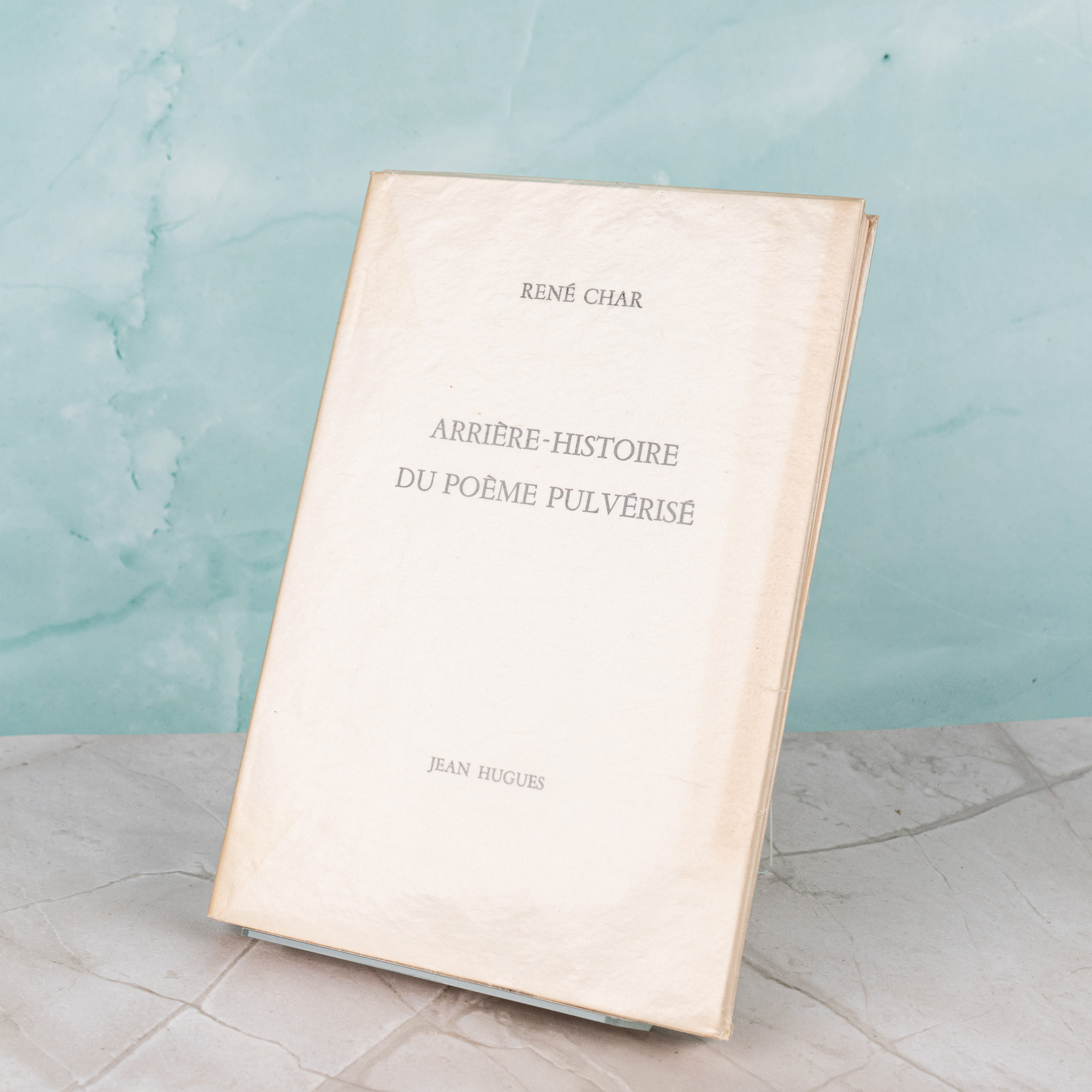
Char, Rene · Stael, Nicolas de
Arrière-histoire du poème pulvérisé
*Arrière-histoire du poème pulvérisé* is a later illustrated edition of a key text in which René Char looks back on the genesis and inner background of *Le Poème pulvérisé*. Published in 1972 by Imprimerie Union, it opens with a colour frontispiece by Nicolas de Staël. The pairing of Char and de Staël is especially charged: two post-war voices, each seeking concentration, clarity, and rupture in his own medium. This copy is one of only six hors commerce copies on Arches and is signed. The autograph presentation inscription to Doctor Marcel Zara, with poetic quotation and October 1972 dating, makes it a deeply personal copy.
Illustrated Book
€920


When a Signature Becomes Provenance
A signature confirms; a dedication connects; an association copy tells a story.

The Fragile Meaning of ‘Complet’
In auction descriptions, “complete” often sounds reassuring — but it is only meaningful when verified against the colophon, the justification, and the bibliography. For The Hidden Page, clarity begins where vague market language ends.

Size does (not) matter
Size does (not) matter: The Paradoxical Power of Format in Avant-Garde Book Art