


Les Dieux s’en vont, d’Annunzio reste
A scarce early work by Marinetti, published in Paris in 1908, in which he attacks the cult surrounding d’Annunzio and prepares the modernist break. This copy is notable for a long ink presentation on the half-title—“à mon cher maître et ami / hommage admiratif et dévoué / F.T. Marinetti”—and for an address note on the pastedown: “Poesia / 2 Via Senato / Milan”, a direct link to his journal. The volume is also illustrated with pen drawings by Ugo Valeri, whose sleek Liberty line supplies a visual counter-chant to the polemical energy. Inserted between the lines in graphite, by another hand, appears the name of Laurent Tailhade, likely the addressee. Original wrappers are preserved with protective glassine. As a document of networks and polemical energy, the book shows Marinetti’s French platform on the eve of the *Futurist Manifesto*. A compelling copy for collectors of the historical avant-garde.
Quantity


Marinetti, Filippo Tommaso
Valeri, Ugo
Les Dieux s’en vont, d’Annunzio reste
1908 | Paris | E. Sansot & Cie
An early Marinetti with autograph in original wrappers—a threshold piece toward Futurism. Maximum historical yield from a modest form. Copy with telling provenance cues.
A scarce early work by Marinetti, published in Paris in 1908, in which he attacks the cult surrounding d’Annunzio and prepares the modernist break. This copy is notable for a long ink presentation on the half-title—“à mon cher maître et ami / hommage admiratif et dévoué / F.T. Marinetti”—and for an address note on the pastedown: “Poesia / 2 Via Senato / Milan”, a direct link to his journal. The volume is also illustrated with pen drawings by Ugo Valeri, whose sleek Liberty line supplies a visual counter-chant to the polemical energy. Inserted between the lines in graphite, by another hand, appears the name of Laurent Tailhade, likely the addressee. Original wrappers are preserved with protective glassine. As a document of networks and polemical energy, the book shows Marinetti’s French platform on the eve of the *Futurist Manifesto*. A compelling copy for collectors of the historical avant-garde.
€980
Condition Report:
In-Depth Study
References & Bibliography
Format
In-12 (Duodecimo) approx. 17 × 22 cm
Edition Particulars
With long ink presentation on half-title; address note “Poesia / 2 Via Senato / Milan” on pastedown; name “Laurent Tailhade” later added in pencil by another hand.
1
Edition Particulars:
We welcome private inquiries, collaborations with institutions, and acquisition requests. Each message is treated with discretion and respect. We welcome private inquiries, collaborations with institutions, and acquisition requests.
1
Print Run:
Condition Report:
1
Copy Number:
Condition Report:
1
Paper:
Condition Report:
1
Signed:
Condition Report:
Product DETAIL
Marinetti’s text is a compact, fiery pamphlet that turns against aestheticism and the politics of literary fame. In taut, rhythmic French prose he relativizes d’Annunzio’s legacy and posits a new, aggressive modernity. The stakes are moral as much as artistic: away from decorum toward speed and energy. The book documents how, before 1909, Marinetti had already found the tone and combat register of Futurism. The paratext—inscription and address—links the Parisian scene to the Milan editorial office of *Poesia*. Valeri’s drawings act as vignettes and accents pacing the oratorical surge.
Apollinaire, Guillaume · Férat, Serge
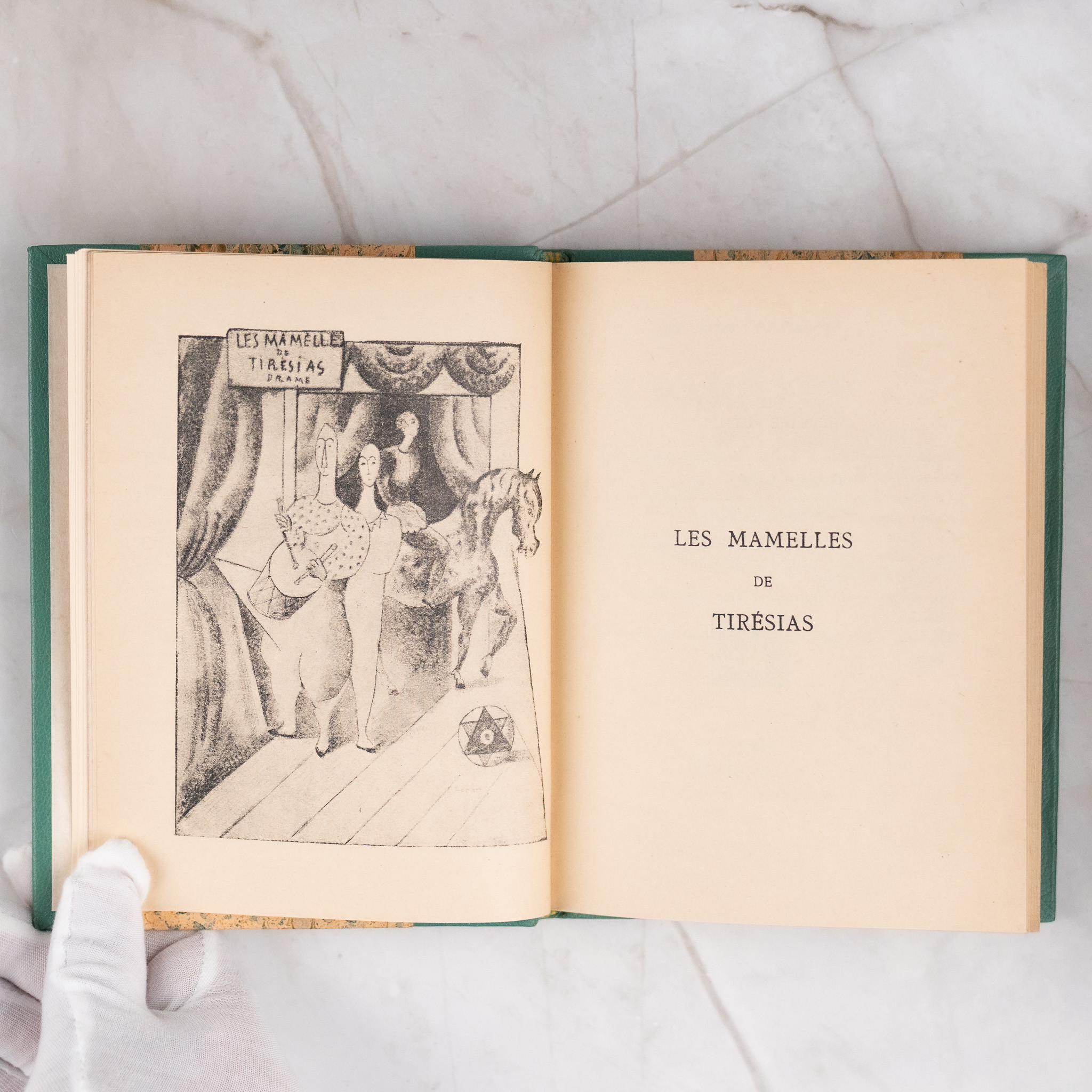
Les Mamelles de Tirésias. Drame surréaliste en deux actes et un prologue
*Les Mamelles de Tirésias* is a key book of the historical avant-garde: Apollinaire’s “drame surréaliste” appeared in 1918 from SIC, shortly after the scandalous 1917 staging. The edition brings together text, image and music: Serge Férat’s drawings and Germaine Albert-Birot’s music make it more than a printed play. In its title and subtitle, the word “surréaliste” appears at a moment when it did not yet name a movement, but a poetic possibility. The book therefore stands at the threshold between Cubist theatrical renewal, Dadaist disruption and the Surrealism to come. This copy on ordinary paper is bound in turquoise-green half leather, with gilt spine and the original wrappers preserved. Its provenance is notable: the circular blind stamp “Bibliothèque de Jean Cassou”, with the “JC” monogram, places the copy in the library of an important writer, critic, museum director and Resistance figure. A foundational avant-garde book is thus linked to a second layer of French cultural history.
Ill Book
€950
Dorgelès, Roland · Dunoyer de Segonzac
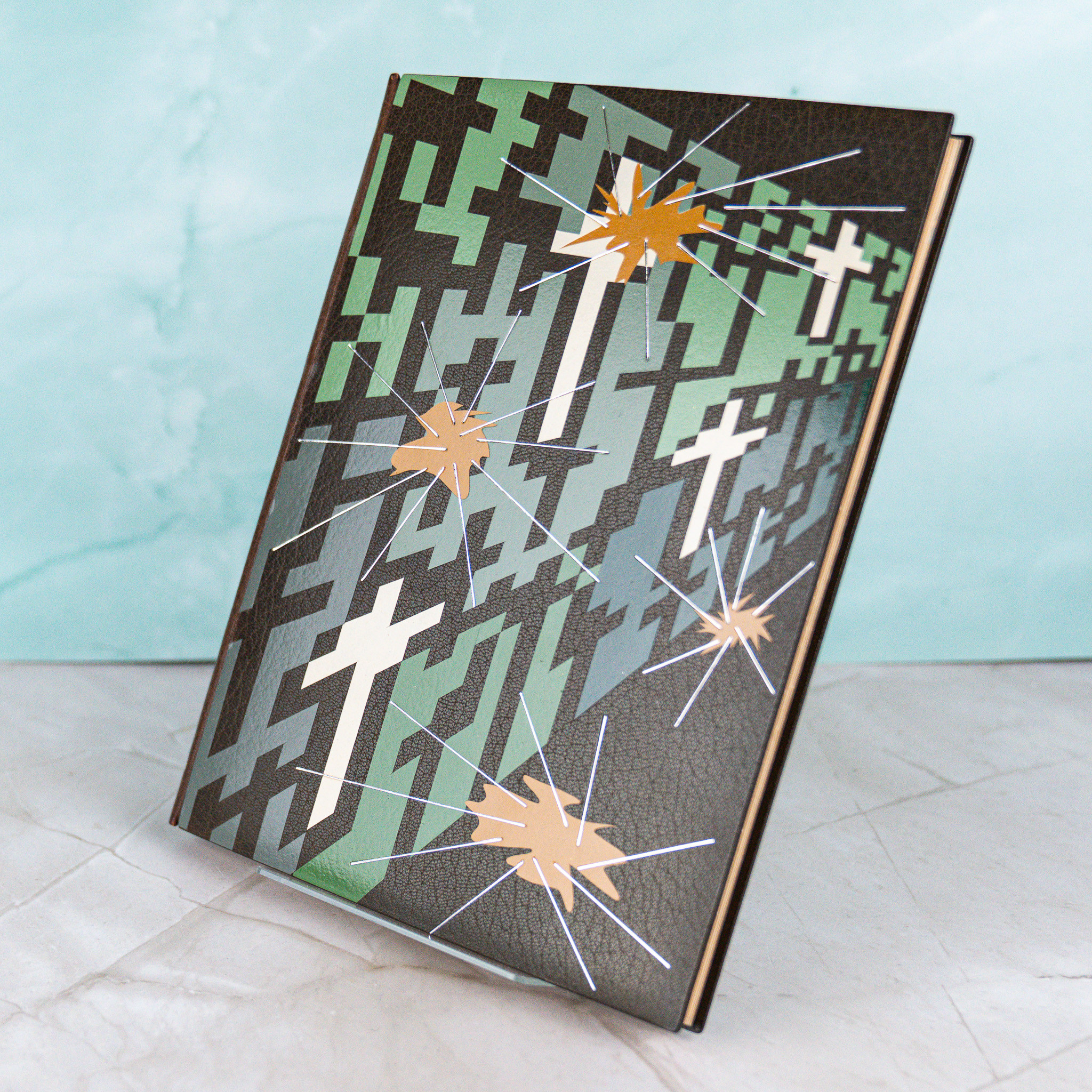
La Boule de gui
This first edition brings together three war episodes omitted from Les Croix de bois: La Boule de gui, Permissionnaires, and Le Prisonnier bénévole, formerly titled L’Ennemi des vieux. Published in 1922, it is also the first illustrated issue of these texts. André Dunoyer de Segonzac accompanies Dorgelès’s front-line prose with 42 reproduced drawings and five original drypoints hors texte, including the frontispiece. His nervous, direct line closely matches the stories’ hard observation and comradeship. This copy, number 401 on tinted Lafuma paper, belongs to the regular yet still limited issue of 519 copies on this stock. Devauchelle’s exceptional artist’s binding translates trenches, crosses, and explosions into a forceful modern design, turning the volume into a distinctive bibliophile object.
Ill Book
€1,150
Char, Rene · Stael, Nicolas de
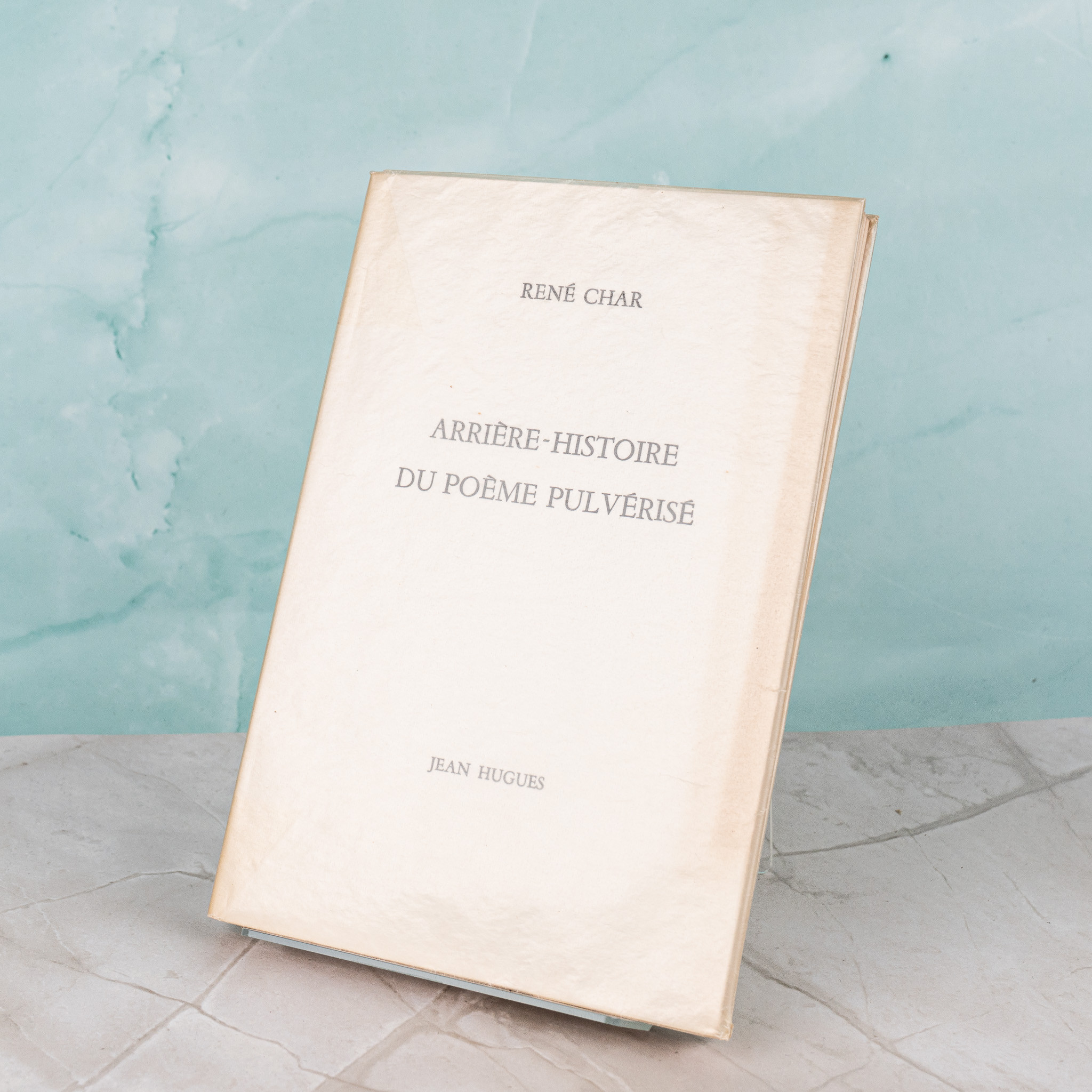
Arrière-histoire du poème pulvérisé
*Arrière-histoire du poème pulvérisé* is a later illustrated edition of a key text in which René Char looks back on the genesis and inner background of *Le Poème pulvérisé*. Published in 1972 by Imprimerie Union, it opens with a colour frontispiece by Nicolas de Staël. The pairing of Char and de Staël is especially charged: two post-war voices, each seeking concentration, clarity, and rupture in his own medium. This copy is one of only six hors commerce copies on Arches and is signed. The autograph presentation inscription to Doctor Marcel Zara, with poetic quotation and October 1972 dating, makes it a deeply personal copy.
Ill Book
€920
Crevel, René · Tchelitchew, Pavel
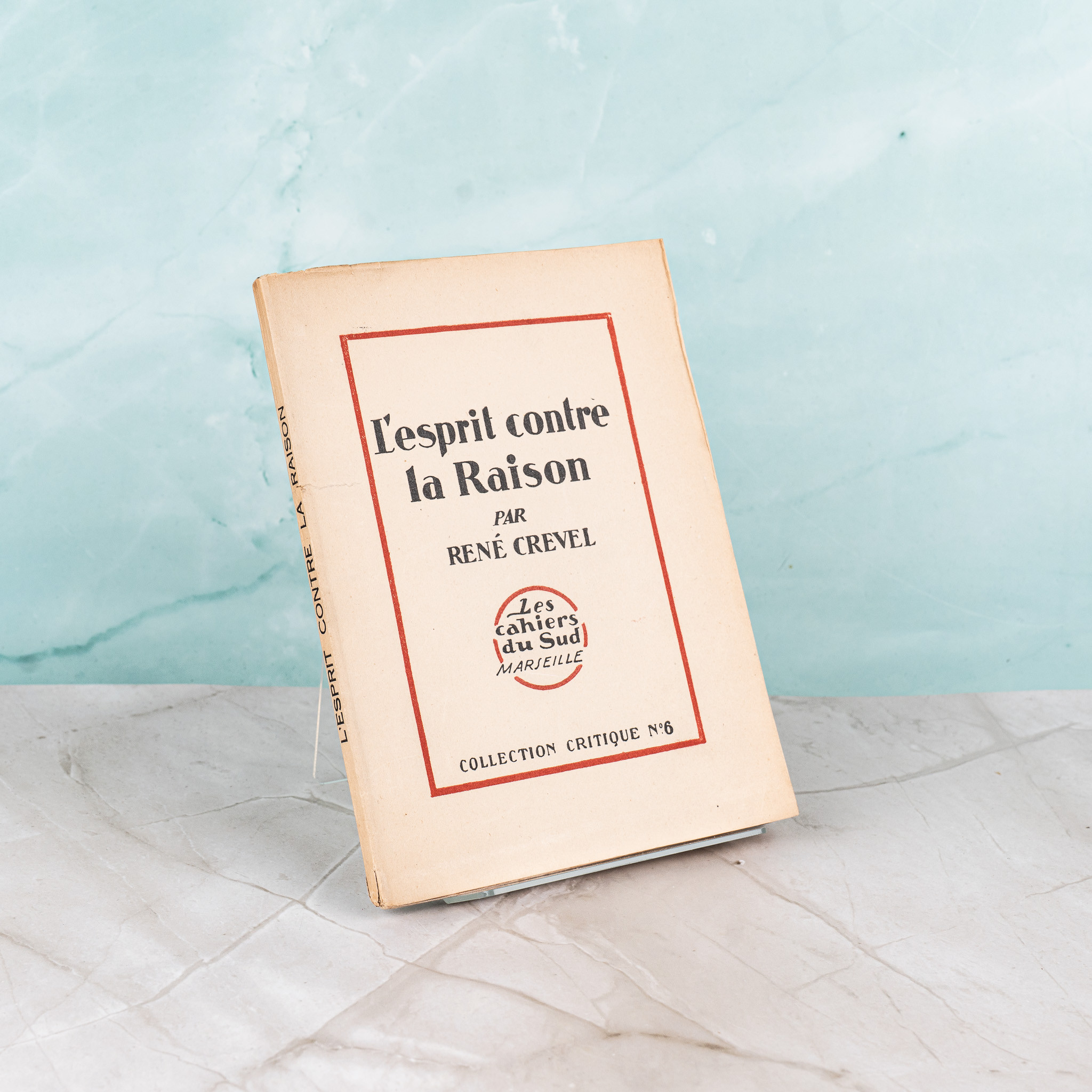
L’esprit contre la raison
L’esprit contre la raison is a brief, vehement text from the heart of French Surrealism. René Crevel writes here not as a systematic philosopher, but as a polemicist intent on disturbing the order of reason, morality and bourgeois clarity. The book was published in 1927 by Les Cahiers du Sud, a review and publishing circle receptive to literary experiment beyond the Parisian centre. Pavel Tchelitchew’s frontispiece portrait gives the volume a strong visual presence and links Crevel’s voice to the cosmopolitan artistic world of the 1920s. In its original wrappers, the copy preserves the sober, nervous materiality of a text that reads more like an assault than a treatise. Its status as a review copy also marks it as a book meant to move through the literary networks of its moment.

