


Lettre à Jacques Maritain + Réponse à Jean Cocteau
Lettre à Jacques Maritain and Réponse à Jean Cocteau together form a remarkable 1926 diptych in which literature, conversion, friendship and Catholic intellectual culture meet. Cocteau addresses Jacques Maritain from a moment of spiritual and moral reorientation, while Maritain replies from his position as philosopher and Catholic thinker. The two pamphlets are modest in format but considerable in meaning: they document one of the most sensitive points of contact between the French avant-garde and religious thought in the interwar period. This ensemble is especially notable for the double inscription to Jacques Guenne, writer, critic and man of letters. In the Lettre, Cocteau writes: “à Jacques Guenne / son ami / Jean”, while Maritain notes in the Réponse: “à Jacques Guenne / sincère hommage / J. Maritain”. The condition is fragile, with faded and damaged wrappers, losses, tears and foxing, but that fragility precisely matches the ephemeral pamphlet form. As service de presse copies with two autograph inscriptions to the same literary recipient, they form a highly charged association set.
Quantity


Jean Cocteau, Jacques Maritain
Lettre à Jacques Maritain + Réponse à Jean Cocteau
1926 | Paris | Stock
This double service de presse ensemble is notable for its two autograph inscriptions to Jacques Guenne. Despite the fragile and damaged wrappers, the pair preserves a rare dialogue between Cocteau’s intimate modernity and Maritain’s Catholic seriousness. It is a vulnerable but charged association copy from the heart of the interwar period.
Lettre à Jacques Maritain and Réponse à Jean Cocteau together form a remarkable 1926 diptych in which literature, conversion, friendship and Catholic intellectual culture meet. Cocteau addresses Jacques Maritain from a moment of spiritual and moral reorientation, while Maritain replies from his position as philosopher and Catholic thinker. The two pamphlets are modest in format but considerable in meaning: they document one of the most sensitive points of contact between the French avant-garde and religious thought in the interwar period. This ensemble is especially notable for the double inscription to Jacques Guenne, writer, critic and man of letters. In the Lettre, Cocteau writes: “à Jacques Guenne / son ami / Jean”, while Maritain notes in the Réponse: “à Jacques Guenne / sincère hommage / J. Maritain”. The condition is fragile, with faded and damaged wrappers, losses, tears and foxing, but that fragility precisely matches the ephemeral pamphlet form. As service de presse copies with two autograph inscriptions to the same literary recipient, they form a highly charged association set.
€650
Condition Report:
In-Depth Study
References & Bibliography
Format
In-12 (Duodecimo) approx. 17 × 22 cm
Edition Particulars
Two service de presse copies: Lettre à Jacques Maritain with Jean Cocteau’s inscription “à Jacques Guenne / son ami / Jean”; Réponse à Jean Cocteau with Jacques Maritain’s inscription “à Jacques Guenne / sincère hommage / J. Maritain”.
Inscription
Association Copy
Product DETAIL
The two texts constitute a direct correspondence in book form. Cocteau’s Lettre à Jacques Maritain begins from his personal relationship with Maritain and from the tensions between art, sin, faith, purity and public reputation. He speaks as a poet and artist examining the moral and spiritual consequences of his life and work. Maritain’s Réponse à Jean Cocteau takes these questions seriously and places them within a Catholic and philosophical framework. The core of the diptych is not a fictional plot, but a dialogue on the artist’s position before grace, discipline, modernity and inner truth. The exchange is at once personal and public, intimate and programmatic. The inscriptions to Jacques Guenne show that these texts immediately circulated within a critical literary milieu.

Ribemont-Dessaignes, Georges
Ariane
A remarkable copy of *Ariane*, published in the *Les Cahiers Nouveaux* series, inscribed with a poetic and enigmatic message by Ribemont-Dessaignes to Jacques Matarasso. This deluxe Japan paper edition was elegantly rebound in 1994 by Georges Leroux, in a restrained style that echoes the work’s Dadaist spirit.
Book
€1,100
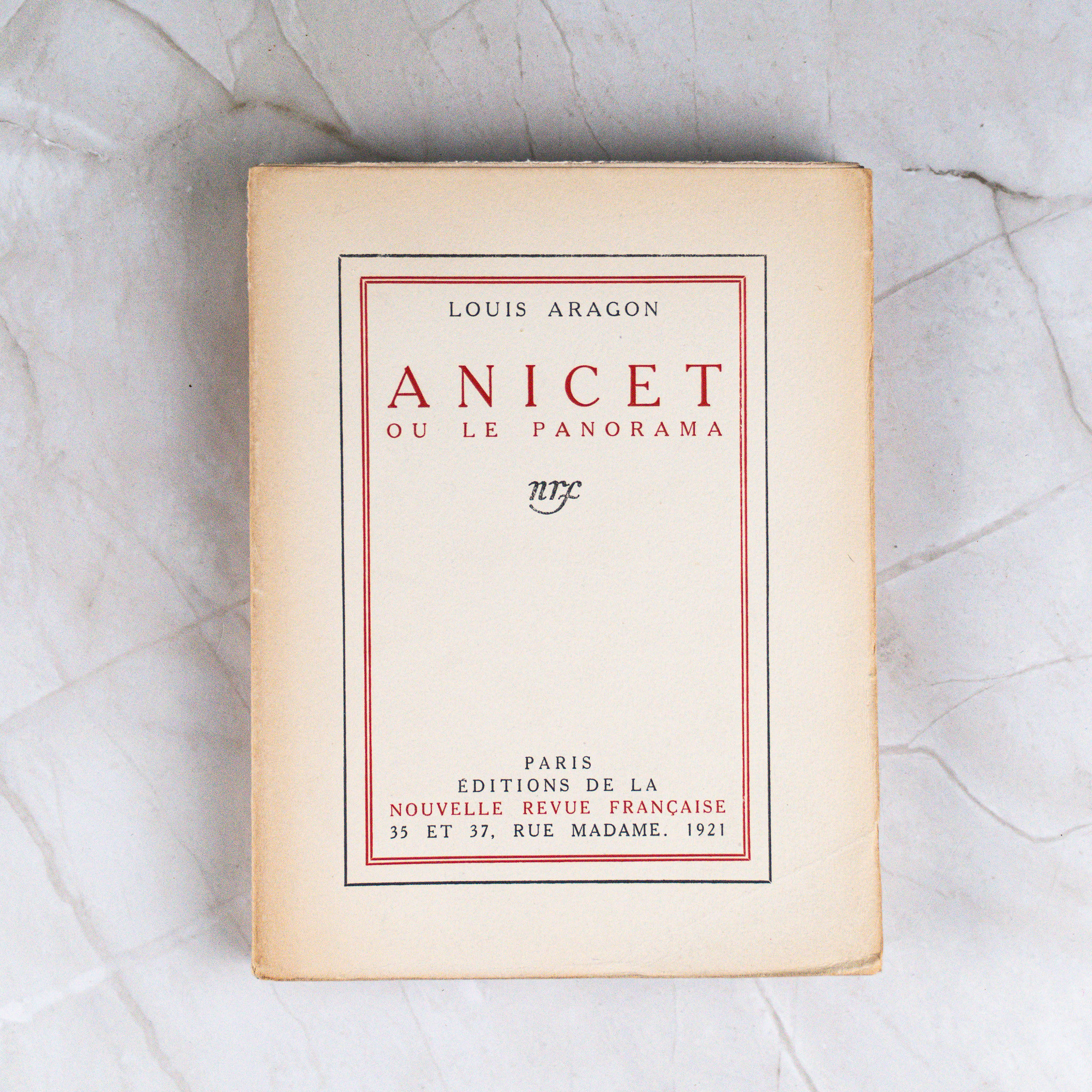
Aragon, Louis
Anicet ou le panorama
With *Anicet ou le panorama* (Paris, NRF, 1921), Louis Aragon delivers an early, deliberately hybrid novel written at the hinge between Dada disruption and the rise of Surrealism. The book proceeds by visions and sequences—a “panorama” in which identity, desire, and the act of looking continually shift. In this bibliophile form (“tirage de tête” reserved for NRF bibliophiles), the novel also becomes a collectible object intended for a small inner circle. This copy is specifically designated “pour le Dr. Sourdel” and numbered XLVIII, underscoring the selective, personalized nature of the issue. Published under the NRF imprint, Aragon is anchored in the literary center while keeping the book’s formal audacity intact. A key item for understanding the nervous modernity of the early 1920s.
Book
€1,150

Cocteau, Jean · Marie Laurencin
Poésies. 1917-1920
*Poésies. 1917-1920* gathers poems from a decisive period in Jean Cocteau’s development, at the intersection of poetry, music and the Parisian avant-garde. The collection was published in 1920 by Éditions de la Sirène, a house closely associated with Cocteau during these years. The poems belong to the period of his involvement with Erik Satie, the Groupe des Six and artists connected with Cubism, although Cocteau himself resisted identification with any single movement. Marie Laurencin contributed the printed illustration for the original wrapper, giving the volume a significant visual dimension. In this copy that wrapper has been preserved within an attractive contemporary half-leather binding. Most notably, Cocteau inscribed the book to a friend named Marcelle, possibly the pianist Marcelle Meyer, potentially connecting this individual copy with the artistic circle in which the work originated.
Book
€950

Éluard, Paul · PERET, Benjamin
152 Proverbes mis au goût du jour
With *152 Proverbes mis au goût du jour*, Paul Éluard and Benjamin Péret published in 1925 one of the most characteristic linguistic experiments of the first phase of organized Surrealism. The book takes one of the most familiar forms of collective wisdom, the proverb, and subjects it to systematic disruption. Familiar expressions are shifted, crossed and rewritten so that their apparently self-evident logic gives way to unexpected meanings. The collaboration brings together two central voices of the young Surrealist movement in a text where humour and poetic subversion are inseparable. The work appeared in the immediate orbit of *La Révolution surréaliste*, the periodical that from late 1924 served as a major organ of the movement. It is also bibliographically significant as the first title of the Éditions Surréalistes, recorded as Sebbag, no. 1 and also referenced as Lhermitte 236. This copy belongs to the ordinary issue on edition paper. As an early independent Surrealist publication, the book has both literary and documentary importance.
Book
€250

When a Signature Becomes Provenance
A signature confirms; a dedication connects; an association copy tells a story.

The Fragile Meaning of ‘Complet’
In auction descriptions, “complete” often sounds reassuring — but it is only meaningful when verified against the colophon, the justification, and the bibliography. For The Hidden Page, clarity begins where vague market language ends.

Size does (not) matter
Size does (not) matter: The Paradoxical Power of Format in Avant-Garde Book Art