


Lisières du devenir
Published in Paris in 1963 by Jean Hugues, Lisières du devenir is a masterful collaboration between poet Lucien Scheler and visual artist Raoul Ubac. More than a book, it is a fully realized livre d’artiste—a fusion of poetry and visual art that epitomizes the French avant-garde's embrace of material experimentation and poetic depth in the post-war years. Here, text and image converse with striking intensity, resulting in an object as tactile as it is conceptual.
Quantity


Scheler, Lucien
Ubac, Raoul
Lisières du devenir
1963 | Paris | Jean Hugues
A haunting, tactile encounter between poetic intuition and graphic materiality, Lisières du devenir is a landmark of 20th-century artist books.
Published in Paris in 1963 by Jean Hugues, Lisières du devenir is a masterful collaboration between poet Lucien Scheler and visual artist Raoul Ubac. More than a book, it is a fully realized livre d’artiste—a fusion of poetry and visual art that epitomizes the French avant-garde's embrace of material experimentation and poetic depth in the post-war years. Here, text and image converse with striking intensity, resulting in an object as tactile as it is conceptual.
€2,200
Condition Report:
In-Depth Study
References & Bibliography
Format
In-4 (Quarto) approx. 25 × 32 cm
Edition Particulars
First edition, deluxe issue
Print Run
90
Copy Number
0
Paper
Papier d’Auvergne (Richard de Bas) + suite op Japon Impérial
Inscription
Signed by the Author,Signed by the Illustrator
Product DETAIL
Scheler’s verse unfolds in fifteen elliptical sections, tracing the margins of transformation, memory, and dissolution. His language is dense and syncopated, evocative rather than descriptive, and structured around the idea of the lisière—the boundary or edge—as a metaphor for becoming. This is poetry meant to be read slowly, its rhythms resonating like echoes across a shifting landscape.
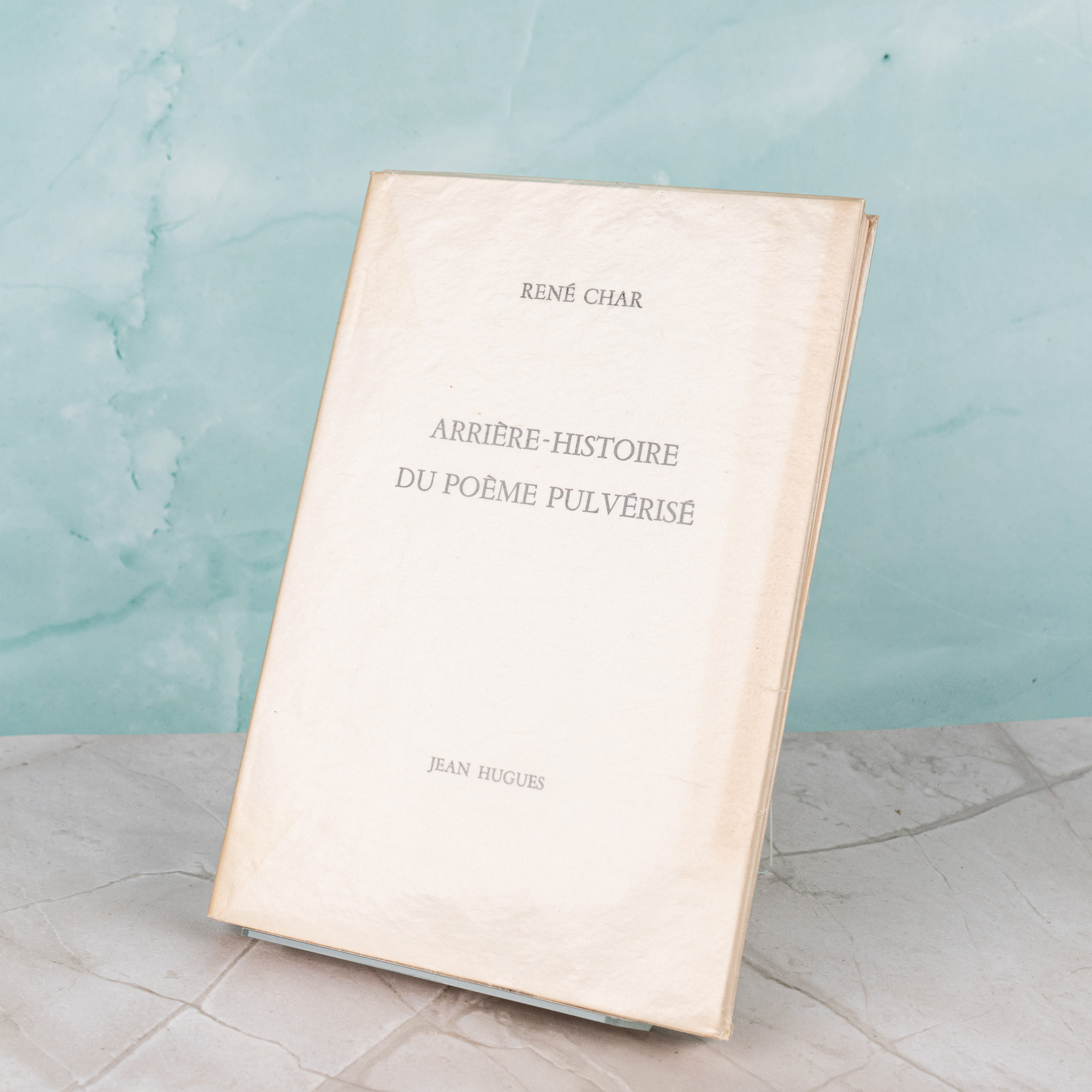
Char, Rene · Stael, Nicolas de
Arrière-histoire du poème pulvérisé
*Arrière-histoire du poème pulvérisé* is a later illustrated edition of a key text in which René Char looks back on the genesis and inner background of *Le Poème pulvérisé*. Published in 1972 by Imprimerie Union, it opens with a colour frontispiece by Nicolas de Staël. The pairing of Char and de Staël is especially charged: two post-war voices, each seeking concentration, clarity, and rupture in his own medium. This copy is one of only six hors commerce copies on Arches and is signed. The autograph presentation inscription to Doctor Marcel Zara, with poetic quotation and October 1972 dating, makes it a deeply personal copy.
Illustrated Book
€920

Derain, André
Amis & Amille. Mystère du XIVe siècle.
This sumptuously bound book brings a medieval mystery to life through a rare collaboration between ancient literature and modern illustration. The geometric box design on garnet morocco provides striking contrast. André Derain’s 22 color lithographs – including one double and three full-page – enhance the narrative with expressive visual force. Printed on Rives vellum in an edition of 180 numbered copies, this copy (No. 72) was made for Baroness Vaxelaire and includes a suite on fine Japanese paper. The binding by Lucie Weill exemplifies artisanal excellence. A harmonious blend of narrative tradition and graphic daring.
Illustrated Book
€1,460

Michaux, Henri · Bettencourt, Pierre
Arriver à se réveiller
A rare first edition of Arriver à se réveiller, written by Henri Michaux in the tremulous post-war years. The text unfolds as an inward journey toward lucidity, where sleep and waking mirror each other. Printed and published by Pierre Bettencourt in his own workshop, the edition’s small run preserves the work’s intimacy. The title-page vignette, a linocut by Bettencourt, sets a spare, rhythmic visual key that amplifies Michaux’s vigilant, vulnerable tone. This copy is handsomely bound in brown morocco with balsa boards by Miguet, a tactile nod to lightness under tension. For bibliophiles, it is an exemplary union of poetry, craft, and experiment. The volume embodies the independence of the post-war small press and Michaux’s radical sensitivity.
