


Nocturnal Notebook
During his American exile, André Masson created Nocturnal Notebook, a compact yet electric artist’s book that redirected surrealist energy. Fourteen “automatic” nocturnal visions, drawn during a sleepless night in May 1942, were reproduced in 1944. Biomorphic, floating forms seem to rise unfiltered from the unconscious, retaining a rare freshness. The book records Masson’s pursuit of speed, matter and chance, extended through printmaking. The deluxe issue adds an original etching printed at Atelier 17, translating the drawing’s immediacy into copper. For bibliophiles, it unites historical depth with tactile refinement: paper, impression and signature in concert.
Quantity


Masson, André
Nocturnal Notebook
1944 | New York | Curt Valentin
A key piece for collectors of surrealist artists’ books; scarce with the signed etching.
During his American exile, André Masson created Nocturnal Notebook, a compact yet electric artist’s book that redirected surrealist energy. Fourteen “automatic” nocturnal visions, drawn during a sleepless night in May 1942, were reproduced in 1944. Biomorphic, floating forms seem to rise unfiltered from the unconscious, retaining a rare freshness. The book records Masson’s pursuit of speed, matter and chance, extended through printmaking. The deluxe issue adds an original etching printed at Atelier 17, translating the drawing’s immediacy into copper. For bibliophiles, it unites historical depth with tactile refinement: paper, impression and signature in concert.
€2,500
Condition Report:
In-Depth Study
References & Bibliography
Format
In-4 (Quarto) approx. 25 × 32 cm
Edition Particulars
One of 50 on “rag paper,” with an original Masson etching signed (deluxe issue); also signed at the colophon.
Print Run
665
Paper
Rag paper
Product DETAIL
The sequence stages dream-logic in motion: lines seek and dissolve one another. Masson couples automatic gestures with a keen rhythm so the pages read like notes from an inner theatre. Biomorphic motifs—shadows, bodies, fragments—float in an open field with no fixed scale. Themes are transformation and dislocation; war and exile hum beneath the surface. It is literary without words: the order of sheets suggests a silent narrative.

Michaux, Henri · Bettencourt, Pierre
Arriver à se réveiller
A rare first edition of Arriver à se réveiller, written by Henri Michaux in the tremulous post-war years. The text unfolds as an inward journey toward lucidity, where sleep and waking mirror each other. Printed and published by Pierre Bettencourt in his own workshop, the edition’s small run preserves the work’s intimacy. The title-page vignette, a linocut by Bettencourt, sets a spare, rhythmic visual key that amplifies Michaux’s vigilant, vulnerable tone. This copy is handsomely bound in brown morocco with balsa boards by Miguet, a tactile nod to lightness under tension. For bibliophiles, it is an exemplary union of poetry, craft, and experiment. The volume embodies the independence of the post-war small press and Michaux’s radical sensitivity.
Illustrated Book
€680

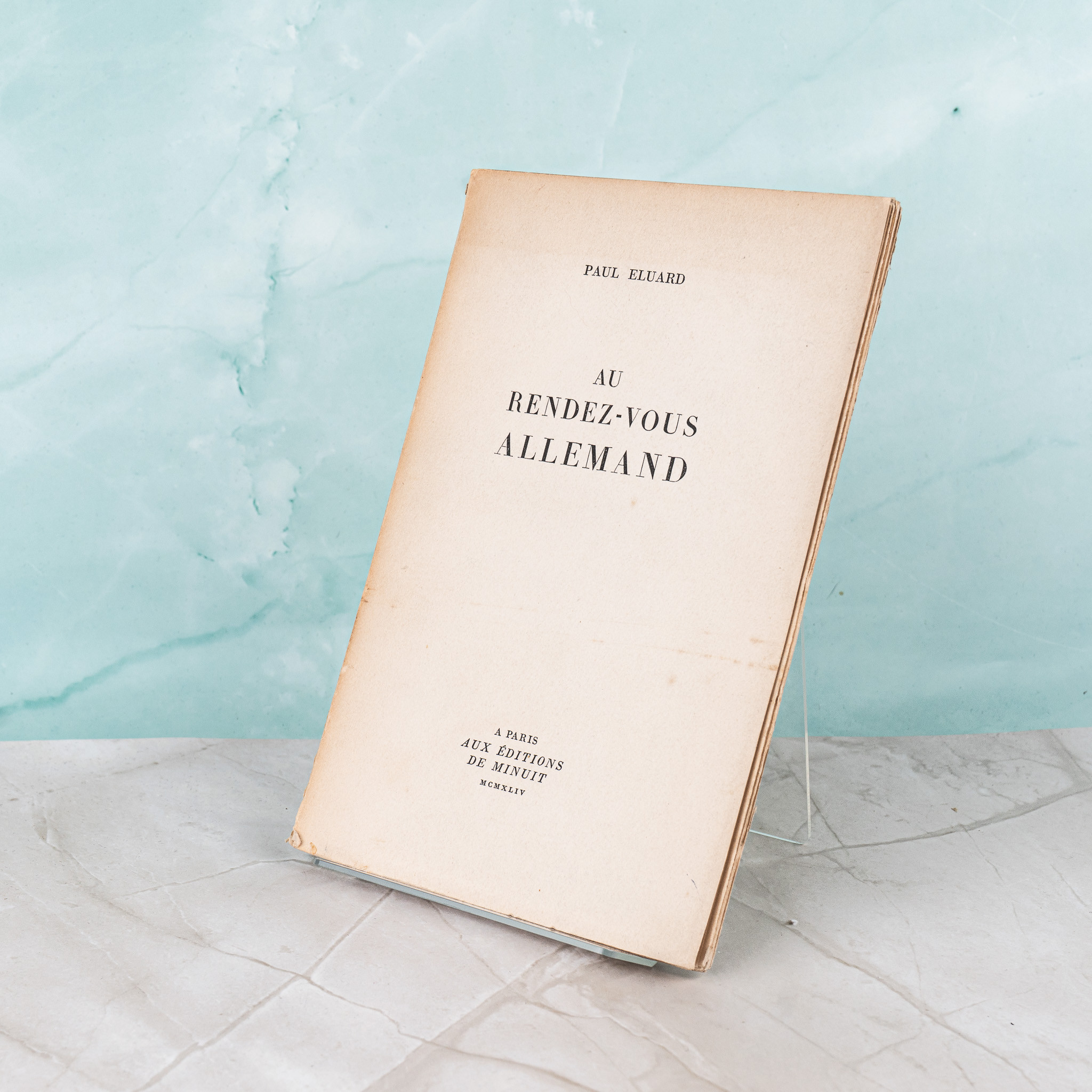
Éluard, Paul
Au rendez-vous allemand
Au rendez-vous allemand is one of the emblematic collections of Éluard’s wartime poetry. The book appeared in 1944 from Les Éditions de Minuit, the publishing house that, under the Occupation, became a moral landmark of the French literary Resistance. The volume gathers poems in which love, mourning, revolt and hope appear not as abstractions but as immediate necessities under German rule. The frontispiece, a portrait of the poet after Picasso, gives the book a powerful artistic signature: two voices of modern France, poet and artist, stand here in the same struggle. This is an ordinary, unnumbered copy, but signed by Éluard on the first page. That signature makes the book more than a Resistance document: it becomes a tangible witness to literary presence in a historically charged year. For the collector, it unites the clandestine aura of Minuit, Picasso’s name and Éluard’s own hand.
Illustrated Book
€350

Gracq, Julien · Bellmer, Hans
André Breton. Quelques aspects de l'écrivain.
A rare homage by Julien Gracq to André Breton, published by José Corti in a limited edition of 70 copies. This essay is both a powerful literary portrait and a visual tribute, thanks to Hans Bellmer’s iconic line portrait on the cover. Bellmer, known for his surrealist and psychosexual art, ties the book to the avant-garde movements of the 20th century. Gracq’s analysis is rigorous and insightful, reflecting his close engagement with Breton’s ideas. The collaboration between these two major figures and the fine print quality make this a coveted item for collectors of surrealist literature.
Illustrated Book
€500

When a Signature Becomes Provenance
A signature confirms; a dedication connects; an association copy tells a story.

The Fragile Meaning of ‘Complet’
In auction descriptions, “complete” often sounds reassuring — but it is only meaningful when verified against the colophon, the justification, and the bibliography. For The Hidden Page, clarity begins where vague market language ends.

The Avant-Garde and the Illustrated Word
How the Twentieth Century Recast the Book as an Artistic and Ideological Medium