


Parade funèbre pour Charles Estienne
A rare homage volume in which Dubuffet honours his friend and champion, the critic Charles Estienne. The book is entirely screenprinted: cover, endpapers and pages pulse as a single black-and-white field. His graphic idiom—organic loops, cellular meshes, bone-like shapes—translates mourning into rhythm. Issued in 1967 by Jeanne Bucher, Dubuffet’s dealer, in a limited edition. Generous margins and tactile stock heighten the physical act of reading-as-looking. Numbered copy from the library of Jacques Dauchez, securing collection history.
Quantity


Dubuffet, Jean
Parade funèbre pour Charles Estienne
1967 | Paris | Jeanne Bucher
Rare numbered artist’s book, entièrement screenprinted, in fine condition.
A rare homage volume in which Dubuffet honours his friend and champion, the critic Charles Estienne. The book is entirely screenprinted: cover, endpapers and pages pulse as a single black-and-white field. His graphic idiom—organic loops, cellular meshes, bone-like shapes—translates mourning into rhythm. Issued in 1967 by Jeanne Bucher, Dubuffet’s dealer, in a limited edition. Generous margins and tactile stock heighten the physical act of reading-as-looking. Numbered copy from the library of Jacques Dauchez, securing collection history.
€750
Condition Report:
In-Depth Study
References & Bibliography
Format
In-4 (Quarto) approx. 25 × 32 cm
Edition Particulars
One of 400 numbered copies (total 450 incl. 50 h.c.); this is no. 104; provenance: library of Jacques Dauchez.
Print Run
450
Copy Number
104
Paper
vélin fort, en feuilles à la japonaise
Inscription
No inscription
Product DETAIL
The images operate as a procession: motifs sliding, colliding, condensing. Screenprint gives grain and saturation akin to Dubuffet’s materialist sensibility. Text and image merge into a ritual score where blacks articulate pause and mourning. The project treats printmaking as autonomous painting on paper. An homage that is both personal and programmatic.
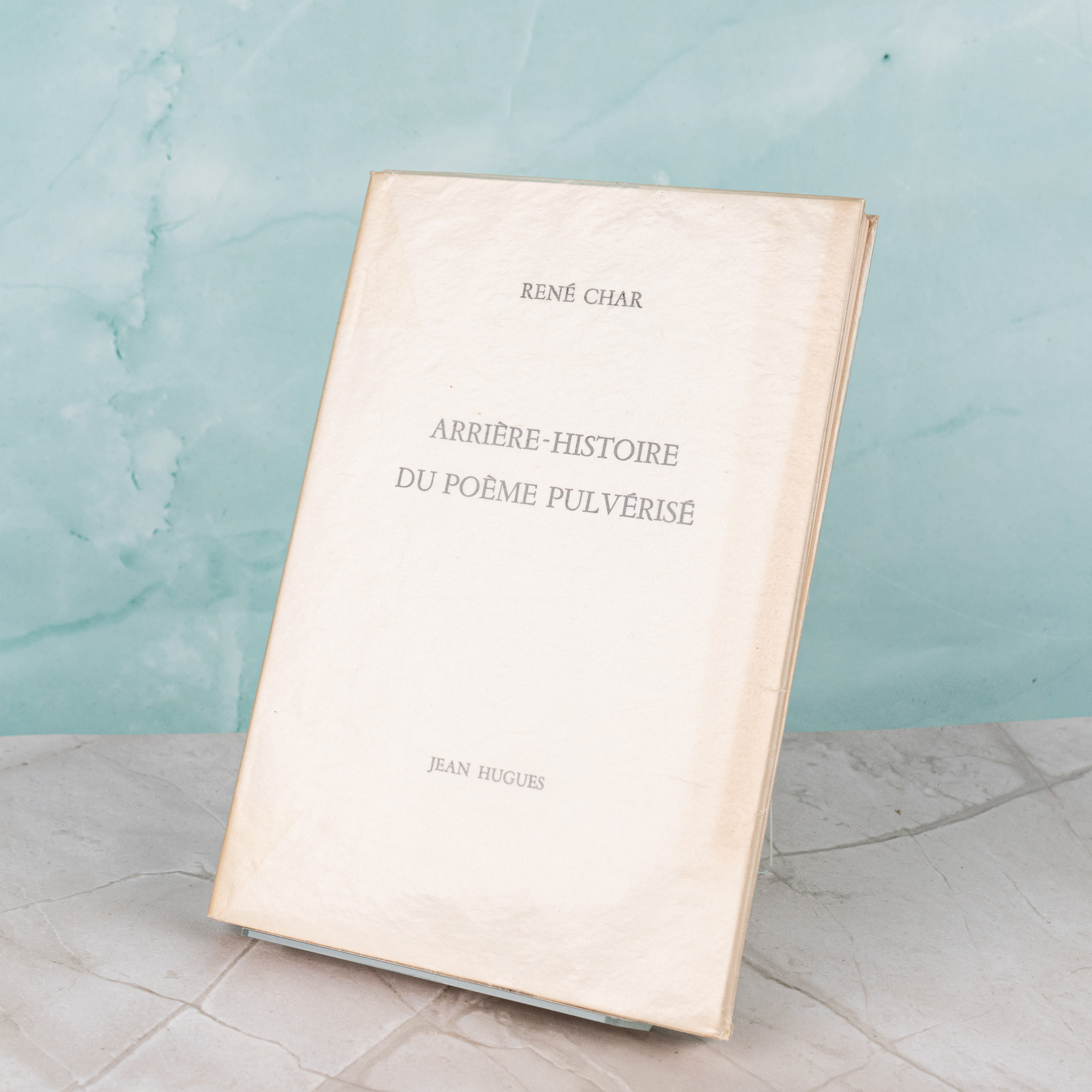
Char, Rene · Stael, Nicolas de
Arrière-histoire du poème pulvérisé
*Arrière-histoire du poème pulvérisé* is a later illustrated edition of a key text in which René Char looks back on the genesis and inner background of *Le Poème pulvérisé*. Published in 1972 by Imprimerie Union, it opens with a colour frontispiece by Nicolas de Staël. The pairing of Char and de Staël is especially charged: two post-war voices, each seeking concentration, clarity, and rupture in his own medium. This copy is one of only six hors commerce copies on Arches and is signed. The autograph presentation inscription to Doctor Marcel Zara, with poetic quotation and October 1972 dating, makes it a deeply personal copy.
Illustrated Book
€920
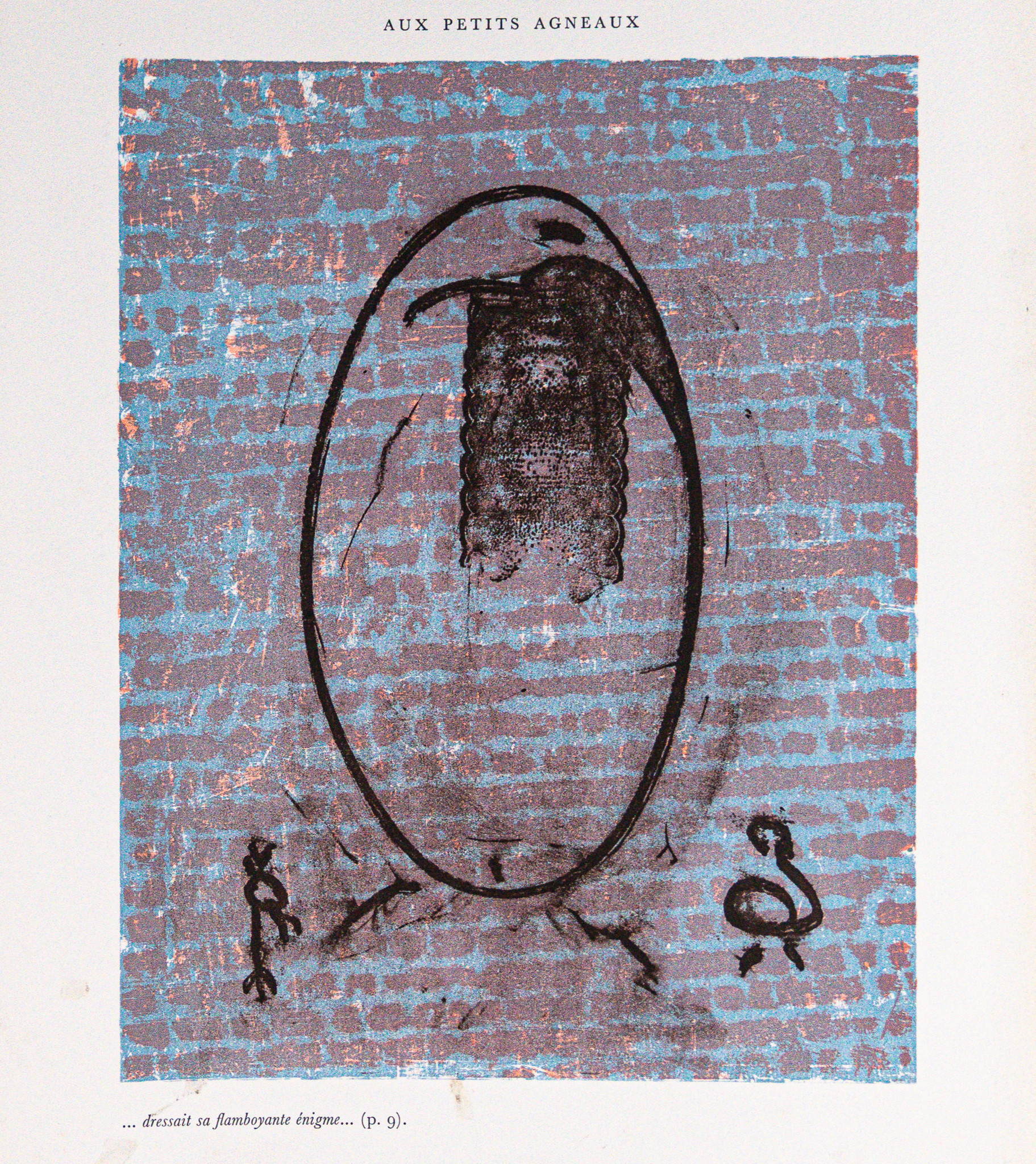
Waldberg, Patrick · Ernst, Max
Aux Petits Agneaux
A artist’s book resulting from the collaboration between writer Patrick Waldberg and surrealist master Max Ernst. This first edition includes 19 original lithographs printed on luxurious vélin d'Arches. Published in Paris in 1971 in a limited edition of 174 copies signed by both author and artist, and presented in a custom publisher’s box.
Illustrated Book
€2,200

Derain, André
Amis & Amille. Mystère du XIVe siècle.
This sumptuously bound book brings a medieval mystery to life through a rare collaboration between ancient literature and modern illustration. The geometric box design on garnet morocco provides striking contrast. André Derain’s 22 color lithographs – including one double and three full-page – enhance the narrative with expressive visual force. Printed on Rives vellum in an edition of 180 numbered copies, this copy (No. 72) was made for Baroness Vaxelaire and includes a suite on fine Japanese paper. The binding by Lucie Weill exemplifies artisanal excellence. A harmonious blend of narrative tradition and graphic daring.
Illustrated Book
€1,460

Bédouin, Jean-Louis · Hallart, Guy
L'arbre descend du singe
L'Arbre descend du singe is a beautifully illustrated edition that highlights the collaboration between the poet Jean-Louis Bedouin and the artist Guy Hallart. The work, published in a limited edition, is characterized by a rich dialogue between poetry and image, where the visual compositions reflect the dreamy and often cryptic nature of Bedouin's texts. The book is a tangible testament to the artistic symbiosis between the two creators and offers a unique insight into a creative dialogue from the mid-1970s.