


Peintures initiatiques d’Alfonso Ossorio
Dubuffet introduces Alfonso Ossorio in a concise, rhythmic volume that makes the early work’s intensity visible. Pages alternate vivid colour plates mounted on black stock with plain black-and-white reproductions. Dubuffet’s prose is exact, animated and gently polemical, casting Ossorio as a kindred spirit in material sensitivity and symbolic ferment. Typographic sobriety lets the sequence read like an initiation. First edition issued by La Pierre volante in 1951—a bibliophile document linking Paris to the international avant-garde.
Quantity


Dubuffet, Jean
Ossorio, Alfonso
Peintures initiatiques d’Alfonso Ossorio
1951 | Paris | La Pierre volante
An exemplary nexus of text, images and network—rare, personal, and persuasive as an object.
Dubuffet introduces Alfonso Ossorio in a concise, rhythmic volume that makes the early work’s intensity visible. Pages alternate vivid colour plates mounted on black stock with plain black-and-white reproductions. Dubuffet’s prose is exact, animated and gently polemical, casting Ossorio as a kindred spirit in material sensitivity and symbolic ferment. Typographic sobriety lets the sequence read like an initiation. First edition issued by La Pierre volante in 1951—a bibliophile document linking Paris to the international avant-garde.
€700
Condition Report:
In-Depth Study
References & Bibliography
Format
In-4 (Quarto) approx. 25 × 32 cm
Edition Particulars
One of 60 hors commerce copies on pur fil Johannot (presentation), with autograph presentation “cordialement” to Gualtieri di San Lazzaro (October 1951); with 6 tipped-in colour plates and 39 black-and-white reproductions.
Print Run
1536
Copy Number
Hors commerce
Paper
pur fil Johannot
Inscription
Envoi
Product DETAIL
Contents comprise Dubuffet’s accompanying essay and a suite of 6 colour plates mounted on black sheets, followed by 39 black-and-white reproductions. Mounting on dark stock heightens pictorial relief and gives the sequence a ceremonial rhythm. Dubuffet stresses Ossorio’s signs, liturgical fervour and organic density. Text and plates form an argued introduction—both compact monograph and statement of affinity.

Michaux, Henri · Bettencourt, Pierre
Arriver à se réveiller
A rare first edition of Arriver à se réveiller, written by Henri Michaux in the tremulous post-war years. The text unfolds as an inward journey toward lucidity, where sleep and waking mirror each other. Printed and published by Pierre Bettencourt in his own workshop, the edition’s small run preserves the work’s intimacy. The title-page vignette, a linocut by Bettencourt, sets a spare, rhythmic visual key that amplifies Michaux’s vigilant, vulnerable tone. This copy is handsomely bound in brown morocco with balsa boards by Miguet, a tactile nod to lightness under tension. For bibliophiles, it is an exemplary union of poetry, craft, and experiment. The volume embodies the independence of the post-war small press and Michaux’s radical sensitivity.
Illustrated Book
€680

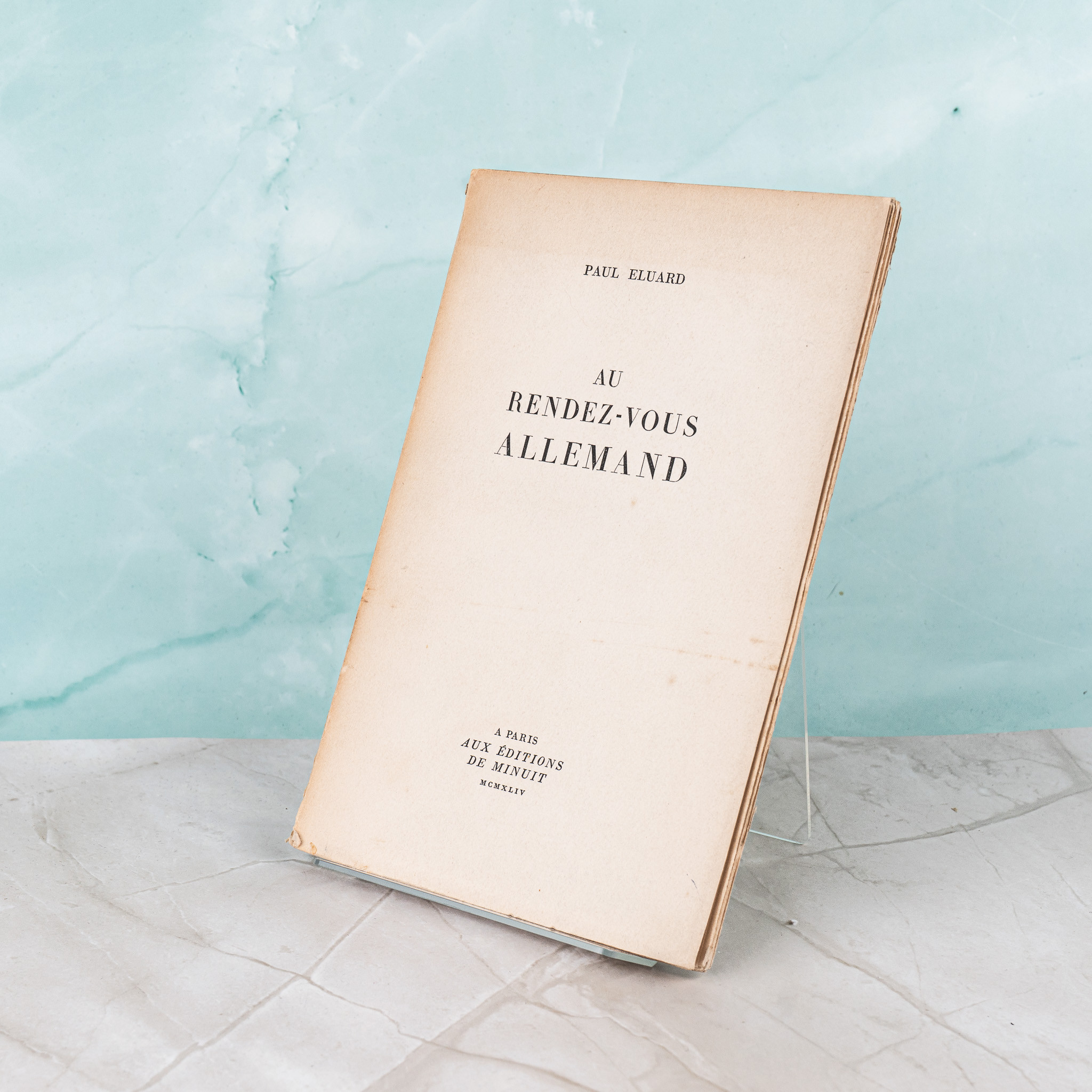
Éluard, Paul
Au rendez-vous allemand
Au rendez-vous allemand is one of the emblematic collections of Éluard’s wartime poetry. The book appeared in 1944 from Les Éditions de Minuit, the publishing house that, under the Occupation, became a moral landmark of the French literary Resistance. The volume gathers poems in which love, mourning, revolt and hope appear not as abstractions but as immediate necessities under German rule. The frontispiece, a portrait of the poet after Picasso, gives the book a powerful artistic signature: two voices of modern France, poet and artist, stand here in the same struggle. This is an ordinary, unnumbered copy, but signed by Éluard on the first page. That signature makes the book more than a Resistance document: it becomes a tangible witness to literary presence in a historically charged year. For the collector, it unites the clandestine aura of Minuit, Picasso’s name and Éluard’s own hand.
Illustrated Book
€350

Derain, André
Amis & Amille. Mystère du XIVe siècle.
This sumptuously bound book brings a medieval mystery to life through a rare collaboration between ancient literature and modern illustration. The geometric box design on garnet morocco provides striking contrast. André Derain’s 22 color lithographs – including one double and three full-page – enhance the narrative with expressive visual force. Printed on Rives vellum in an edition of 180 numbered copies, this copy (No. 72) was made for Baroness Vaxelaire and includes a suite on fine Japanese paper. The binding by Lucie Weill exemplifies artisanal excellence. A harmonious blend of narrative tradition and graphic daring.