


Persécuté Persécuteur
First edition of a pivotal Aragon collection, issued by Éditions surréalistes in 1931 at the threshold of his communist commitment. The book opens with the notorious “Front rouge”, whose militant cadence sealed the split with André Breton and sets the combative tenor of the volume. This large-paper copy on pur fil Johannot ranks among the most coveted, owing to the limited paper hierarchy. The blend of literary history, political charge, and bibliophile presentation (half-morocco, errata) makes it a keystone item. A rare opportunity to handle a hinge moment in French modernism.
Quantity


Aragon, Louis
Persécuté Persécuteur
1931 | Paris | Éditions Surréalistes
A hinge-piece of modern poetry, in a desirable large-paper issue.
First edition of a pivotal Aragon collection, issued by Éditions surréalistes in 1931 at the threshold of his communist commitment. The book opens with the notorious “Front rouge”, whose militant cadence sealed the split with André Breton and sets the combative tenor of the volume. This large-paper copy on pur fil Johannot ranks among the most coveted, owing to the limited paper hierarchy. The blend of literary history, political charge, and bibliophile presentation (half-morocco, errata) makes it a keystone item. A rare opportunity to handle a hinge moment in French modernism.
€650
Condition Report:
In-Depth Study
References & Bibliography
Format
In-8 (Octavo) approx. 20 × 26 cm
Edition Particulars
One of 70 copies on pur fil Johannot, third paper after 15 Japan and 30 Holland.
Print Run
70
Copy Number
85
Paper
Fil Johannot
Inscription
No inscription
Product DETAIL
The collection fuses revolutionary rhetoric with formal experiment, where chant, slogan and command collide. “Front rouge” acts as both aesthetic and political preface; subsequent poems probe the strain between avant-garde freedom and party discipline. The volume reads as a ledger of transition, surrealist fantasy yielding to collectivist rhythms. The climate of 1931 surfaces in brusque cut-ups, urban imagery and hard enjambments. A compact, pugnacious corpus that politicises the lyric field.

Ribemont-Dessaignes, Georges
Ariane
A remarkable copy of *Ariane*, published in the *Les Cahiers Nouveaux* series, inscribed with a poetic and enigmatic message by Ribemont-Dessaignes to Jacques Matarasso. This deluxe Japan paper edition was elegantly rebound in 1994 by Georges Leroux, in a restrained style that echoes the work’s Dadaist spirit.
Book
€1,100

Gracq, Julien
Au château d'Argol
Julien Gracq’s debut novel, issued by José Corti, sets a gothic castle on the Breton coast as the stage for a charged, almost dream-logic encounter between three figures. The prose is musical and image-rich, favouring symbolic landscapes and metaphysical weather. Born near Surrealism yet distinctly independent, the book establishes Gracq’s lucid enchantment from the start. For bibliophiles this is a key title: an early Corti publication, scarce in appealing condition, and the opening note of a major twentieth-century voice. Its limited print-run and initially slow reception add to the sense of discovery. This copy is on publisher’s stock.
Book
€610
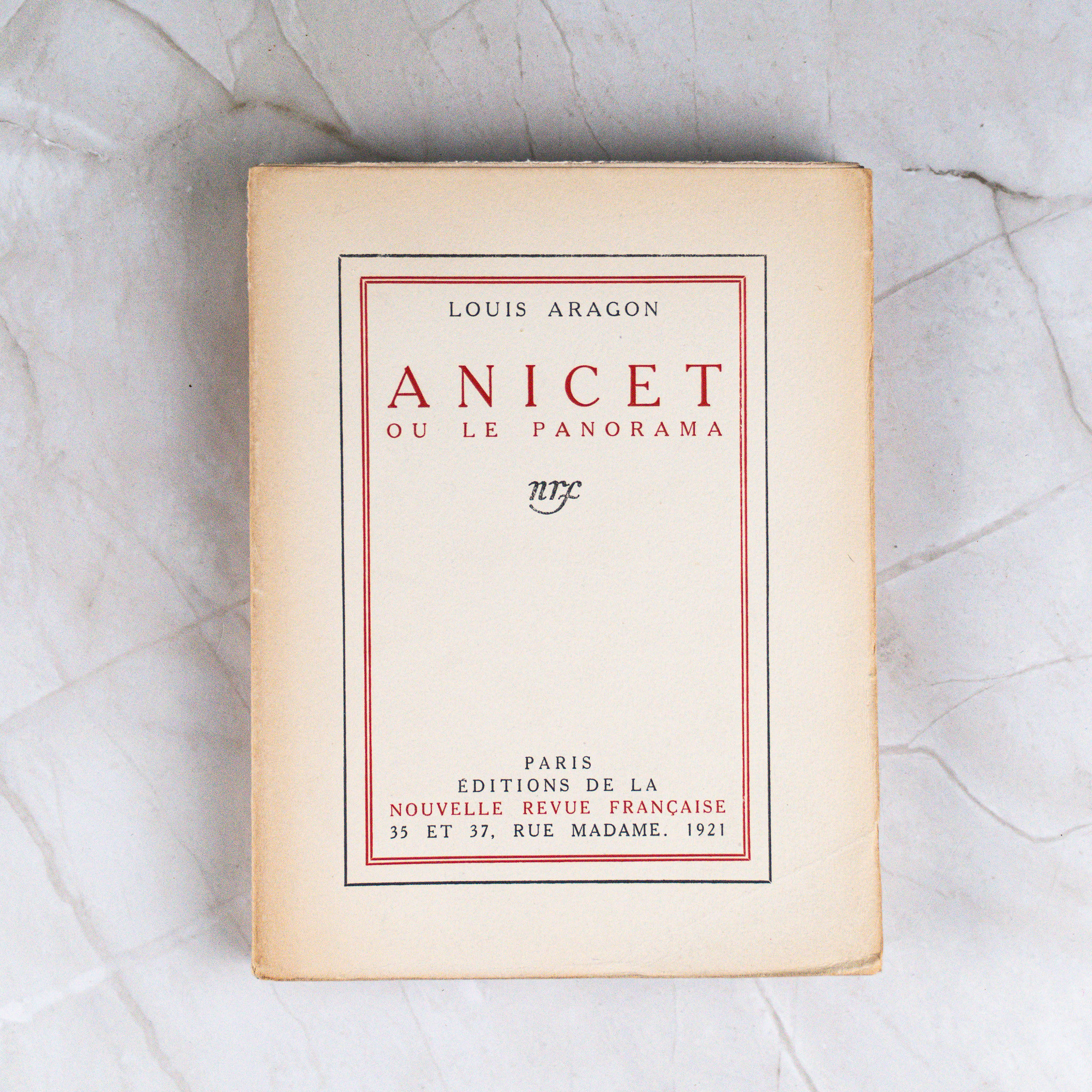
Aragon, Louis
Anicet ou le panorama
With *Anicet ou le panorama* (Paris, NRF, 1921), Louis Aragon delivers an early, deliberately hybrid novel written at the hinge between Dada disruption and the rise of Surrealism. The book proceeds by visions and sequences—a “panorama” in which identity, desire, and the act of looking continually shift. In this bibliophile form (“tirage de tête” reserved for NRF bibliophiles), the novel also becomes a collectible object intended for a small inner circle. This copy is specifically designated “pour le Dr. Sourdel” and numbered XLVIII, underscoring the selective, personalized nature of the issue. Published under the NRF imprint, Aragon is anchored in the literary center while keeping the book’s formal audacity intact. A key item for understanding the nervous modernity of the early 1920s.
Book
€1,150

Bousquet, Joë
Traduit du silence. Proses
Traduit du silence. Proses is one of Joë Bousquet’s rare pre-war publications, issued in the poetic series of Les Cahiers du Journal des Poètes. Its title already contains the central paradox of the book: writing as if translated from silence, seclusion and inward intensity. This copy is notable for its deluxe issue on Featherweight fort, numbered with the crowned-heart device, but above all for its signed autograph inscription to Jeanne and James Ducellier. The Ducelliers were among Bousquet’s closest confidants in Carcassonne and belonged to the circle where literature, friendship and surrealism converged. This is therefore not merely an early and refined edition, but a tangible document of a personal and artistic network. The book connects Bousquet’s enclosed room with the broader surrealist constellation of Max Ernst, Paul Éluard, Yves Tanguy and Raymond Roussel.
Book
€250

When a Signature Becomes Provenance
A signature confirms; a dedication connects; an association copy tells a story.

The Fragile Meaning of ‘Complet’
In auction descriptions, “complete” often sounds reassuring — but it is only meaningful when verified against the colophon, the justification, and the bibliography. For The Hidden Page, clarity begins where vague market language ends.

The Avant-Garde and the Illustrated Word
How the Twentieth Century Recast the Book as an Artistic and Ideological Medium