


Sombre printemps. Traduit de l’allemand par Ruth Henry et Robert Valançay.
This large and sumptuous edition of Sombre printemps brings together one of Unica Zürn’s most haunting texts and an original burin frontispiece by Hans Bellmer. Issued by Pierre Belfond as the French translation of Dunkler Frühling, it appeared when Zürn’s name had become inseparable from Bellmer’s. That proximity is not merely biographical here; it shapes the entire aura of the book, in which text and image seem to emerge from the same disturbed inner world. The deluxe issue, printed on vélin d’Arches and accompanied by an additional proof on japon nacré, gives the volume a distinctly bibliophilic status. Bellmer’s signed frontispiece does not simply decorate the text, but stands as a visual counterpoint to Zürn’s claustrophobic prose. The publication is all the more poignant for having followed so closely upon Zürn’s death, as though the book became both tribute and posthumous memorial. Within the Cahiers du Regard, it ranks among the most charged and desirable collaborations. For the collector, this copy unites literary intensity, surrealist resonance, and exceptional material refinement.
Quantity


Zürn, Unica
Bellmer, Hans
Sombre printemps. Traduit de l’allemand par Ruth Henry et Robert Valançay.
1971 | Paris | Pierre Belfond
A rare and hauntingly beautiful copy in which text, engraving, and fate converge.
This large and sumptuous edition of Sombre printemps brings together one of Unica Zürn’s most haunting texts and an original burin frontispiece by Hans Bellmer. Issued by Pierre Belfond as the French translation of Dunkler Frühling, it appeared when Zürn’s name had become inseparable from Bellmer’s. That proximity is not merely biographical here; it shapes the entire aura of the book, in which text and image seem to emerge from the same disturbed inner world. The deluxe issue, printed on vélin d’Arches and accompanied by an additional proof on japon nacré, gives the volume a distinctly bibliophilic status. Bellmer’s signed frontispiece does not simply decorate the text, but stands as a visual counterpoint to Zürn’s claustrophobic prose. The publication is all the more poignant for having followed so closely upon Zürn’s death, as though the book became both tribute and posthumous memorial. Within the Cahiers du Regard, it ranks among the most charged and desirable collaborations. For the collector, this copy unites literary intensity, surrealist resonance, and exceptional material refinement.
€1,400
Condition Report:
In-Depth Study
References & Bibliography
Format
In-folio (Folio) approx. 30 × 40 cm
Edition Particulars
One of 150 copies numbered in Arabic numerals, with the signed frontispiece and an additional proof on japon nacré.
Print Run
170
Copy Number
No. 124
Paper
vélin d’Arches; épreuve de la gravure sur japon nacré
Inscription
Signed by the Illustrator
1
Edition Particulars:
We welcome private inquiries, collaborations with institutions, and acquisition requests. Each message is treated with discretion and respect. We welcome private inquiries, collaborations with institutions, and acquisition requests.
1
Print Run:
Condition Report:
1
Copy Number:
Condition Report:
1
Paper:
Condition Report:
1
Signed:
Condition Report:
Product DETAIL
The narrative follows an unnamed thirteen-year-old girl growing up in a stifling bourgeois environment, where the awakening of her body is felt as both fascination and threat. The story unfolds within the enclosed world of family, school, and inner fantasy, where the child is at once curious and exposed. As her desire becomes more sharply defined, her relation to her own body, to adults, and to forbidden images grows increasingly disturbed. The text develops as a fictional autobiography in which perception, shame, fascination, and fear are tightly interwoven. What begins as a discovery of sexuality and imagination gradually turns into isolation, obsession, and psychic disintegration. The tensions accumulate until the girl sees no escape and throws herself from a window. The book is thus both an account of adolescence and a record of fatal inner escalation. Only in its final register does it become a dark meditation on desire, guilt, and self-loss, written in a voice poised between dream and confession.
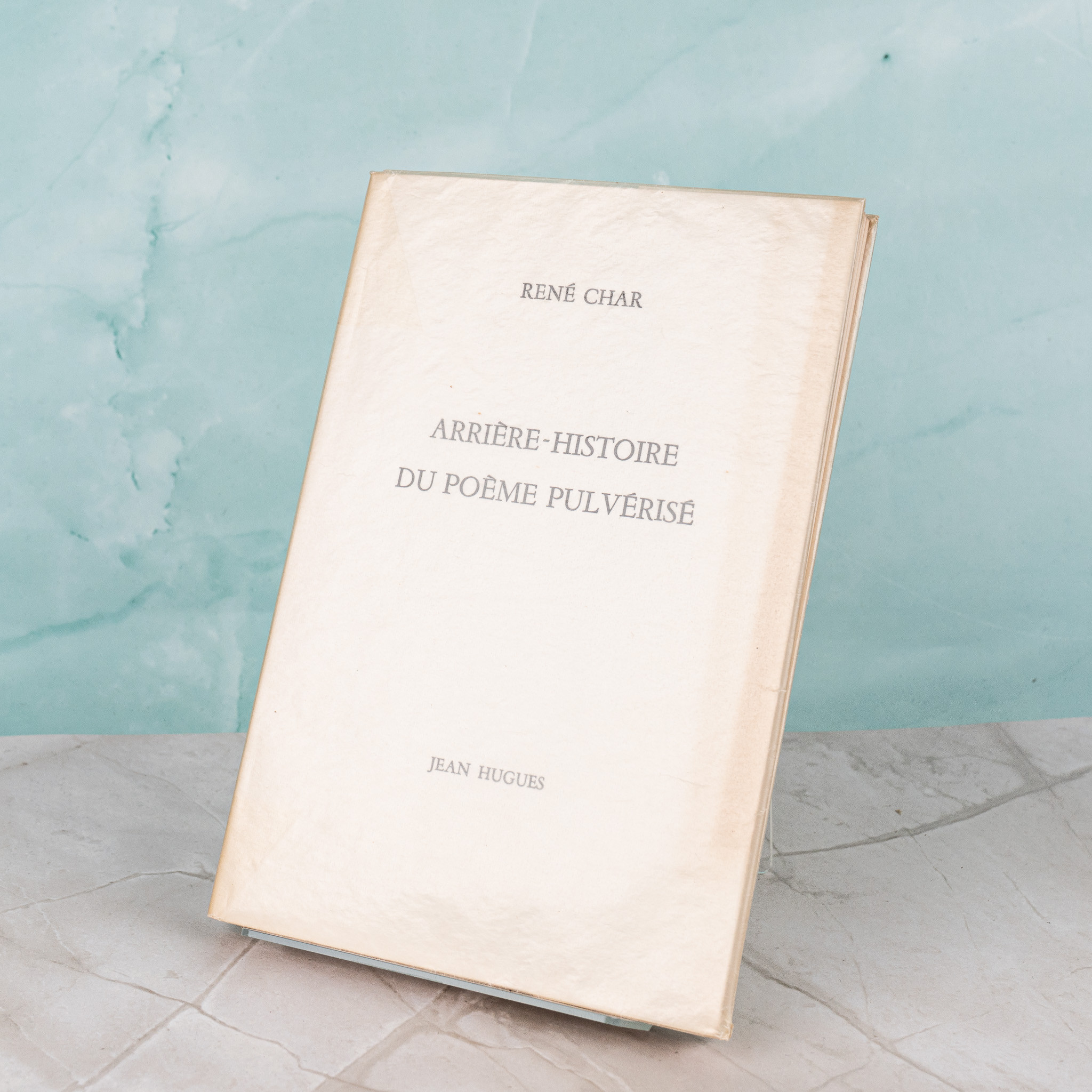
Char, Rene · Stael, Nicolas de
Arrière-histoire du poème pulvérisé
*Arrière-histoire du poème pulvérisé* is a later illustrated edition of a key text in which René Char looks back on the genesis and inner background of *Le Poème pulvérisé*. Published in 1972 by Imprimerie Union, it opens with a colour frontispiece by Nicolas de Staël. The pairing of Char and de Staël is especially charged: two post-war voices, each seeking concentration, clarity, and rupture in his own medium. This copy is one of only six hors commerce copies on Arches and is signed. The autograph presentation inscription to Doctor Marcel Zara, with poetic quotation and October 1972 dating, makes it a deeply personal copy.
Ill Book
€920

Ruscha, Edward · Ruscha, Ed
Some Los Angeles Apartments
Some Los Angeles Apartments is one of Ed Ruscha’s iconic early artist’s books, devoted to the banal architecture of Los Angeles. Instead of monuments, drama or urban glamour, Ruscha shows ordinary apartment buildings, coolly photographed and without visible sentimentality. This second edition of 1970, printed in 3,000 unnumbered copies, confirms the wider circulation of his conceptual book form. The small format, sober wrappers and original glassine wrapper make it an essential Ruscha object.
Ill Book
€950
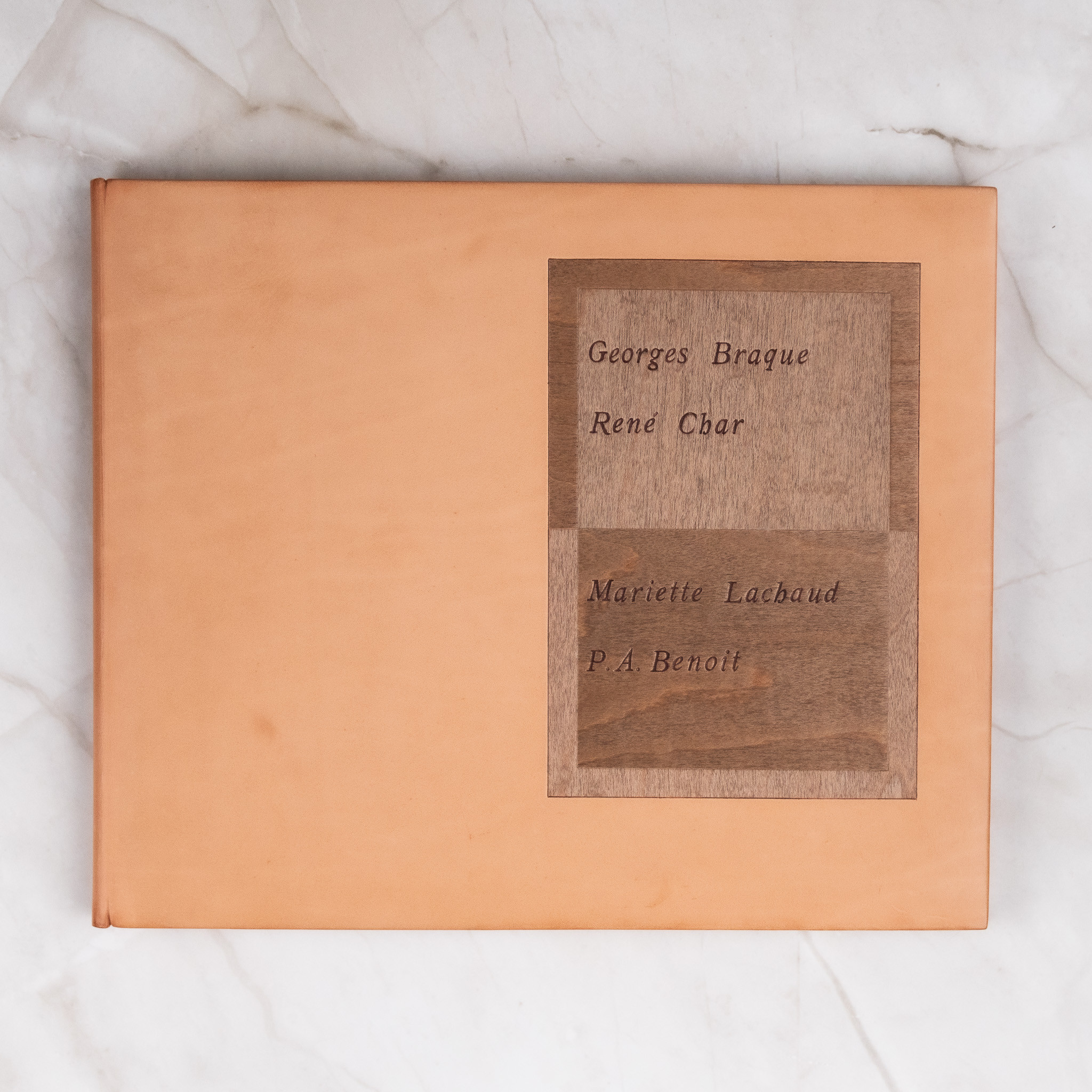
René Char, Georges Braque · Lachaud, Mariette · Pierre Andre Benoit (PAB)
Ainsi va l'amitié
What makes this copy especially memorable is not only its tiny limitation but the way it fixes three friendships at once: that between Char and Braque, that between Char and PAB, and that of all of them with the image that outlives them. The eight original photographs are not an illustrative supplement but the true bearers of presence; they preserve gazes, workspaces, and silences. The fact that PAB and Mariette Lachaud signed this copy gives it an almost confidential status, as though the circle of makers were still present within the book. In such editions, bibliophily becomes more than rarity alone: it becomes a form of shared memory.
Ill Book
€4,500
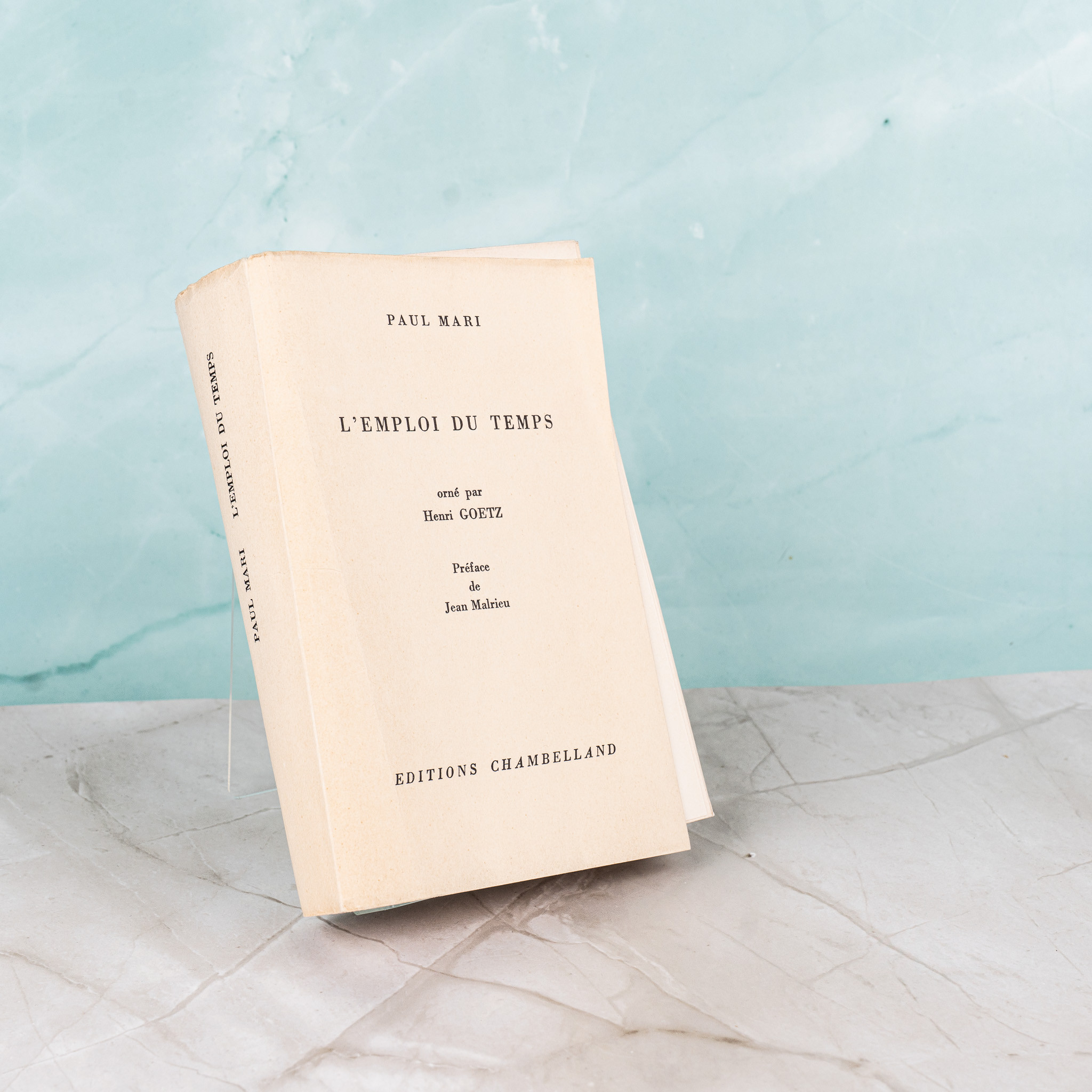
Mari, Paul · Goetz, Henri
L’emploi du temps
L’emploi du temps is a modest yet notably appealing poetry book from the late 1960s. Paul Mari’s text is given particular weight by the presence of Henri Goetz, whose signed original colour engraving moves the volume into the field of the modern artist’s book. Published by Éditions Chambelland in 1969, it appeared in a limited issue on pur fil paper. This copy, number 22 of 50, belongs to the deluxe variant with original print. It is made more distinctive by Paul Mari’s autograph presentation inscription to Susy Solidor, a figure with her own charged place in twentieth-century artistic and social culture. The combination of small limitation, signed print, inscription and avant-garde context makes the book relevant to The Hidden Page, even if Mari is less canonical than his illustrator.
