


Tables paysagées, paysages mentaux, pierres philosophiques
A rare working document for Dubuffet’s show at Pierre Matisse Gallery, New York (February 1952): the typewritten manuscript of the catalogue text. Onion-skin leaves register studio urgency—emendations, corrections, the hunt for exact phrasing. This copy is accompanied by the original 1952 printed catalogue in which the text appeared, uniting source and publication. Purposefully sent to René Bertelé in Paris, Dubuffet’s editorial partner and relay. Signed on the cover—discreet yet telling.
Quantity


Dubuffet, Jean
ILLUSTRATORS
ILLUSTRATORS
ILLUSTRATORS
Tables paysagées, paysages mentaux, pierres philosophiques
1952 | New York | Pierre Matisse Gallery
A nodal piece of Dubuffet’s discursive practice, showing both preparation and publication as one set.
A rare working document for Dubuffet’s show at Pierre Matisse Gallery, New York (February 1952): the typewritten manuscript of the catalogue text. Onion-skin leaves register studio urgency—emendations, corrections, the hunt for exact phrasing. This copy is accompanied by the original 1952 printed catalogue in which the text appeared, uniting source and publication. Purposefully sent to René Bertelé in Paris, Dubuffet’s editorial partner and relay. Signed on the cover—discreet yet telling.
Contact for Price
Condition Report:
In-Depth Study
References & Bibliography
Edition Particulars
Unique file of 12 pages on onion-skin; signed on the cover; with the original handwritten envelope to René Bertelé; accompanied by the original printed catalogue (Pierre Matisse Gallery, Feb. 1952) in which the text appeared.
Paper
Papier pelure (onion-skin) voor het manuscrit; drukwerk voor het catalogus-exemplaar
Inscription
Signed by the Author
1
Edition Particulars:
We welcome private inquiries, collaborations with institutions, and acquisition requests. Each message is treated with discretion and respect. We welcome private inquiries, collaborations with institutions, and acquisition requests.
1
Print Run:
Condition Report:
1
Copy Number:
Condition Report:
1
Paper:
Condition Report:
1
Signed:
Condition Report:
Product DETAIL
The text considers works from 1950–1951, showing how material behaviour, grain and “terrains” re-school the eye. Dubuffet stages recognition against estrangement. The manuscript links studio to gallery; the accompanying catalogue documents the public rollout. Together they offer a compact case of his discursive method.
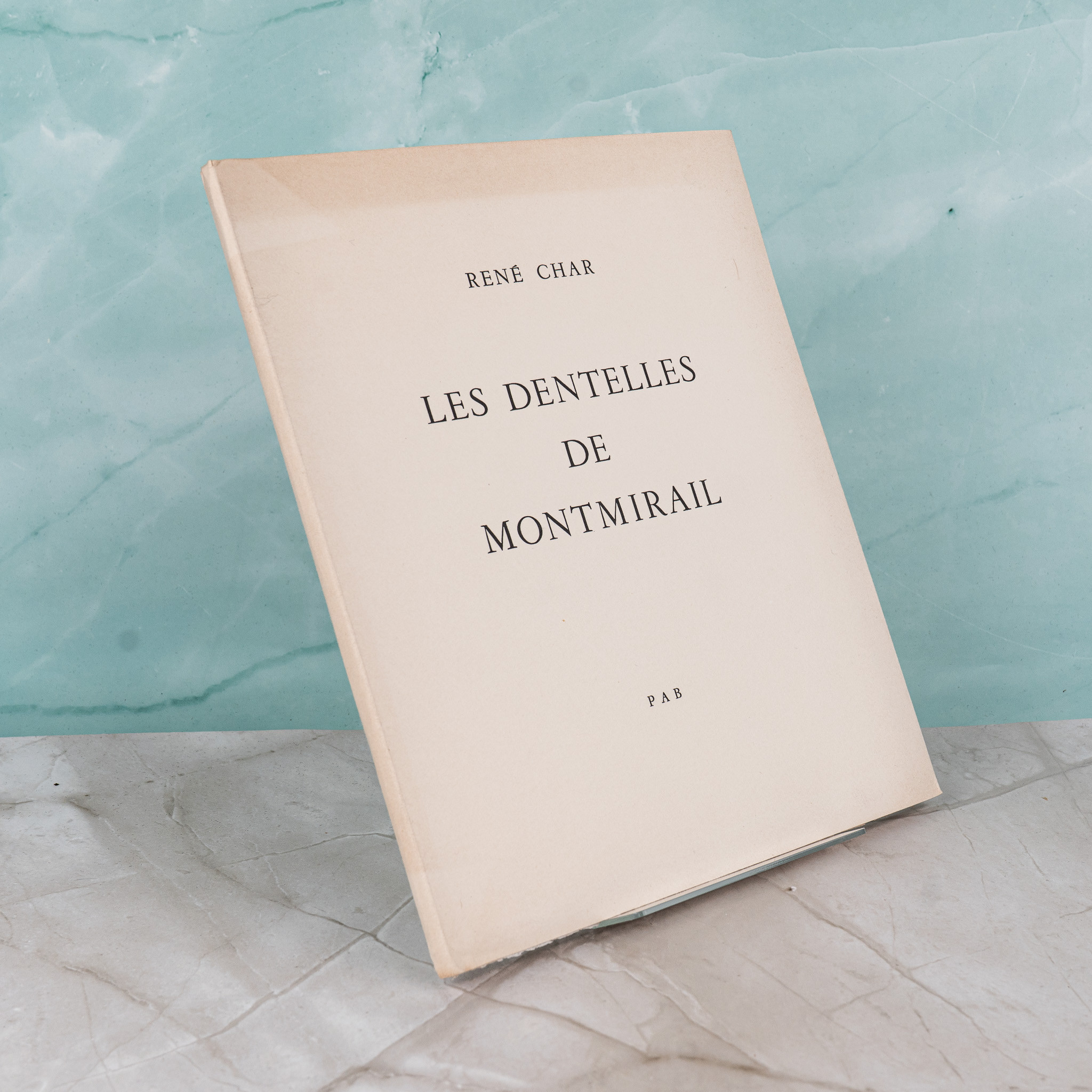
Char, Rene · Pierre Andre Benoit (PAB)
Les Dentelles de Montmirail
Les Dentelles de Montmirail is one of the characteristic small masterpieces born of the collaboration between René Char and PAB. It was published in 1960 between L’Isle-sur-Sorgue and Alès, two places that immediately evoke the geography of Char and that of Pierre André Benoit. The edition joins Char’s brief, aphoristic lyric voice to five natural impressions from Montmirail, so that text and matter quite literally meet. With PAB, poetry often takes on an intimate, almost handmade form, and that quality is especially palpable here. The limited issue on Arches heightens the book’s discreet yet unmistakable bibliophile character. This copy gains further importance from the autograph inscription to Dr Marcel Zara, far more than a routine dedication and almost readable as a small autonomous poem. For collectors, it is an exemplary PAB production in which landscape, trace, inscription, and poem become a single object.
Ill Book
€2,250
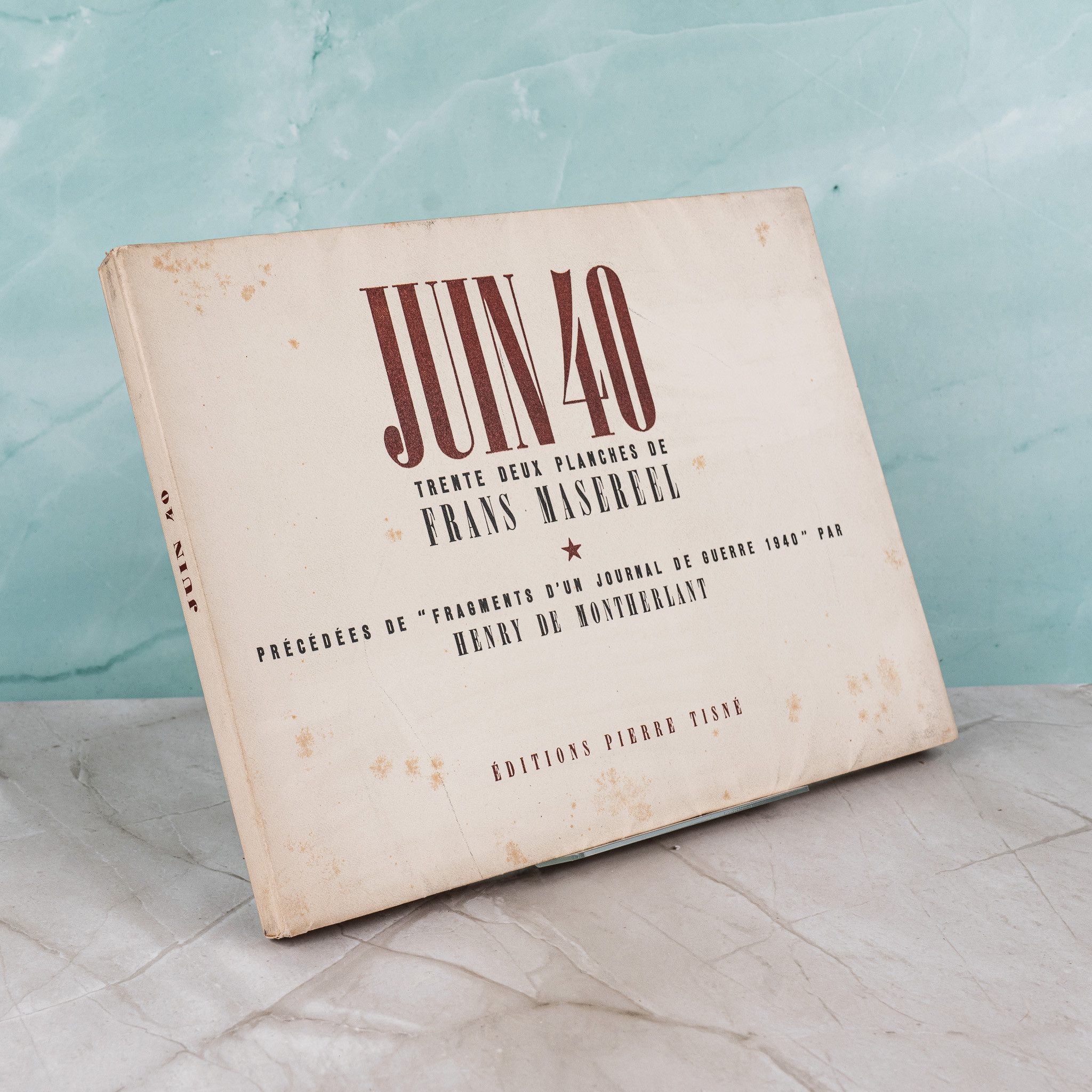
Montherlant, Henry de · Masereel, Frans
Juin 40
Juin 40 is a powerful illustrated war book in which Frans Masereel gives visual form, through 32 plates, to the French defeat and disarray of June 1940. The plates are preceded by Henry de Montherlant’s Fragments d’un journal de guerre 1940, so that text and image together create a double testimony: literary, historical and moral. Masereel, renowned for his woodcuts and wordless novels, here brings his expressive black-and-white drama to bear on an immediate historical trauma. The oblong format gives the plates a horizontal, almost cinematic space in which flight, soldiers, civilians and destruction can unfold. The book appeared in Paris with Pierre Tisné in 1942, in the midst of the war, giving it a special tension between memory, censorship, mourning and visual urgency. This copy, n°16, belongs to the first 350 copies on vélin Lana Bélier within a total edition of 1,550. It is an early and materially attractive copy of a book in which Masereel’s humanist graphic art retains its historical edge.
Ill Book
€420
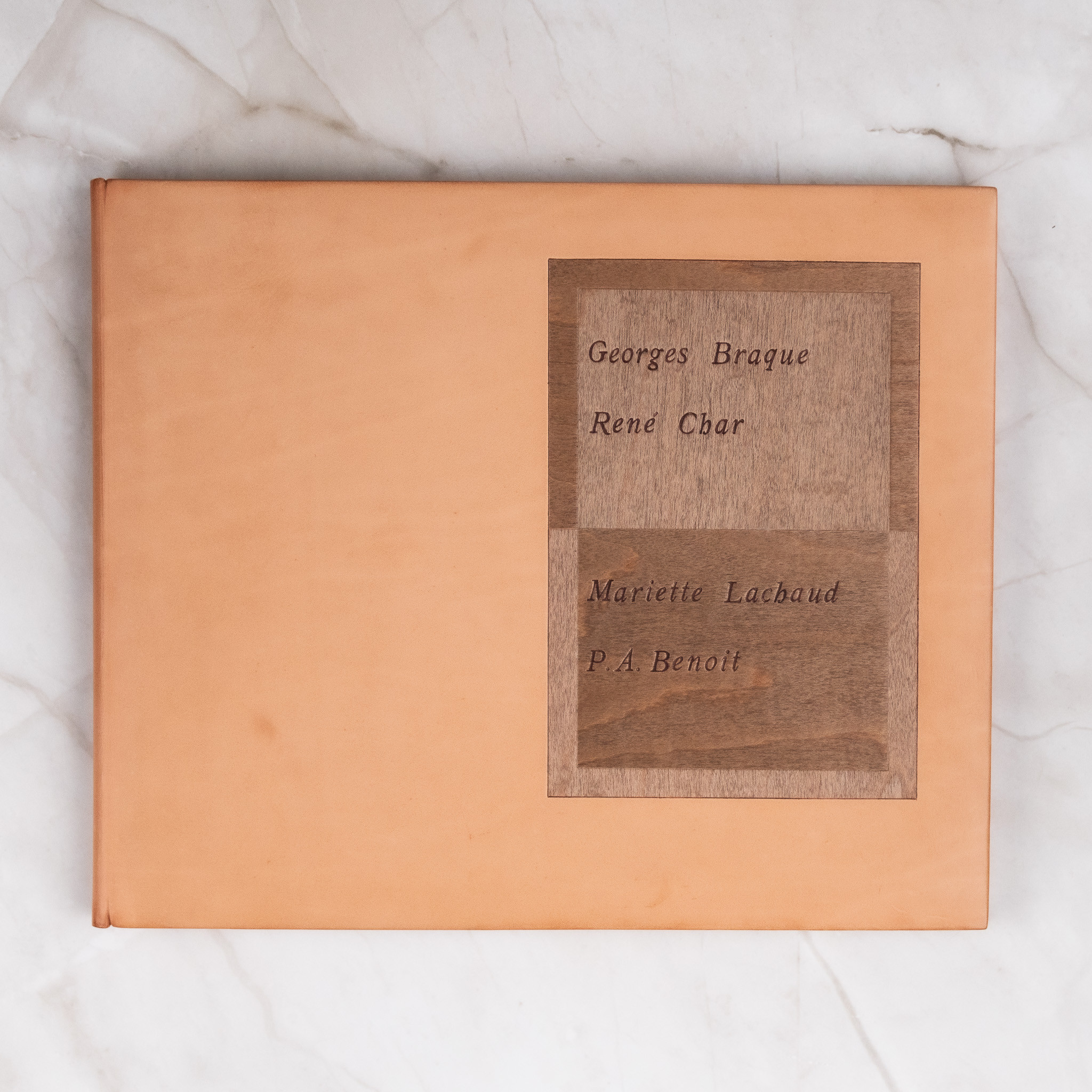
René Char, Georges Braque · Lachaud, Mariette · Pierre Andre Benoit (PAB)
Ainsi va l'amitié
What makes this copy especially memorable is not only its tiny limitation but the way it fixes three friendships at once: that between Char and Braque, that between Char and PAB, and that of all of them with the image that outlives them. The eight original photographs are not an illustrative supplement but the true bearers of presence; they preserve gazes, workspaces, and silences. The fact that PAB and Mariette Lachaud signed this copy gives it an almost confidential status, as though the circle of makers were still present within the book. In such editions, bibliophily becomes more than rarity alone: it becomes a form of shared memory.
Ill Book
€4,500
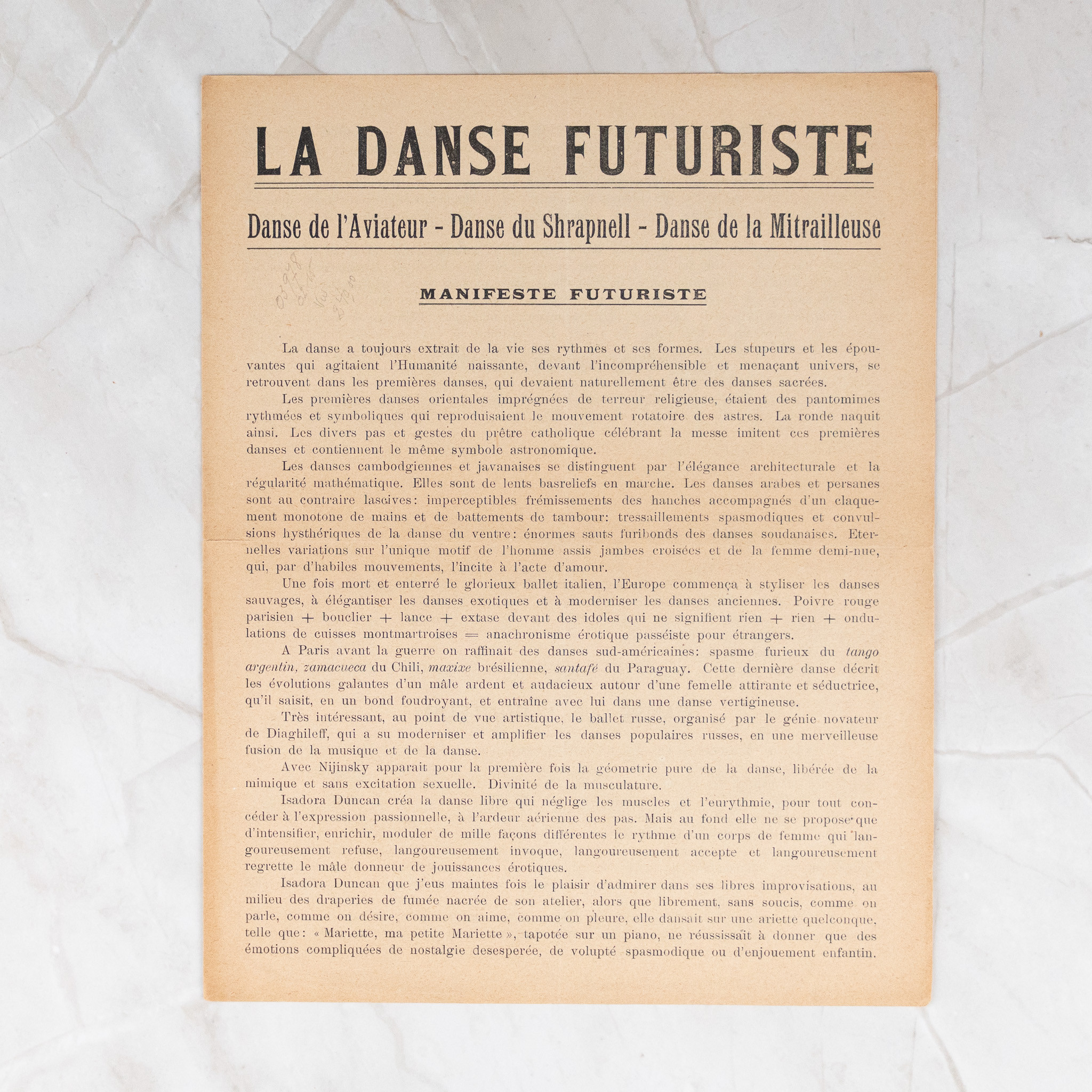
Marinetti, Filippo Tommaso
La Danse Futuriste. Danse de l’aviateur – Danse du shrapnell – Danse de la mitrailleuse. Manifeste futuriste
La Danse Futuriste is one of the key texts of Italian Futurism in its most direct, militant, and performative form. It is a separately issued French manifesto by Filippo Tommaso Marinetti, founder and tireless propagandist of the movement. Rather than a deluxe book, it is a tract, designed for the rapid circulation of ideas and for immediate impact. That modest physical form is precisely what makes it so faithful to Futurist practice, in which print was used as an instrument of artistic intervention. The text transfers the Futurist glorification of speed, violence, and mechanism into the realm of dance, doing so with the aggressive clarity that is so characteristic of Marinetti. As a separate French issue, the pamphlet is bibliographically intriguing, since specialists have catalogued it both as 1917 and as circa 1920. That uncertainty only adds to its interest rather than diminishing its importance. For collectors, this is above all a primary avant-garde document: scarce, fragile, and historically charged.

