


Toutes ces dames au salon !
This sharp postwar intervention belongs to the primary printed matter of the Internationale Lettriste, on the threshold of the Debord milieu and the genealogy of Situationism. *Toutes ces dames au salon !* responds to the Brussels exhibition “L’Industrie du pétrole vue par des artistes” (2–14 June 1956), targeting the moral veneer of the salon system sustained by corporate patronage. The sheet operates as direct action: a text that does not merely speak about art but intervenes in the social field. The convergence of Paris (Internationale Lettriste), Brussels (Les Lèvres Nues) and Milan (Movimento Arte Nucleare) turns it into a rare node of transnational neo-avant-garde exchange. This set is especially desirable because it brings together two material variants: the well-known large two-column placard and the narrow one-column version that also circulates on its own. Ephemera of this kind was made to vanish, and its survival—here in duplicate form—is exactly what gives it bibliophilic force.
Quantity


AUTHORS
AUTHORS
AUTHORS
Collective
Toutes ces dames au salon !
1956 | Bruxelles
Two variants of a militant Lettrist intervention from 1956: rare, early, and directly tied to the genealogy that would lead to Situationism.
This sharp postwar intervention belongs to the primary printed matter of the Internationale Lettriste, on the threshold of the Debord milieu and the genealogy of Situationism. *Toutes ces dames au salon !* responds to the Brussels exhibition “L’Industrie du pétrole vue par des artistes” (2–14 June 1956), targeting the moral veneer of the salon system sustained by corporate patronage. The sheet operates as direct action: a text that does not merely speak about art but intervenes in the social field. The convergence of Paris (Internationale Lettriste), Brussels (Les Lèvres Nues) and Milan (Movimento Arte Nucleare) turns it into a rare node of transnational neo-avant-garde exchange. This set is especially desirable because it brings together two material variants: the well-known large two-column placard and the narrow one-column version that also circulates on its own. Ephemera of this kind was made to vanish, and its survival—here in duplicate form—is exactly what gives it bibliophilic force.
€750
Condition Report:
In-Depth Study
References & Bibliography
Format
Divers
Edition Particulars
Set of 2 items: (1) large placard approx. 38.4 × 37.4 cm, recto in 2 columns, fold marks; (2) narrow version 41 × 20 cm, recto in 1 column, without edition statement.
Inscription
No inscription
1
Edition Particulars:
We welcome private inquiries, collaborations with institutions, and acquisition requests. Each message is treated with discretion and respect. We welcome private inquiries, collaborations with institutions, and acquisition requests.
1
Print Run:
Condition Report:
1
Copy Number:
Condition Report:
1
Paper:
Condition Report:
1
Signed:
Condition Report:
Product DETAIL
The tract targets the rhetoric of “art” as an industrial shop-window and asks who truly speaks when companies purchase cultural prestige. In pamphlet form, the salon—its polished audience and coded taste—is exposed as an instrument of legitimation. The text is built for immediate circulation: read, passed on, posted, and made to disappear. The coalition of Lettrists, the Brussels network around *Les Lèvres Nues*, and Italy’s Arte Nucleare gives the piece a distinctly international, anti-bourgeois charge. It is therefore less an exhibition souvenir than an assault on the system that makes such exhibitions possible.

Éluard, Paul
L'Éternelle Revue, n° 1 et 2
L'Éternelle Revue stands as a monument of intellectual resistance during the Occupation of France. Compiled by Paul Éluard and published in the summer of 1944, these issues served as a moral beacon for the underground literary world. Printed clandestinely, they were originally intended to be dropped by parachute over occupied territory. The project bears witness to the indestructible power of the free spirit against oppression. For the bibliophile, these fascicles represent the ultimate symbiosis between poetry and political engagement. This specific lot contains the exceedingly rare first two issues in their original state. The fragile nature of the paper underscores the precarious conditions under which this work was produced.
Pamflet
€600
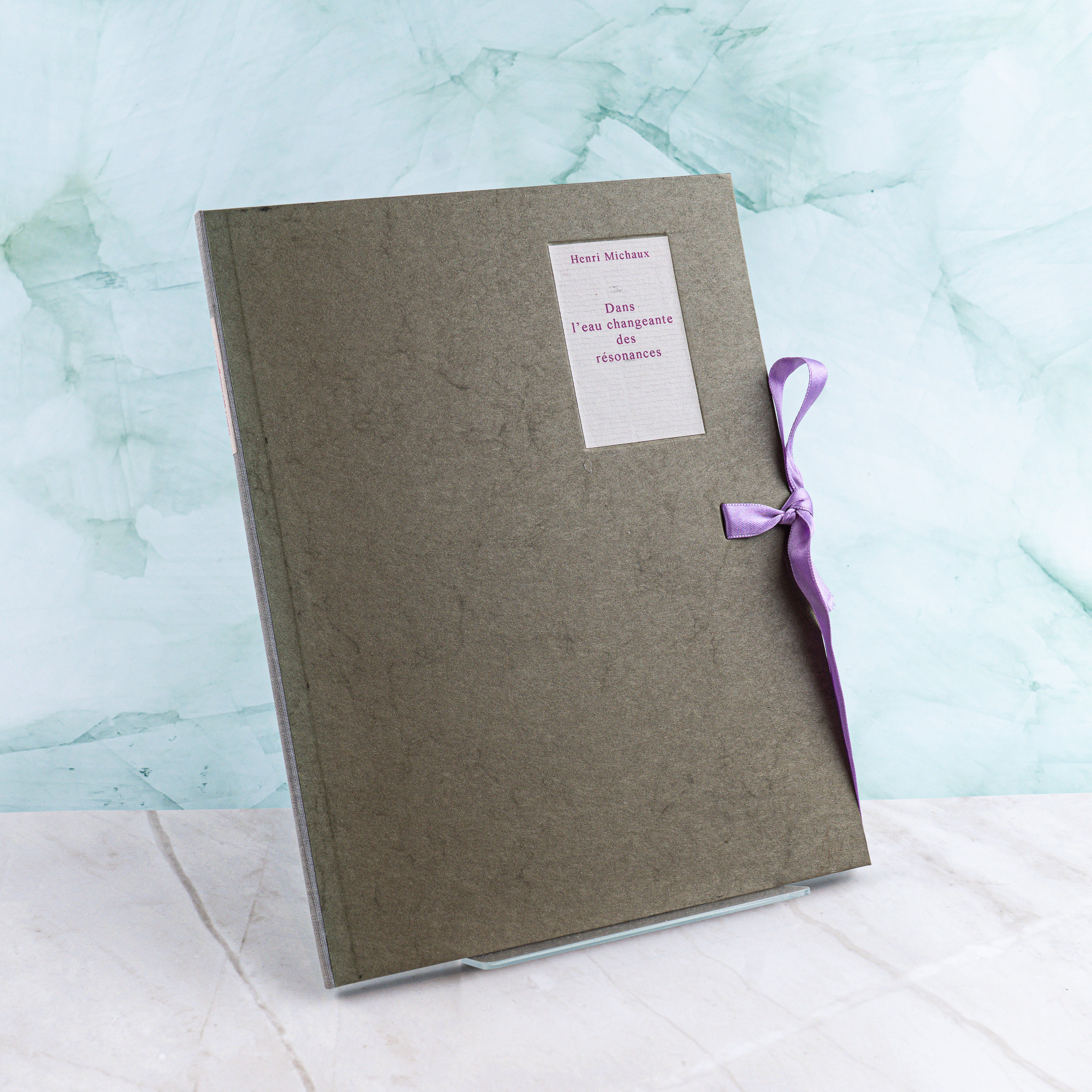
Michaux, Henri
Dans l’eau changeante des résonances
Scarce édition originale as an offprint from Les Cahiers du Chemin no. 22 (1974), produced in small numbers. A meditative piece on listening, vibration, and the resonant body. This copy carries a signed author’s inscription and several textual corrections, very likely in Michaux’s hand (not formally confirmed). The stripped, pamphlet-like presentation suits the taut clarity of the essay. The later Gillot chemise–slipcase reflects careful collection stewardship.
Pamflet
€540
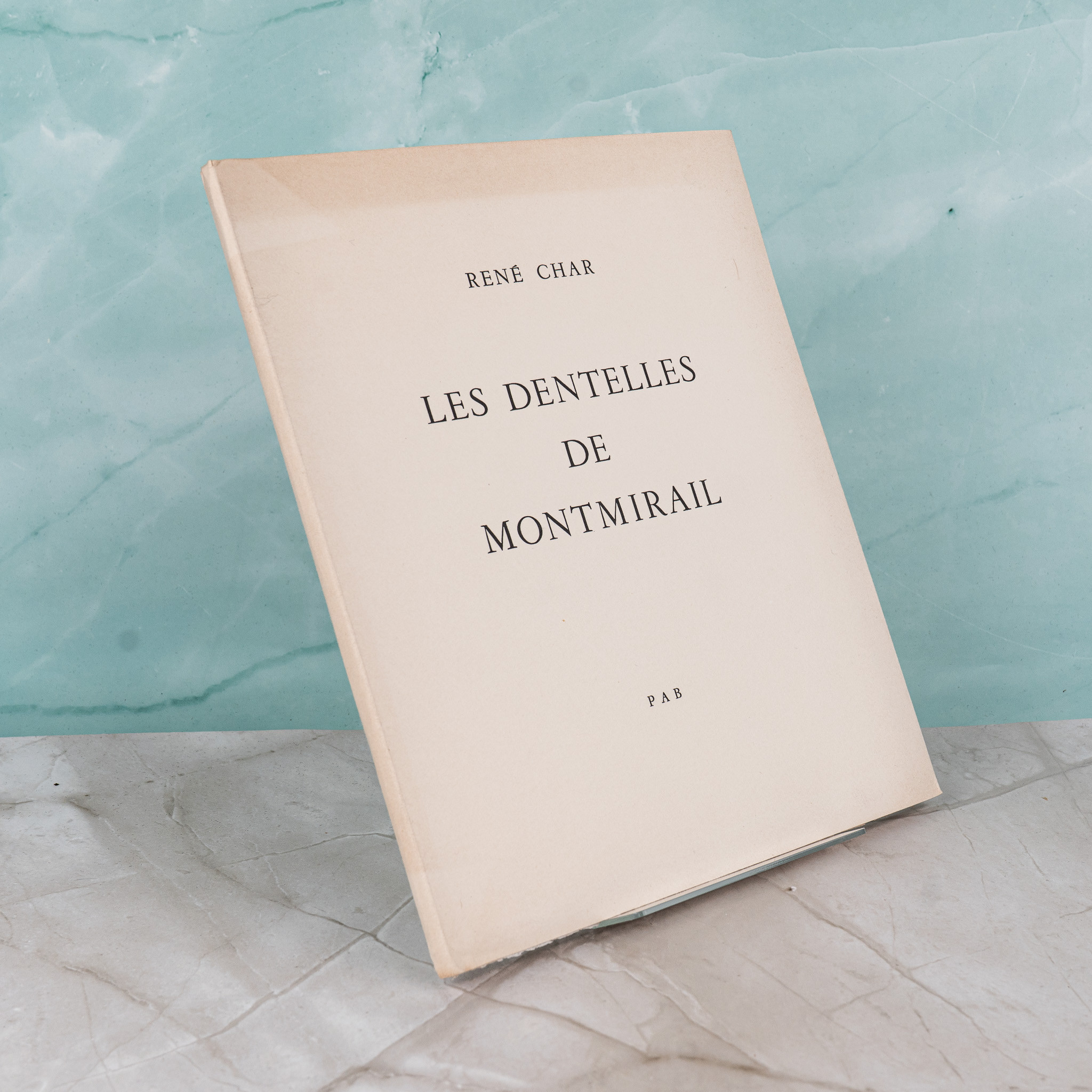
Char, Rene · Pierre Andre Benoit (PAB)
Les Dentelles de Montmirail
Les Dentelles de Montmirail is one of the characteristic small masterpieces born of the collaboration between René Char and PAB. It was published in 1960 between L’Isle-sur-Sorgue and Alès, two places that immediately evoke the geography of Char and that of Pierre André Benoit. The edition joins Char’s brief, aphoristic lyric voice to five natural impressions from Montmirail, so that text and matter quite literally meet. With PAB, poetry often takes on an intimate, almost handmade form, and that quality is especially palpable here. The limited issue on Arches heightens the book’s discreet yet unmistakable bibliophile character. This copy gains further importance from the autograph inscription to Dr Marcel Zara, far more than a routine dedication and almost readable as a small autonomous poem. For collectors, it is an exemplary PAB production in which landscape, trace, inscription, and poem become a single object.
Ill Book
€2,250
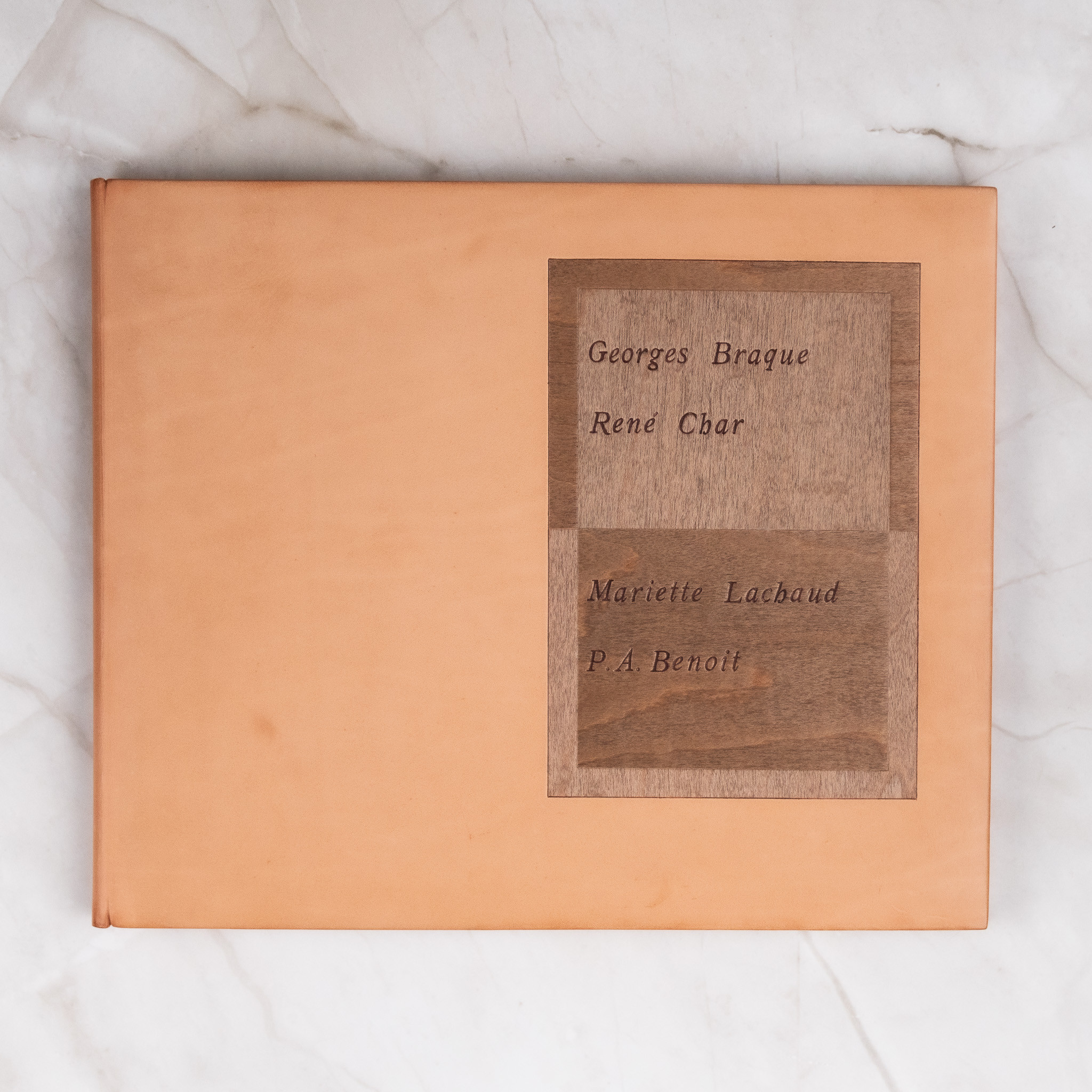
René Char, Georges Braque · Lachaud, Mariette · Pierre Andre Benoit (PAB)
Ainsi va l'amitié
What makes this copy especially memorable is not only its tiny limitation but the way it fixes three friendships at once: that between Char and Braque, that between Char and PAB, and that of all of them with the image that outlives them. The eight original photographs are not an illustrative supplement but the true bearers of presence; they preserve gazes, workspaces, and silences. The fact that PAB and Mariette Lachaud signed this copy gives it an almost confidential status, as though the circle of makers were still present within the book. In such editions, bibliophily becomes more than rarity alone: it becomes a form of shared memory.
