


Trente dessins
Trente dessins' is a landmark in post-war Parisian art book publishing, bringing together two giants of the avant-garde: the photographer-artist Brassaï and the poet Jacques Prévert. Published in 1946, just after the Occupation, this work marks a crucial creative period for Brassaï, who had focused on drawing and sculpture during the war. These thirty drawings, often sensual and organic nudes, offer an intimate glimpse into a lesser-known side of his oeuvre. They are introduced by a poem from Prévert, a key figure of Surrealism, creating a profound dialogue between image and word. This particular copy is of historical significance due to its handwritten inscription from Brassaï to Marie-Louise Bousquet. As the influential fashion editor for Harper's Bazaar and host of a famous literary salon, Bousquet was a central figure in Parisian cultural life. This inscription connects the world of Surrealist art with that of emerging haute couture, transforming this book from a work of art into a unique cultural artifact. It stands as tangible evidence of the cross-pollination between artistic and intellectual circles in liberated Paris.
Quantity


Prévert, Jacques
Brassaï
Trente dessins
1946 | Paris | Pierre Tisné
This is an exceptional association copy, bridging the worlds of Surrealist art and high fashion through a personal inscription to one of the most influential figures in post-war Parisian culture.
Trente dessins' is a landmark in post-war Parisian art book publishing, bringing together two giants of the avant-garde: the photographer-artist Brassaï and the poet Jacques Prévert. Published in 1946, just after the Occupation, this work marks a crucial creative period for Brassaï, who had focused on drawing and sculpture during the war. These thirty drawings, often sensual and organic nudes, offer an intimate glimpse into a lesser-known side of his oeuvre. They are introduced by a poem from Prévert, a key figure of Surrealism, creating a profound dialogue between image and word. This particular copy is of historical significance due to its handwritten inscription from Brassaï to Marie-Louise Bousquet. As the influential fashion editor for Harper's Bazaar and host of a famous literary salon, Bousquet was a central figure in Parisian cultural life. This inscription connects the world of Surrealist art with that of emerging haute couture, transforming this book from a work of art into a unique cultural artifact. It stands as tangible evidence of the cross-pollination between artistic and intellectual circles in liberated Paris.
€980
Condition Report:
In-Depth Study
References & Bibliography
Format
In-folio (Folio) approx. 30 × 40 cm
Edition Particulars
One of 600 copies on vélin pur chiffon de Lana, with an autograph inscription by Brassaï.
Print Run
600
Copy Number
49
Paper
vélin pur chiffon de Lana
Inscription
Signed by the Illustrator
Product DETAIL
This publication is a portfolio of thirty drawings by the Hungarian-French artist Brassaï, accompanied by an introductory poem by Jacques Prévert. The drawings, created during and after the German Occupation of Paris, mark a period when Brassaï turned away from photography. The subject matter focuses largely on the female nude, rendered in fluid, organic, and almost sculptural lines. The works explore themes of fertility, nature, and the subconscious. Prévert's poetic text does not function as a literal description but as a lyrical companion that enhances the dreamlike and sensual atmosphere of the images. The book is conceived as a 'livre d'artiste', where text and image form an inseparable artistic whole.

Michaux, Henri · Bettencourt, Pierre
Arriver à se réveiller
A rare first edition of Arriver à se réveiller, written by Henri Michaux in the tremulous post-war years. The text unfolds as an inward journey toward lucidity, where sleep and waking mirror each other. Printed and published by Pierre Bettencourt in his own workshop, the edition’s small run preserves the work’s intimacy. The title-page vignette, a linocut by Bettencourt, sets a spare, rhythmic visual key that amplifies Michaux’s vigilant, vulnerable tone. This copy is handsomely bound in brown morocco with balsa boards by Miguet, a tactile nod to lightness under tension. For bibliophiles, it is an exemplary union of poetry, craft, and experiment. The volume embodies the independence of the post-war small press and Michaux’s radical sensitivity.
Illustrated Book
€680

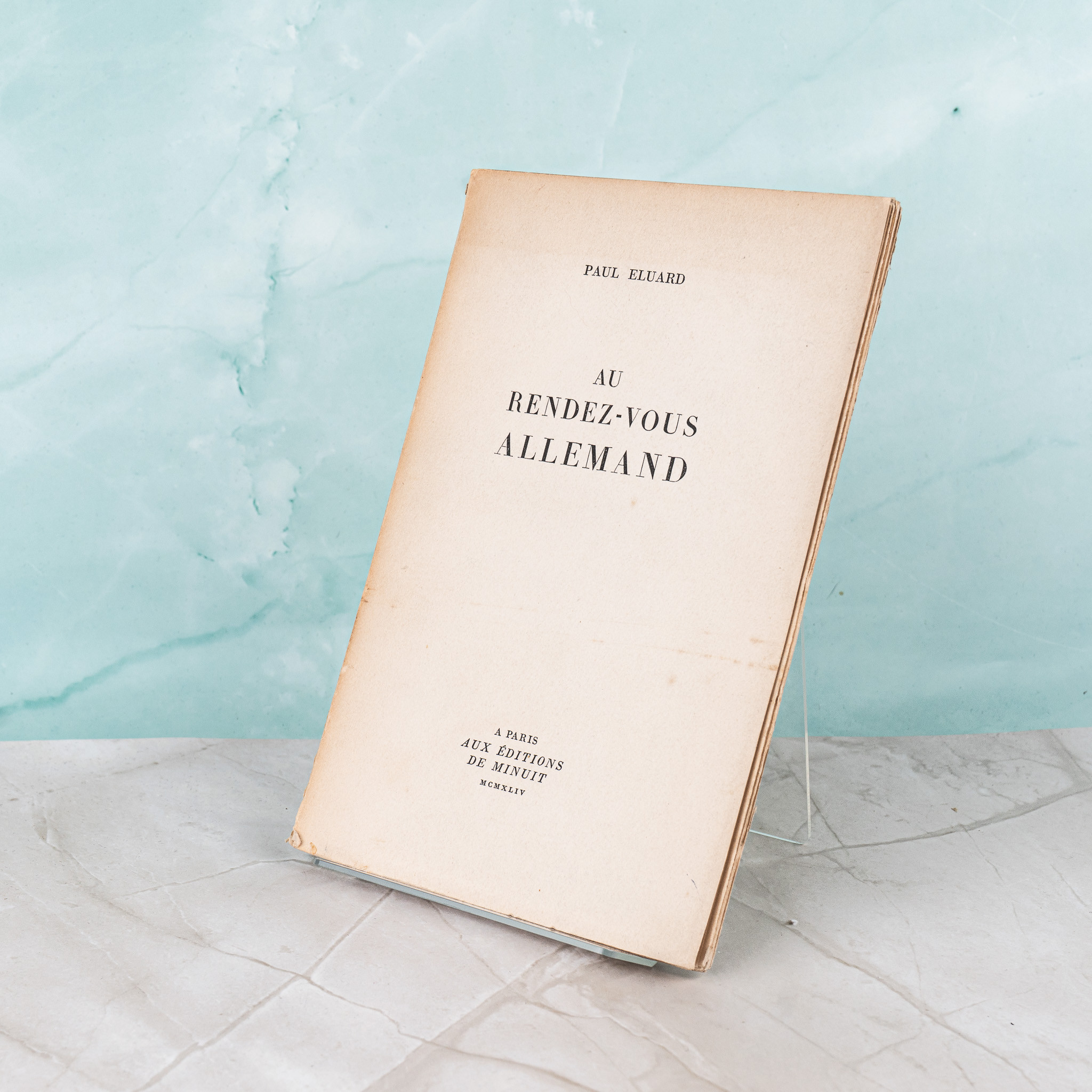
Éluard, Paul
Au rendez-vous allemand
Au rendez-vous allemand is one of the emblematic collections of Éluard’s wartime poetry. The book appeared in 1944 from Les Éditions de Minuit, the publishing house that, under the Occupation, became a moral landmark of the French literary Resistance. The volume gathers poems in which love, mourning, revolt and hope appear not as abstractions but as immediate necessities under German rule. The frontispiece, a portrait of the poet after Picasso, gives the book a powerful artistic signature: two voices of modern France, poet and artist, stand here in the same struggle. This is an ordinary, unnumbered copy, but signed by Éluard on the first page. That signature makes the book more than a Resistance document: it becomes a tangible witness to literary presence in a historically charged year. For the collector, it unites the clandestine aura of Minuit, Picasso’s name and Éluard’s own hand.
Illustrated Book
€350

Gracq, Julien · Bellmer, Hans
André Breton. Quelques aspects de l'écrivain.
A rare homage by Julien Gracq to André Breton, published by José Corti in a limited edition of 70 copies. This essay is both a powerful literary portrait and a visual tribute, thanks to Hans Bellmer’s iconic line portrait on the cover. Bellmer, known for his surrealist and psychosexual art, ties the book to the avant-garde movements of the 20th century. Gracq’s analysis is rigorous and insightful, reflecting his close engagement with Breton’s ideas. The collaboration between these two major figures and the fine print quality make this a coveted item for collectors of surrealist literature.
Illustrated Book
€500

When a Signature Becomes Provenance
A signature confirms; a dedication connects; an association copy tells a story.

The Fragile Meaning of ‘Complet’
In auction descriptions, “complete” often sounds reassuring — but it is only meaningful when verified against the colophon, the justification, and the bibliography. For The Hidden Page, clarity begins where vague market language ends.

The Avant-Garde and the Illustrated Word
How the Twentieth Century Recast the Book as an Artistic and Ideological Medium