


Ubu Roi
This first edition of *Ubu Roi* is one of the pivotal books of modern theatre. Alfred Jarry transformed a schoolboy caricature into Père Ubu, a grotesque tyrant who remains both ludicrous and disturbing. The Mercure de France published the text in 1896, the same year in which its performance by the Théâtre de l’Œuvre caused a scandal. Two portraits of Père Ubu after Jarry’s woodcuts also reveal the author as the visual creator of his own myth. This copy belongs to the unnumbered ordinary issue, following five copies on Japanese paper and fifteen on Hollande, and bears the owl woodcut as its justification mark. The remarkable presentation inscription to François Coppée adds a subtle and characteristically Jarryesque provocation. Pierre-Lucien Martin’s later half-morocco binding and the exceptional freshness of the book make this a particularly desirable bibliophilic copy.
Quantity


Jarry, Alfred
Ubu Roi
1896 | Paris | Mercure de France
This copy unites the first edition of a decisive work of modern theatre with Jarry’s own visual language, a master binding, and an exceptionally ironic presentation inscription. Its combination of literary importance, provenance, and remarkable condition gives it rare museum and bibliophilic distinction.
This first edition of *Ubu Roi* is one of the pivotal books of modern theatre. Alfred Jarry transformed a schoolboy caricature into Père Ubu, a grotesque tyrant who remains both ludicrous and disturbing. The Mercure de France published the text in 1896, the same year in which its performance by the Théâtre de l’Œuvre caused a scandal. Two portraits of Père Ubu after Jarry’s woodcuts also reveal the author as the visual creator of his own myth. This copy belongs to the unnumbered ordinary issue, following five copies on Japanese paper and fifteen on Hollande, and bears the owl woodcut as its justification mark. The remarkable presentation inscription to François Coppée adds a subtle and characteristically Jarryesque provocation. Pierre-Lucien Martin’s later half-morocco binding and the exceptional freshness of the book make this a particularly desirable bibliophilic copy.
Contact for Price
Condition Report:
In-Depth Study
References & Bibliography
Format
In-16 (approx. 16,6 x 13,5 cm)
Edition Particulars
Copy from the unnumbered ordinary issue, justified with an owl woodcut, following 5 copies on Japanese paper and 15 on Hollande.
Paper
vélin
Inscription
Envoi
Product DETAIL
Père Ubu is a gluttonous, cowardly, and ambitious former king whom Mère Ubu urges to seize the throne of Poland. He arranges the murder of King Wenceslas and his sons, while the young Bougrelas escapes the massacre. Once in power, Ubu dismantles the existing institutions, plunders nobles and magistrates, and imposes exorbitant taxes on the population. Captain Bordure, who assisted in the coup, turns against him and seeks the support of the Russian tsar. When Bougrelas and his allies mount a counterattack, Ubu proves as incompetent as he is cowardly and eventually flees to France with Mère Ubu. The five-act play chiefly parodies *Macbeth* and examines power, greed, and violence through childish language, grotesque exaggeration, and black humour.

Michaux, Henri · Bettencourt, Pierre
Arriver à se réveiller
A rare first edition of Arriver à se réveiller, written by Henri Michaux in the tremulous post-war years. The text unfolds as an inward journey toward lucidity, where sleep and waking mirror each other. Printed and published by Pierre Bettencourt in his own workshop, the edition’s small run preserves the work’s intimacy. The title-page vignette, a linocut by Bettencourt, sets a spare, rhythmic visual key that amplifies Michaux’s vigilant, vulnerable tone. This copy is handsomely bound in brown morocco with balsa boards by Miguet, a tactile nod to lightness under tension. For bibliophiles, it is an exemplary union of poetry, craft, and experiment. The volume embodies the independence of the post-war small press and Michaux’s radical sensitivity.
Illustrated Book
€680
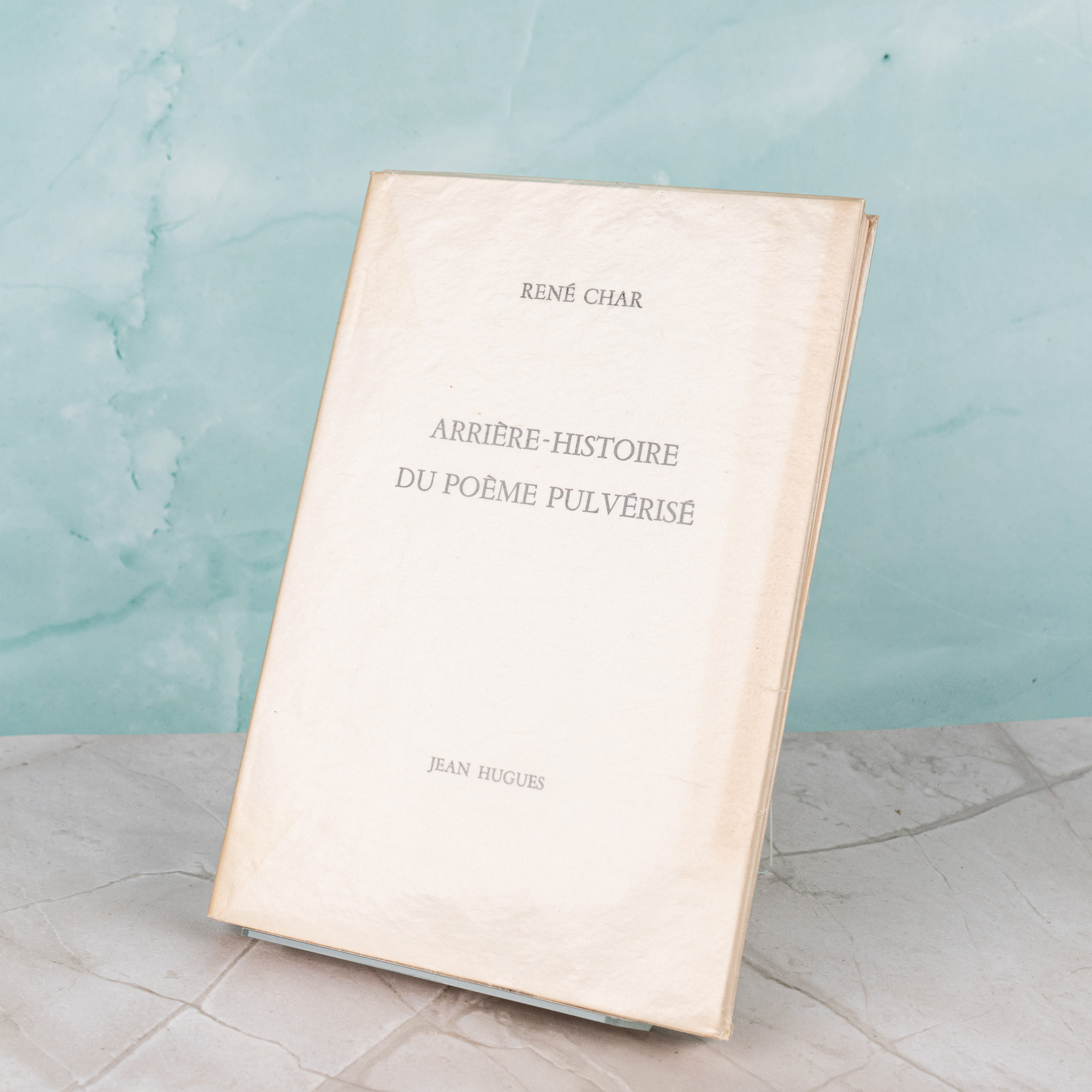
Char, Rene · Stael, Nicolas de
Arrière-histoire du poème pulvérisé
*Arrière-histoire du poème pulvérisé* is a later illustrated edition of a key text in which René Char looks back on the genesis and inner background of *Le Poème pulvérisé*. Published in 1972 by Imprimerie Union, it opens with a colour frontispiece by Nicolas de Staël. The pairing of Char and de Staël is especially charged: two post-war voices, each seeking concentration, clarity, and rupture in his own medium. This copy is one of only six hors commerce copies on Arches and is signed. The autograph presentation inscription to Doctor Marcel Zara, with poetic quotation and October 1972 dating, makes it a deeply personal copy.
Illustrated Book
€920

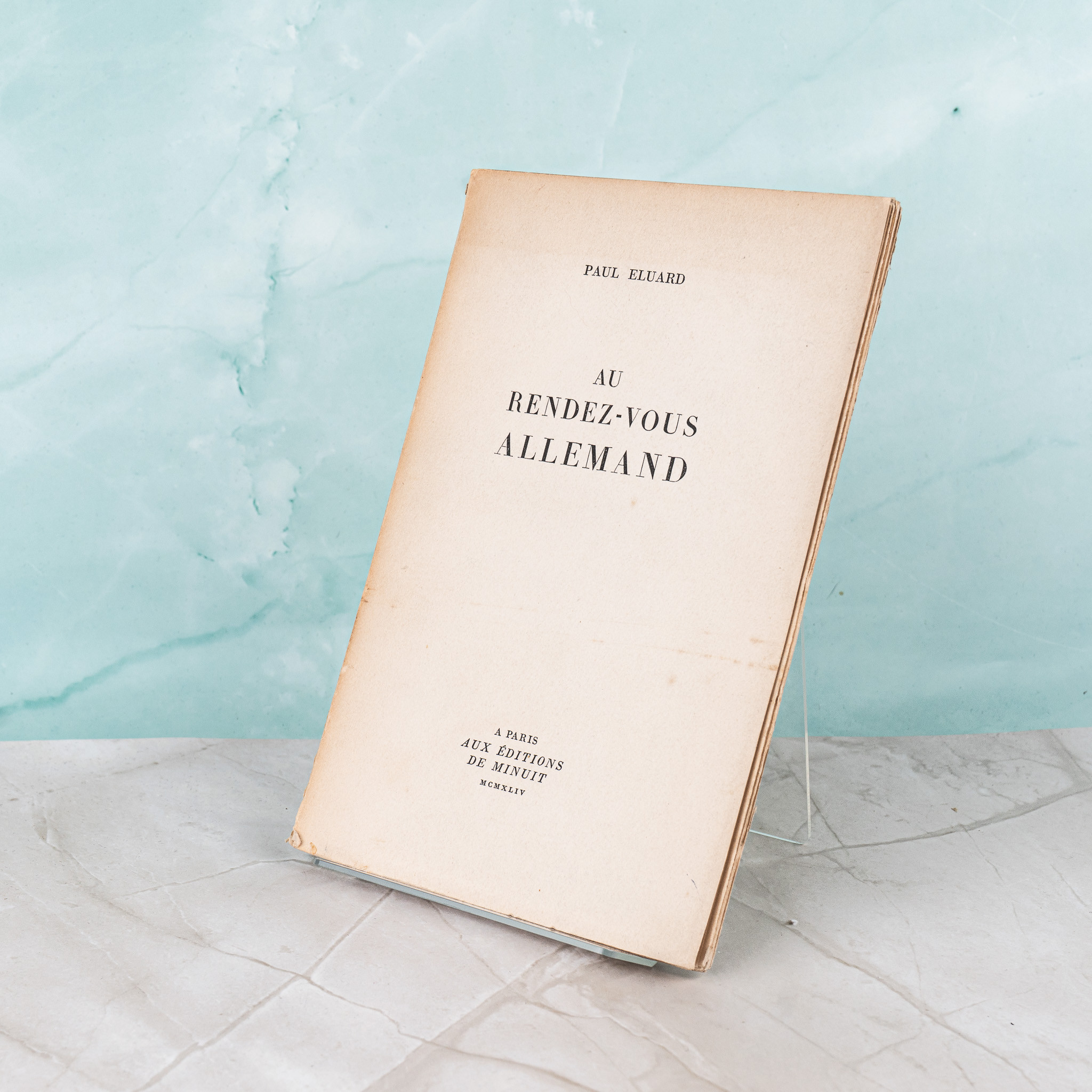
Éluard, Paul
Au rendez-vous allemand
Au rendez-vous allemand is one of the emblematic collections of Éluard’s wartime poetry. The book appeared in 1944 from Les Éditions de Minuit, the publishing house that, under the Occupation, became a moral landmark of the French literary Resistance. The volume gathers poems in which love, mourning, revolt and hope appear not as abstractions but as immediate necessities under German rule. The frontispiece, a portrait of the poet after Picasso, gives the book a powerful artistic signature: two voices of modern France, poet and artist, stand here in the same struggle. This is an ordinary, unnumbered copy, but signed by Éluard on the first page. That signature makes the book more than a Resistance document: it becomes a tangible witness to literary presence in a historically charged year. For the collector, it unites the clandestine aura of Minuit, Picasso’s name and Éluard’s own hand.
Illustrated Book
€350

Size does (not) matter
Size does (not) matter: The Paradoxical Power of Format in Avant-Garde Book Art

The Architecture of Absurdity: Alfred Jarry, Pataphysics and the Destructive Aesthetics of the Ubu Cycle
From schoolyard prank to cultural revolution: how Alfred Jarry created Père Ubu and the science of pataphysics, permanently transforming modern theater, literature, and philosophy.

The Avant-Garde and the Illustrated Word
How the Twentieth Century Recast the Book as an Artistic and Ideological Medium