The book as revolution, as vision, as artifact.
Scroll Down
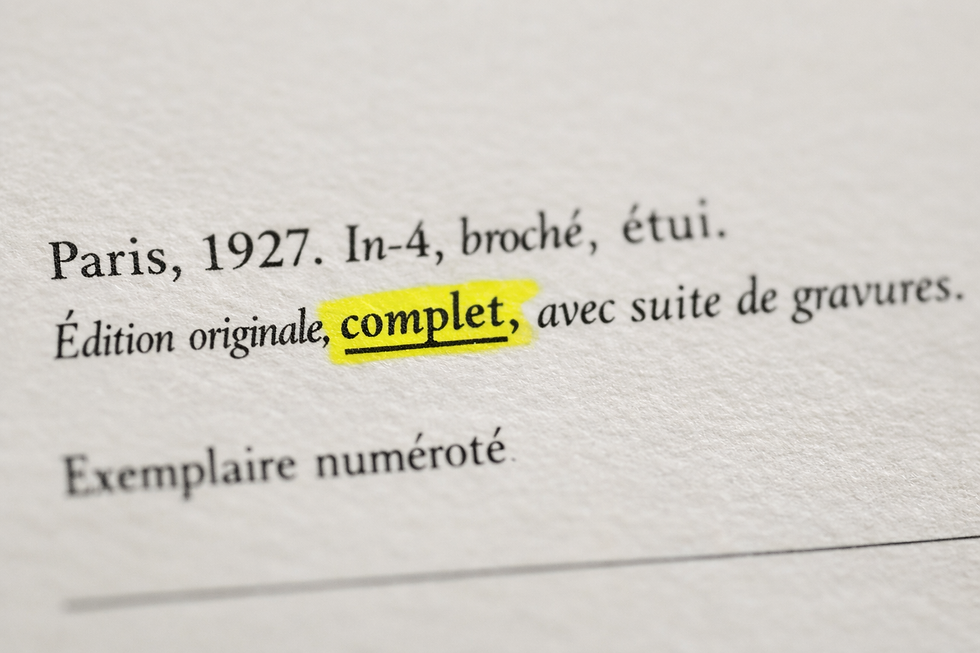
In many auction descriptions, the word “complete” — or its French equivalent, “complet” — appears with reassuring ease. It suggests that everything is in place and that nothing further needs to be asked. Yet in practice, “complet” is often little more than a catch-all term: it claims to say everything, and may end up saying very little.
For a platform that strives for clarity, that is not enough. “Complet” should not be the end of the conversation, but the result of verification against a fixed standard: the colophon, the justification, and the bibliography.
That verification begins by defining the set. If the colophon announces a suite, it should be present. If signatures are called for, they must be visible. If a loose proof, prospectus, or additional element forms part of that specific issue or copy, its presence should be stated explicitly. And where a copy lacks a formal colophon, “complete” is credible only when every relevant component is described without ambiguity.
This is not strictness for its own sake. It is language that reflects the true state of the object.
Better terminology is therefore needed. “Complete as per colophon” is clear and verifiable. “Complete with stated variation” may be appropriate where the difference is disclosed, such as a later binding, added suite, or variant paper. But if the edition is not whole, the wording should say so plainly: “incomplete: lacking…” is more accurate than a timid question mark after “complete.”
A practical example shows why this matters. A copy is offered as “complet,” yet the colophon explicitly mentions a loose proof print. The proof is absent. To insist on “complet” is to twist the term against its own definition. More precise would be: complete except for the loose proof print — with obvious consequences for price, desirability, and placement.
The same discipline should apply to provenance notes. An envoi is not a decorative label, but the beginning of a story. To whom was it written? When? With what words? A routine dedication rarely changes the character of a copy. A meaningful one — or an envoi that opens an archival trail — often does.
Language that marks that distinction adds knowledge, not noise.
For those who want to take this further, see elsewhere on the site: a concise guide to colophons and an essay on the economics of the envoi. Clear wording, consistent verification, and visible evidence: this is the triad that restores real meaning to “complet.”
From the Collection

AUTHORS · AUTHORS
Rare Books, Living Legacies Rare Books, Living Legacies
We specialize in rare, illustrated editions from the avant-garde movements. Every book is accompanied by high-quality visuals, detailed reports, and scholarly context.
Paris | 1931 | Japon nacré
€360
AUTHORS · AUTHORS
Rare Books, Living Legacies Rare Books, Living Legacies
We specialize in rare, illustrated editions from the avant-garde movements. Every book is accompanied by high-quality visuals, detailed reports, and scholarly context.
Paris | 1931 | Japon nacré
€360
AUTHORS · AUTHORS
Rare Books, Living Legacies Rare Books, Living Legacies
We specialize in rare, illustrated editions from the avant-garde movements. Every book is accompanied by high-quality visuals, detailed reports, and scholarly context.
Paris | 1931 | Japon nacré
€360
AUTHORS · AUTHORS
Rare Books, Living Legacies Rare Books, Living Legacies
We specialize in rare, illustrated editions from the avant-garde movements. Every book is accompanied by high-quality visuals, detailed reports, and scholarly context.
Paris | 1931 | Japon nacré
€360
Bibliography
Carteret, Léopold. Le Trésor du bibliophile romantique et moderne. Paris: L. Carteret, 1924–1928.
Monod, Luc. Manuel de l’amateur de livres illustrés modernes, 1875–1975. Neuchâtel: Ides et Calendes, 1992.
Vicaire, Georges. Manuel de l’amateur de livres du XIXe siècle. Paris: A. Rouquette, 1894–1920.
curator’s insight
In this article, we examine the fragile meaning of “complete” in auction descriptions — and why, for rare books, the word only becomes reliable when tested against the colophon, the justification, and the bibliography.


Related Reading
Rare Books, Living Legacies Rare Books, Living Legacies
We specialize in rare, illustrated editions from the avant-garde movements. Every book is accompanied by high-quality visuals, detailed reports, and scholarly context.
Paris | 1931 | Japon nacré
€360
Rare Books, Living Legacies Rare Books, Living Legacies
We specialize in rare, illustrated editions from the avant-garde movements. Every book is accompanied by high-quality visuals, detailed reports, and scholarly context.
Paris | 1931 | Japon nacré
€360
Rare Books, Living Legacies Rare Books, Living Legacies
We specialize in rare, illustrated editions from the avant-garde movements. Every book is accompanied by high-quality visuals, detailed reports, and scholarly context.
Paris | 1931 | Japon nacré
€360
Rare Books, Living Legacies Rare Books, Living Legacies
We specialize in rare, illustrated editions from the avant-garde movements. Every book is accompanied by high-quality visuals, detailed reports, and scholarly context.