
All Products










The book as revolution, as vision, as artifact.
Scroll Down
Avant Garde Catalogue
Explore rare avant-garde and surrealist books
AUTHOR
illustrator
PUBLISHER
ERA
Movements & Artistic Circles
TYPE OF PUBLICATION
Inscription
PRICE RANGE
Filters

Suarès, André
Hélène chez Archimède
Hélène chez Archimède is a remarkable example of the collaboration between a poet and a visual artist, in this case the French author André Suarès and the legendary Spanish master Pablo Picasso. The edition, illustrated with wood engravings, reveals the complex interplay between word and image that culminated in the production of illustrated books in the mid-20th century. This work, originally a project by the famous art dealer Ambroise Vollard, shows the enduring relevance of classical themes, here the myth of Helen, in a modernist context. Thanks to its careful execution and the exclusivity of its print run, Hélène chez Archimède is not only a literary work but also an art object, a testament to the artisanal perfection sought by the Nouveau Cercle parisien du Livre. It represents a significant moment in the history of the modern illustrated book, where the line between illustration and autonomous art blurs. The additions to this copy, such as a menu and an announcement leaflet, enrich its bibliographic and historical value and offer a rare glimpse into its publication context.
Ill Book
€3,500

Malraux, André · Braque, Georges
Dieux et déesses ou hommage à Georges Braque
A monumental tribute to Georges Braque, designed by Pierre de Tartas and enriched with deeply embossed compositions. This bibliophile edition gathers texts by André Malraux and Hervé Alphand, evoking the symbolic and mythical dimensions of Braque’s work. The relief plates, often enhanced with gold leaf, radiate sacred power and sculptural intensity. An exceptional feat of intermedial book art, where typography, printmaking and sculpture merge.
Ill Book
€3,000
Boudaille, Georges · Bitran, Albert
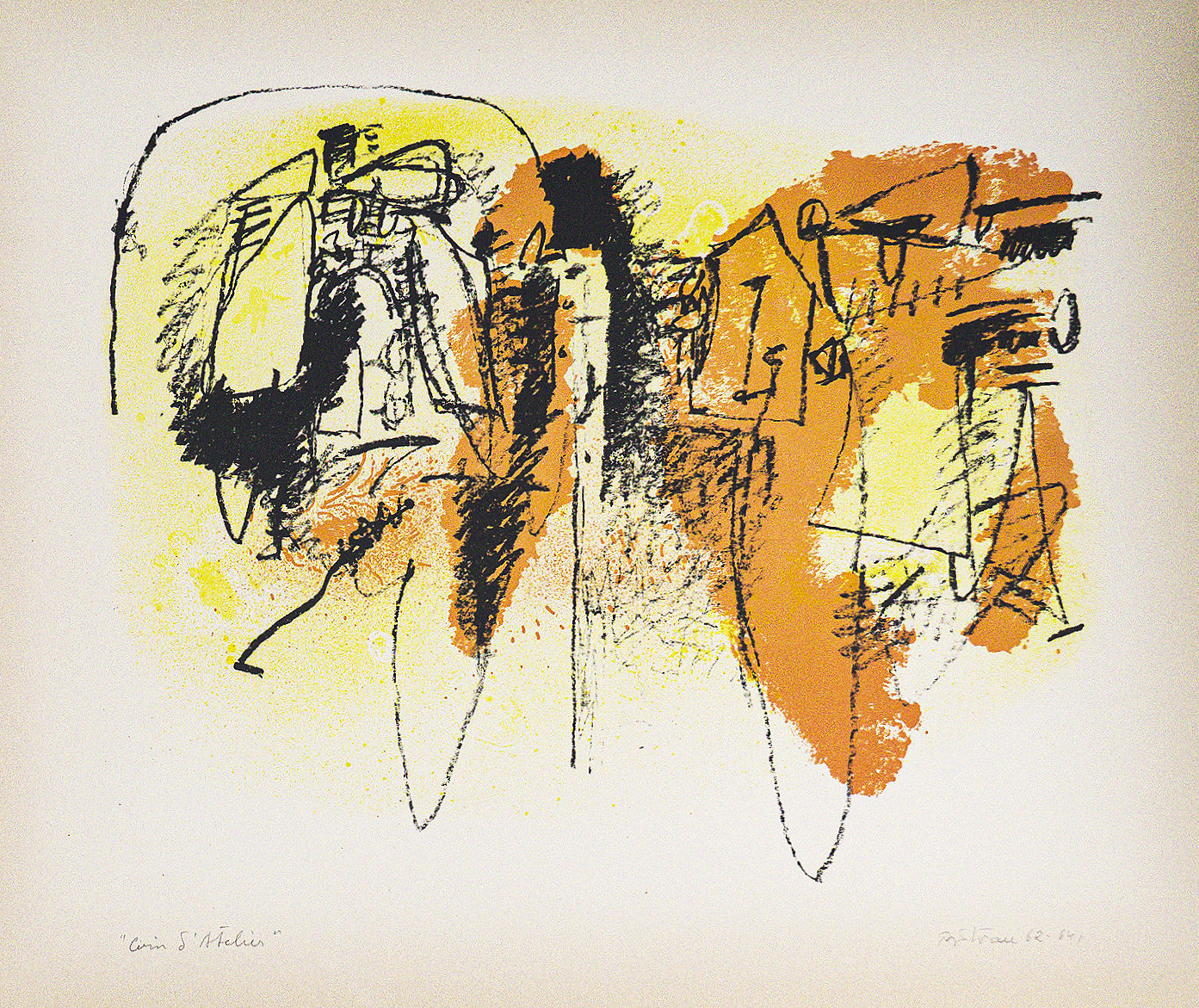
Bitran. L’Atelier
*Bitran. L’Atelier* is a refined bibliophile artist’s publication devoted to Albert Bitran’s studio world, introduced by the critic Georges Boudaille. It brings together text, image, and object in the spirit of the post-war livre d’artiste: not merely as a monograph, but as a tactile approach to the artist’s working space. The folio format and portfolio presentation give it the character of a studio dossier rather than an ordinary book. This copy is one of only fifteen deluxe copies printed on mould-made Arches vellum. Bitran’s signed presentation inscription to Bernard Gheerbrandt, enhanced with a small original drawing, makes it a remarkable association copy.
Ill Book
€1,250

Sima, Josef
Le livre de Mariage
*Le livre de Mariage* stands among Josef Sima’s earliest and most refined experiments at the intersection of poetry, typography, and image. This Paris edition of 1922 gathers nuptial and love poems by Symbolist and related writers into a carefully orchestrated whole. Sima acted here not only as illustrator, but as the guiding force behind the entire conception. The 31 original woodcuts, both in the text and hors-texte, create a visual rhythm that feels almost musical. The austerity of black and white and the tactile quality of Montval paper deepen the intimacy of the book as object. As an early artist’s book, it already reveals Sima’s gift for fusing literature and image into a single poetic field.
Ill Book
€500

Scutenaire, Louis · van de Wouwer, Roger
Il est toujours trop tard. 1924-1928
This Antwerp publication by La Serfouette (1969) forms an unusually complete set as a “Réunion des 2 tirages” of *Il est toujours trop tard. 1924-1928*. It brings together two issues: an ‘ordinary’ issue in stiff orange paper wrappers and the deluxe issue with Roger van de Wouwer’s graphics. A telling peculiarity: the ordinary issue’s title page also states “Dix Gravures de Roger van de Wouwer”, yet the plates are in fact absent—functioning essentially as a textual ‘copy’ of the deluxe issue. The deluxe issue, by contrast, is complete and accompanied by a “suite de 10 eaux-fortes originales (avec cuvette)”: ten large black etchings, all signed and justified. The ordinary issue is further enriched with an important “envoi autographe signé à Jeanne Abraham et André Stas (note sur la priorité de parution)”, in which Scutenaire insists that this second edition is “in reality, the original” because it appeared weeks, if not months, before the illustrated issue. Together, the two volumes document textual history, bibliophile strategy, and the paradox of publication priority within Antwerp surrealism.
Ill Book
€950

Sernet, Claude · Hérold, Jacques
Ici repose
*Ici repose* is a characteristic Fata Morgana publication, bringing together the poetic voice of Claude Sernet with a frontispiece and, in the deluxe copies, an original colour etching by Jacques Hérold. It belongs to that discreet yet highly charged category of books in which text and image do more than merely coexist: they deepen one another. The restrained format, issued loose in wrappers with flaps, perfectly suits the Montpellier press aesthetic of the 1960s. Sernet, whose poetry often maintains a tone of inward tension, finds here an especially apt visual counterpart in Hérold. The latter brings with him the legacy of Surrealism, though in a concentrated graphic form. The result is a bibliophilic edition in which modern poetry and artists’ printmaking meet with rare elegance. The Arches copies with signed etching make the book all the more desirable for collectors.
Ill Book
€400

Jarry, Alfred · Picasso, Pablo
Poèmes
This extremely rare private edition of Alfred Jarry's Poèmes is a unique document in the Franco-Dutch literary exchange. The collection was printed between 1926 and 1928 at the initiative of the great Dutch writer and bibliophile E. du Perron, who held a deep admiration for Jarry's rebellious spirit. Limited to just thirty copies, not intended for trade, this work embodies the exclusive world of "editions printed for an amateur." The frontispiece features a powerful portrait of Jarry after a drawing by Picasso, underlining the connection between the father of pataphysics and the central figure of modernism. For the connoisseur, this book represents a rare synthesis of bibliophilic passion, international avant-garde, and literary friendship. It is a tangible testament to how Jarry's legacy lived on in the circles of early twentieth-century intellectuals.
Ill Book
€750

Jarry, Alfred · Dado
L’Opium
*L’Opium* is a slight yet electric publication in which an early visionary prose text by Alfred Jarry is reawakened through four original engravings by Dado. Fata Morgana was an especially apt publisher for such a project, having long championed works in which image, poetry, and altered states of mind converge. Jarry’s text is not among his most famous books, yet it reaches directly into the imaginative territory that would later prove crucial to the modern avant-garde. Dado answers that feverish intensity not with mere illustration but with an autonomous visual language of his own, organic and unsettling. The result is more than a reprint: it becomes a genuine reinterpretation. The small edition on vélin d’Arches gives the work the aura of a refined artist’s book. For the bibliophile, it offers a discreet yet highly meaningful encounter between a proto-avant-garde writer and one of the late twentieth century’s most visionary artists.
Ill Book
€680

Elskamp, Max
Les sept Notre-Dame des plus beaux métiers
In this scarce Antwerp book of 1923, Max Elskamp fuses poem and image into a devotional tribute to skilled work. *Les sept Notre-Dame des plus beaux métiers* is offered here in the original edition, issued in a very small numbered limitation by Albert De Tavernier and printed by J.-E. Buschmann. The cycle pairs seven poems with seven Virgin figures, each dedicated to a craft community—from imagiers to clockmakers. Elskamp’s woodcuts—32 distinct blocks, including seven full-page prints—give the sequence a measured, almost liturgical rhythm. Black ink predominates, yet a warm jonquil yellow subtly illuminates key motifs: the clover, the title vignette, and the heart-bordered frame surrounding every page. This copy is further enhanced by a pencil-signed autograph by the author-artist, adding a personal aura to the work. A quintessential bibliophile production in which typography, ornament, and verse achieve an unusually poised harmony.
Ill Book
€950

Dermée, Paul · Picasso, Pablo
O solitude ! O fontaines !
*O solitude ! O fontaines !* belongs to the refined, understated poetry books through which GLM secured a distinctive place in the Parisian literary world of the 1930s. Paul Dermée, poet, critic, and early associate of the avant-garde, gathers here a sequence of poems centred on solitude, inwardness, and controlled lyrical tension. The reproduction of a drawing after Pablo Picasso gives the volume a discreet yet prestigious artistic frame. That alliance between typographic restraint and a major modern artist is precisely what makes the book so appealing to collectors. It was not conceived as a showpiece of luxury, but as a compact and carefully balanced poetic object. This copy acquires added individuality through Dermée’s autograph inscription to the poet René Lacôte. The two accompanying prospectuses further extend its documentary interest. The result is not only an original literary edition, but also a small archive of friendship, milieu, and poetic self-fashioning.
Ill Book
€425
1
…
4
5
6
7
8
…
34
NO RESULTS FOUND
No book exists for your current filters, try clearing all filters.

Looking for something specific?
If you are looking for a particular work, a desirable edition, or a copy with specific characteristics, please do not hesitate to contact us. We will be pleased to advise you on availability, answer your bibliographical questions, and assist you in your search.